

The Collapse of the Social Safety Net Is Driving More Seniors Into Their Cars
This article was originally published in the Barn Raiser with support from our 2026 National Fellowship and Dennis A. Hunt Fund for Health Journalism.

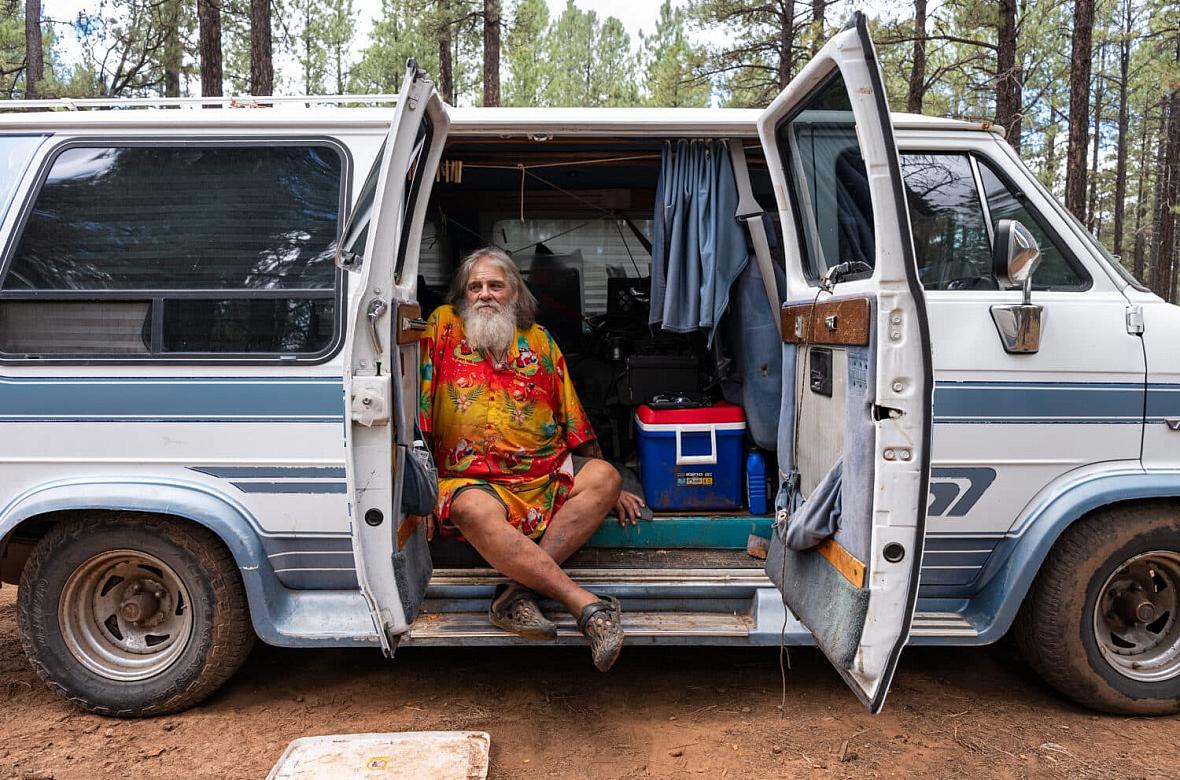
Don Maty sits in his van outside Flagstaff, Arizona, September 2026.
Steve Rumizen
At first glance, Maty could be just another “van-life” guy documenting his days on the road for millions of followers. Yet nobody is tuning into his life via Instagram, and if they did, it would look more like survival than entertainment. After all, he showers with a small black pump warmed in the sun. He shits in the woods.
Maty belongs to a growing tide of older adults across the United States facing similar challenges—high health care costs, fixed incomes and an increasingly unnavigable benefits system—all reaching their financial breaking point. Nearly 20% of all adults experiencing homelessness in America today are 55 and older, according to the 2025 Annual Homelessness Assessment Report published by the U.S. Department of Housing and Urban Development (HUD). The fastest growing group? People age 65 and older, whose numbers increased 6.8% between 2024 and 2025, according to the report.
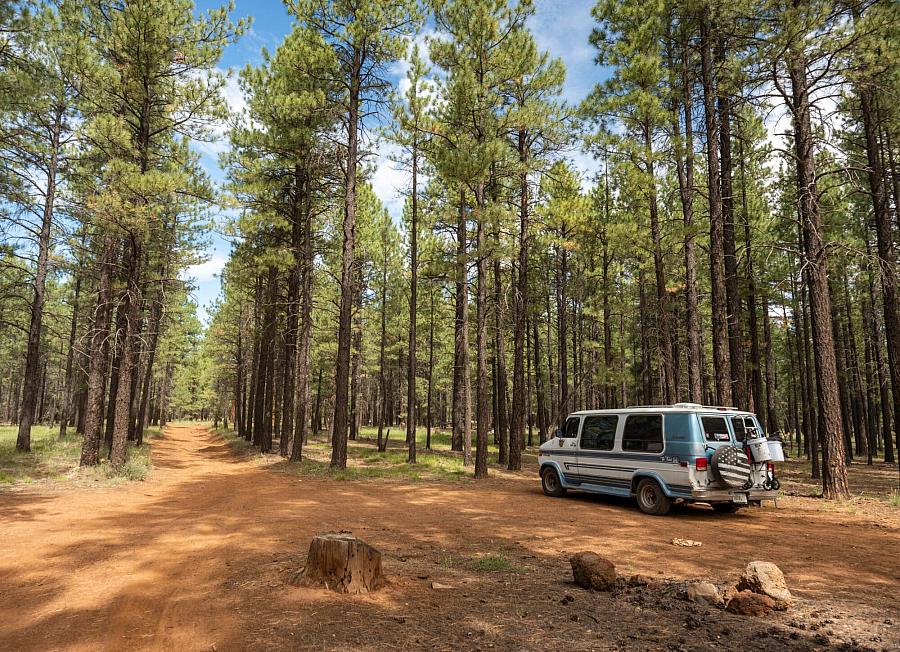
Don Maty’s van in Flagstaff, Arizona, in September 2026.
Steve Rumizen
“This alarming trend should be a wake-up call about much more than our housing crisis,” says Marcy Thompson, VP of Programs and Policy for the National Alliance to End Homelessness (NAEH). “It raises fundamental questions about our economy, the strength of our social safety net, and whether the promise of economic security in old age is slipping away.”
As more older adults exchange the untenability of traditional housing for nomadic life on four wheels, at what cost to us all do these pared-down golden years come?

Don Maty lives wherever his 1992 GMC Vandura is parked. He called the van “Rocinante” after Don Quixote’s horse.
Steve Rumizen
Priced out
Today, the average cost of rent in the United States is $1,665 for a 695 square feet, one-bedroom apartment. While that cost can vary widely across state and region in both urban and rural areas, rising rents and high living costs are directly correlated with the spike in homelessness, a dynamic to which seniors on fixed incomes are particularly vulnerable.
“I can’t live in a house or an apartment for what my social security pays, but I can live pretty good, what I call pretty good, out here,” Maty says, gesturing to the forest. “I can eat every day, I can put enough gas in a vehicle to get around, which I couldn’t do when I was living in the trailer in Florida.”
Where federal safety net programs exist, beneficiaries have found their buying power outstripped by record-high inflation.
For instance, individuals over the age of 65 with limited financial resources can receive the Supplemental Security Income (SSI), administered by the Social Security Administration, in addition to other Social Security benefits. And each year, Social Security automatically provides a cost-of-living increase to those benefits. Yet, a study by the Center for Retirement Research at Boston College found the net amount of Social Security benefits has not kept up with inflation. One reason is because premiums for Medicare Part B—which are deducted from Social Security benefits to cover physician and outpatient services—tend to rise faster than inflation. Moreover, individuals with over $25,000 in income face taxes on their Social Security benefits, and that threshold is not adjusted for wage growth or inflation, subjecting rising benefits to taxation.
Federal benefit requirements and high living costs have pushed more older adults into dire living situations, says Jesse Rabinowitz, campaign and communications director at the National Homelessness Law Center.
“Grandma didn’t choose to sleep outside, Grandma was forced into homelessness because her savings and her government benefits, to which she’s entitled, just cannot keep pace,” Rabinowitz says. “Sadly, that is becoming a fast growing face of homelessness in this country.”
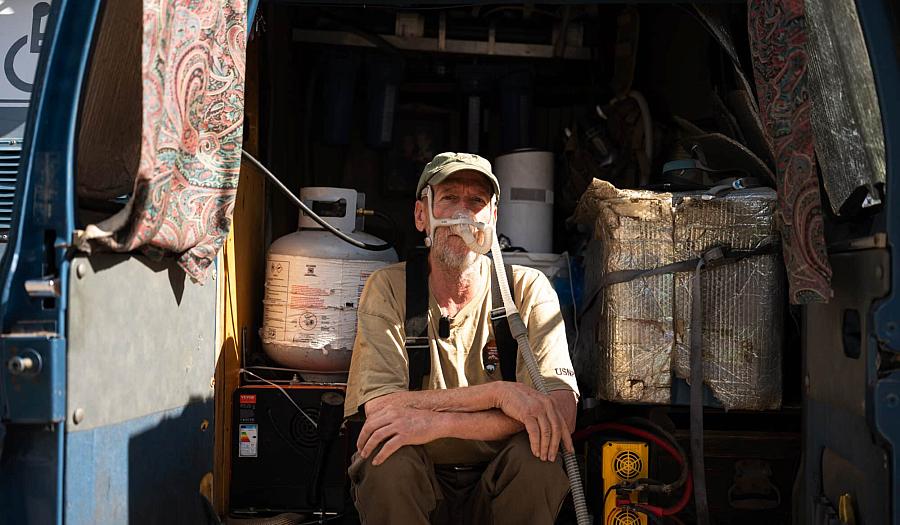
Jeffrey Brooks sits in his van outside Flagstaff, Arizona.
Steve Rumizen
The struggle to secure benefits drives many seniors to sign up for affordable housing programs, but waits can be long. In 2025, renters in the U.S. waited 2 years and 3 months, on average, to get into a subsidized housing unit after signing up. That varied widely by state in 2025, with West Virginia and Wyoming both holding an average wait time of 10 months, while states like Maryland had the longest wait times lasting 57 months, or nearly 5 years.
Jeffrey Brooks, 73, was first diagnosed with the autoimmune condition Reiter’s syndrome (now called reactive arthritis) at age 15. He can’t recall how long he has been on a waiting list for affordable housing.
“I probably have another year or so. They don’t really tell you, ‘oh, you’re moving up in line,’ ” Brooks says. “I think it’s more about how desperate you are. There are people in the shelter here who are bedridden … they’re way at the front of the line.”
Brooks does know how long he’s been homeless: 23 years. In that time, he worked for the National Park Service and even wrote a self-published book about the specialty air purification system he invented. That device, he says, put his symptoms into remission for the past 7 years. Brooks lives in a 1989 Ford Econoline camper van, which he tows with an old dairy delivery truck, since the van no longer runs. He parks his rig outside of a homeless shelter in Flagstaff, where staff provide him with jugs of warm water to pour over his head. Taking a shower inside the shelter would be too difficult because he needs to stay connected to the air filters that protect his lungs from the air pollution that he says could kill him, like it did his adult son—who may have also had the autoimmune condition—should he breathe it in for too long.
This location helps him with networking, too. “They’re broadcasting Wi-Fi. I’m on Facebook all the time promoting my book,” Brooks says. Titled COPD Recovery and Other Respiratory Illnesses, the ebook is available on Amazon for $4.95. He hasn’t had many buyers yet.
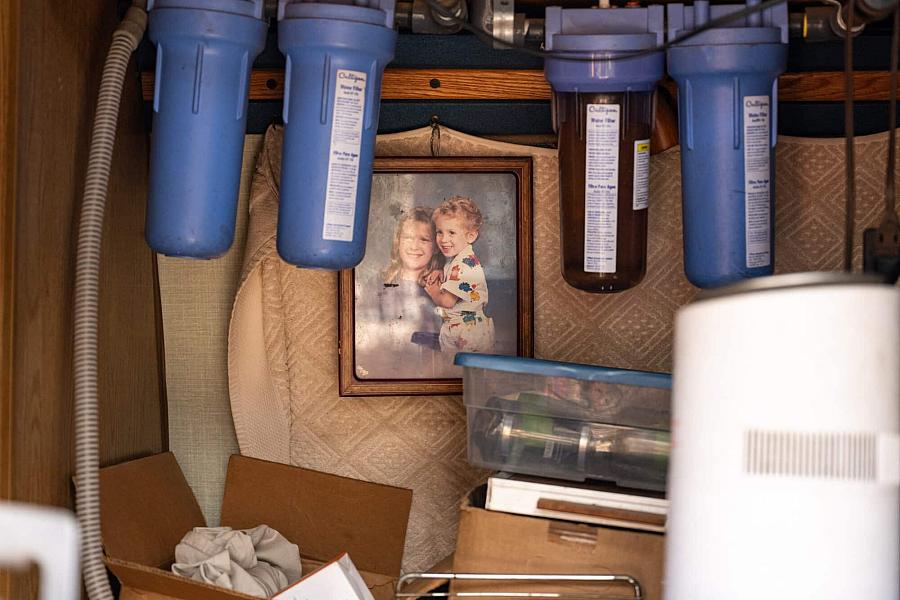
Interior view of Jeffrey Brooks’ van, featuring a photo of his estranged daughter and late son as children.
Steve Rumizen
When fixed incomes are compounded by high costs of living and dwindling government benefits nationwide, it’s not surprising that, for many older adults, life in a vehicle is the only life tenable.
“This is about more than homelessness,” Thompson at NAEH says. “It’s about an affordability crisis that has become so severe that even people with a lifetime of work behind them and a steady source of income can find themselves without a home. It should be seen as a warning about what lies ahead if we don’t change course.”
Unsheltered, aging and at risk
Experiencing homelessness for the first time over the age of 50 is associated with increased mortality compared to people who first become homeless earlier in life. Such individuals are also more likely to experience health conditions typically seen in housed adults over age 70, including memory loss, functional impairment and an increased risk of falls.
“Not surprisingly, people who are homeless have a lifespan that’s 15, 20 years lower than a standard age adjusted population,” says Michael Hochman, a board-certified internist who provides medical care to people experiencing homelessness in California.
That’s because homelessness interrupts people’s access to health care, community, safety and stability—all social determinants of health that are essential to well-being. As a result of this unstable foundation, nomadic seniors are more susceptible to health and safety threats—even when, like Maty, they’re on Medicare.
When Maty’s van broke down in Montana in the spring of 2026, he spent a month at The Poverello Center, a homeless shelter in Missoula, while waiting for his vehicle to be repaired. The shelter staff were helpful; however, Maty believes they weren’t equipped to manage the number of guests seeking their support. He says that unsanitary conditions ultimately sent him to the local emergency room.
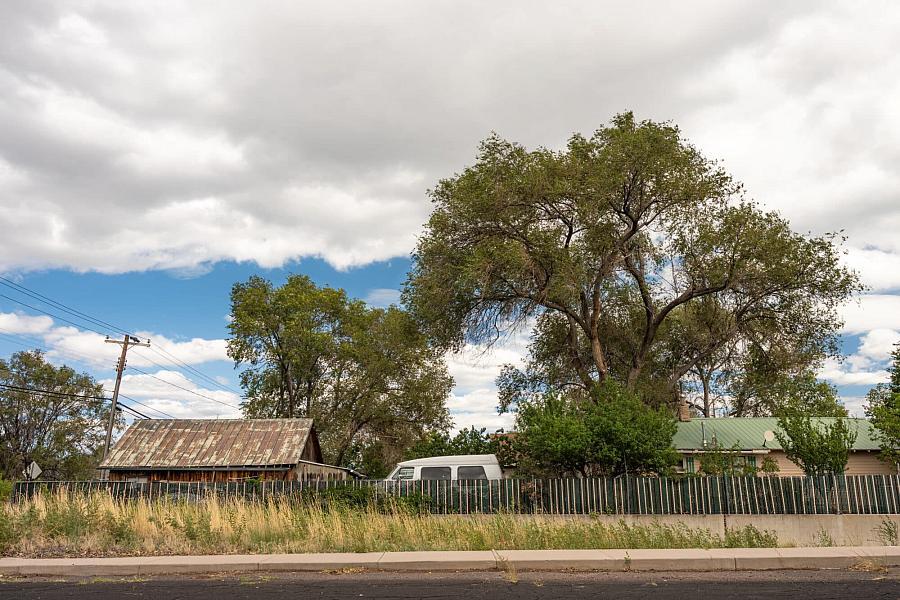
In Arizona, there are only 26 affordable housing units for every 100 households facing poverty, pushing many to seek shelter in the one place they can rely on—their car. Yet 15 cities in Arizona have now introduced camping bans following a Trump administration executive order, forcing many outside of urban areas and into rural America.
Steve Rumizen
“I had a sore that didn’t want to heal on my hand and they said it tested positive for staph,” Maty says, referencing the Staphylococcus bacteria, which can develop into a life-threatening infection if left untreated. “They get a lot of cases from that place because it’s on the mattresses—you don’t get the same mattress every night, you get wherever they put you. I’ve never seen anything disinfected in the month that I was there.”
In an email response, a Poverello Center representative said, “sleeping mats are cleaned daily with a mat sanitizer after the dorm closes, so guests generally would not see that cleaning take place.” The spokesperson added that wound care kits are available to guests, and that the center works closely with the Missoula County Health Department and a local federally qualified health center to manage communicable diseases.
Still, Maty’s experience highlights the precarity of living on the road even for older adults with access to health care.
The criminalization of car camping
Living in a car seems straightforward: A person needs enough money for food, gas, medicine, and supplies. The most important factor—the one that makes life in a car possible—is a safe, legal place to park.
That’s becoming harder to find.
In 2024, the U.S. Supreme Court ruled in the City of Grant’s Pass v. Johnson that municipalities across the United States can create and enforce outdoor camping bans (which often include car camping) because they do not violate the Eighth Amendment’s cruel and unusual punishment law. The ruling opened the door for President Trump’s July 2025 executive order, which granted state and local governments the power to de-fund housing-first policies and end harm reduction programs. The order also set aside more funds for states that enact civil commitment laws, which force people experiencing homelessness into “institutionalized treatment” without their consent. According to the order, civil commitment applies to “individuals with mental illness who pose a danger to others or who are living on the streets and cannot care for themselves.”
The impacts of this order have been devastating and widespread, Rabinowitz says. “In the two years since that decision, over 350 cities passed laws that make it a crime to be homeless.”
In Florida, for instance, it’s now illegal to sleep in your car overnight on public property. Rest stops in the state only allow individuals to sleep for three hours at a time. In Elmira, New York, anyone caught camping in a car can face up to 90 days of imprisonment on top of a $350-500 fine.
Thousands of miles away in Arizona, there are only 26 affordable housing units for every 100 households facing poverty. To prevent homelessness among its lowest income individuals—nearly half (46%) of whom are either senior citizens or disabled—the state would need to build more than 130,000 affordable housing units. Instead, 15 cities in Arizona introduced camping bans after Trump’s executive order. Phoenix has since passed a law prohibiting individuals and organizations from administering medical care and food to people in public parks without a permit—among the strictest of its kind nationwide.
The purported intention of urban camping bans was to clean up streets and improve public safety. Yet the criminalization of homelessness has done little to reduce the number of unsheltered people.
“We need to ask a fundamental question: Are we actually making communities safer, or are we simply making homelessness less visible?” Thompson at NAEH says. “For older adults and people living with disabilities or chronic health conditions, displacement can be particularly dangerous. It can separate them from health care providers, medications, outreach workers, transportation, and the relationships they depend on to survive.”
Hiding in plain sight
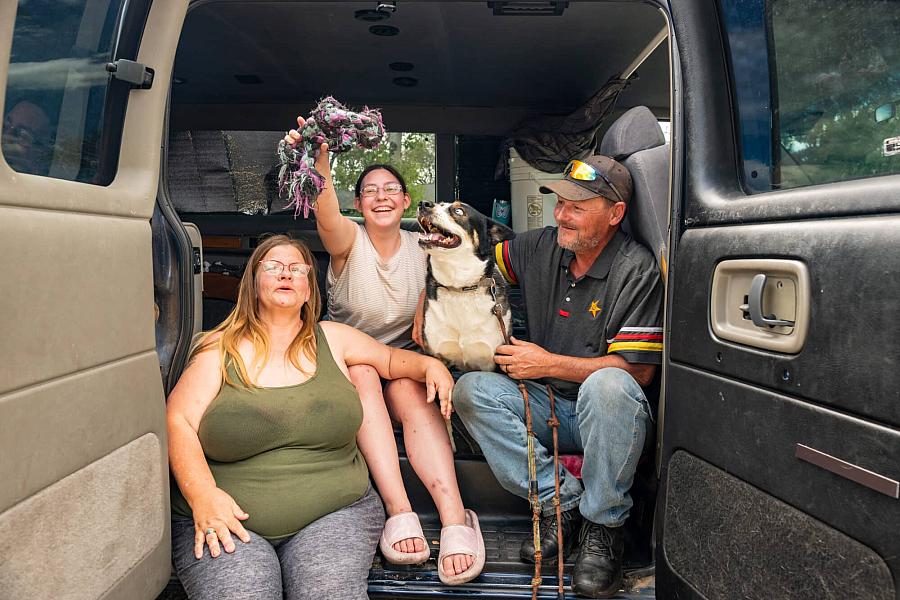
John Anderson, Lucy Anderson, and Allison Anderson, with their dog Gypsy outside Flagstaff, Arizona.
Steve Rumizen
Vehicle dwellers are more likely to get busted for camping on public property, so they often try to fly under the radar on private land and in rural areas.
John Anderson, 53, lives in a Chevrolet Express 1500 passenger van with his wife, Lucy Anderson, 49, his daughter Allison Anderson, 21, and their rescue dog, Gypsy. In March 2026, the family began parking at the Love’s Travel Stop in Williams, Arizona, because John and Lucy both found jobs at the Carl’s Jr. inside the truck stop. Between the actual truck drivers, the long-distance travelers taking short breaks and the other people living in their cars full-time, there’s plenty of ways to blend in.
“Lucy works during the day and I work at nights,” John says. “We park in the employee area and we spend our nights here in the car. Normally, they don’t let people stay, especially as long as we have.”
According to an official comment from Love’s Travel Stops, passenger vehicles can park at Love’s for up to one hour, “to allow space for all customers to take a break and get the essentials they need.”
The Andersons, who are originally from Tennessee, came to Arizona when they first started living in their vehicle in 2018. Together, John’s and Lucy’s jobs at Carl’s Jr. can bring in about $2,500-3,200 monthly. That might seem like enough for rent in theory, but they also have low credit scores, so apartment lessors often want larger security deposits they can’t afford.
Another major challenge is ensuring health care for Allison, who has Type 1 diabetes. After using GoodRX coupons, the monthly cost of her insulin is around $225, not including the test strips, syringes and other supplies she needs.
Health insurance, right now, just doesn’t make sense.
“As each year progresses, they’re starting to cover a lot less of what she actually needs,” John says. “The amount of money that it costs each month for insurance is more than what it actually costs me for needles and everything.”
John and Lucy understand that they are not getting any younger, and they’re acutely aware of the challenges of aging on the road without familial support. “Every single day I see a lot of these older people come in [to the truck stop] and they’re homeless,” John says. “They’re struggling hard, and when I look at them, I will see my mom, my grandma. It sucks bad, I feel so bad for them.”
That’s why they’re already preparing Allison for life without them. “Now I gotta look to her future,” John says. “We’re tryin’ to teach her how to work and teach her how to navigate life, because when we’re gone, she’s on her own and it’s not gonna get any easier.”
Of all the challenges the Andersons face, the cruelty of others stings the most. Over the summer, one customer left a public review on the Google page for the Williams Love’s, which references “a homeless lady living in the parking lot” and wrote that it’s “gross” that she’s allowed to be “touching food.”
Lucy believes the review is about her. “A lot of us didn’t pick this life,” she says. “But we survived.”
So how do they continue that great feat of survival? For John, it comes down to the practice of empathy. “I’m sure I’m gonna get in trouble for it eventually, but if somebody comes in, asks me for food, or they’re hungry, I’ll feed them,” he says, referring to his job at Carl’s Jr. “Burgers and fries, I don’t care. I just give it to them.”
Finding an Eden
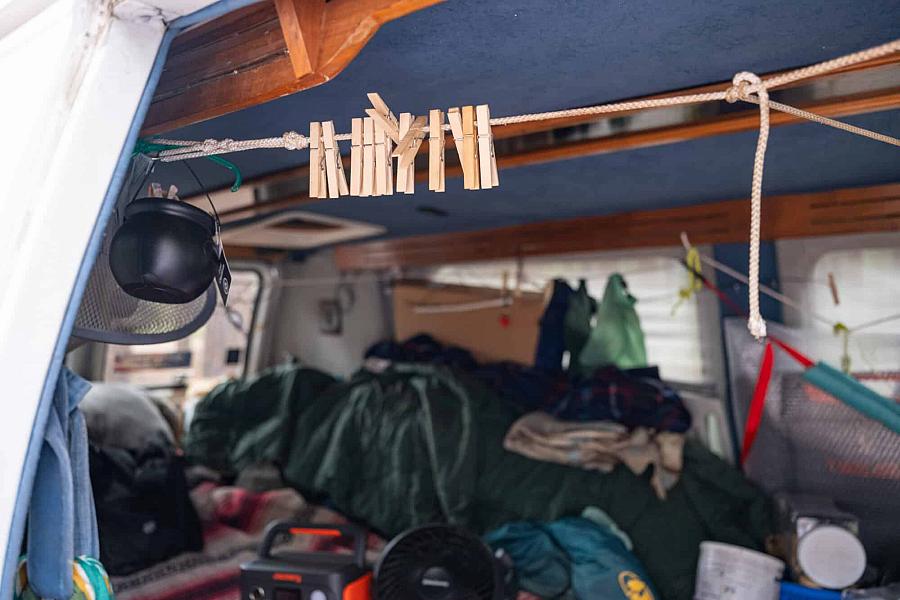
Interior view of Don Maty’s van.
Steve Rumizen
The Andersons never planned on working at the truck stop forever. They were using the job to save up while waiting for September 15, which is when The Bureau of Land Management (BLM) La Posa Long Term Visitor Area (LTVA) in Quartzsite, Arizona opens for the season.
For $180, car campers can buy a permit to stay in the LTVA continuously for seven months. Camping bans do not apply here.
“Once you get to Quartzsite, you can breathe,” John says. “You’re not gonna get chased off, you have a steady place to stay for a while.”
During the 2025-2026 season in Quartzsite, before the Andersons got their van, their small vehicle couldn’t fit them all, so they camped in a tent. When strong winds damaged their tent, two Quartzsite community members—themselves senior nomads who could no longer afford traditional housing—crowdfunded to buy the Andersons a new tent and sleeping bags.
“We call them our desert angels,” John says. “They go around feeding meals to people on Thursdays. They really helped get us through the winter.”
In this way, wintering in Quartzsite hands back the humanity that living on the road can take away.
But the desert has its limitations. Quartzsite’s year-round population is less than 2,000 with a median age of 73.5, according to recent estimates from the U.S. Census Bureau. Yet each winter, the town is flooded with snowbirds—swarms of visitors in RVs, campers and other mobile living quarters seeking warm, dry weather.
“The hardest part about Quartzsite is making money, because from October 1st to March 15th, you can have anywhere from 500,000 to a million people that actually roll through the town,” John says. “There’s so many people that go down there unemployed, it’s very competitive.”
The fact that John doesn’t have a birth certificate or social security card makes finding employment even more difficult, unless someone helps him under the table (like the Carl’s Jr. manager did in Williams).
As of late October, neither John nor Lucy had yet to secure work in Quartzsite.
A housing-first approach
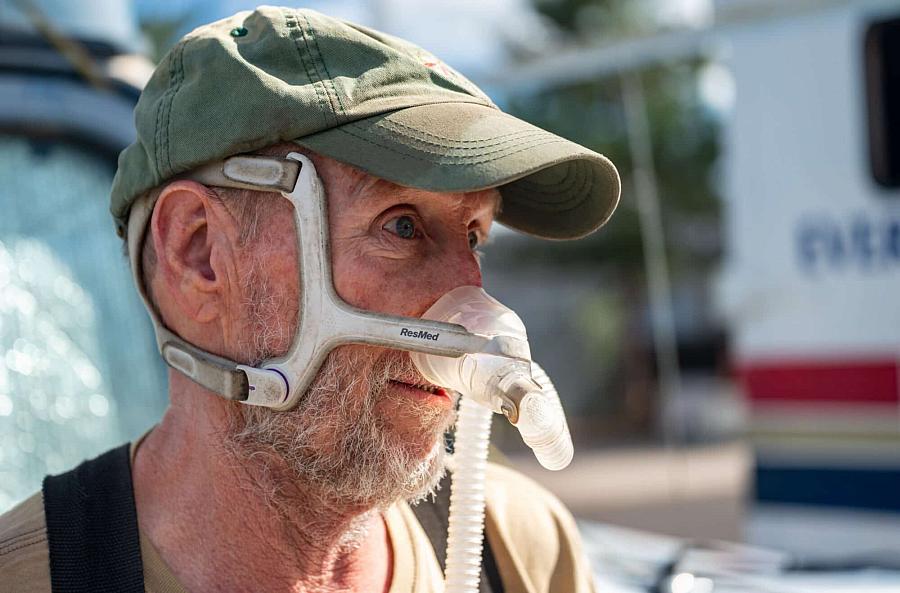
Jeffrey Brooks has been homeless for 23 years. In that time, he worked for the National Park Service and even wrote a self-published book about the specialty air purification system he invented.
Steve Rumizen
Housing-first policies are under threat. The 2025 executive order on homelessness outlined a plan for “ending support for ‘housing first’ policies that deprioritize accountability and fail to promote treatment, recovery, and self-sufficiency.”
However, in a 2025 report, HUD credited housing-first policies with reducing homelessness among veterans by 56% since 2009, helping more than 40,870 veterans obtain stable housing.
This achievement isn’t due to housing-first policies alone. Rather, it’s the fact that funding from the Department of Veterans Affairs (VA) enables the existence of nonprofits like Nation’s Finest, which works directly with veterans in rural communities across Arizona, California and Nevada. By connecting veterans to case managers with deep knowledge of VA benefits, Nation’s Finest helps veterans access the housing, mental health care and employment services available to them.
“I’ve worked as a social worker for 40 years, and this branch of social services is kind of the envy of all the others because of what we’re able to provide people,” says Mike O’Donnell, site director for Nation’s Finest in Flagstaff and himself a beneficiary of VA funding. Since his father was a fully disabled Korean war veteran, O’Donnell was able to attend college tuition-free on the GI bill.
“We like to dream that we’ll do such a great job, and show how effective we are, that society will come to see these types of programs as beneficial to everybody,” O’Donnell says. “There’s just a lot of things that are less expensive when people are housed and have resources, and that enables them to work and more effectively contribute to society—and to their own well-being.”
Federal funding is key to reducing homelessness, but financial support for vulnerable, aging Americans continues to dwindle. The government’s most recent report shows that SSI will be cut by nearly a quarter within the next six years. Additional changes are coming to public benefits in 2027—including a new work requirement for Medicaid recipients and significant changes to SNAP’s funding model.
In addition to disqualifying a greater number of individuals, these stricter guidelines are likely to increase the burden of securing and maintaining benefits. The toll these changes will have on the most disadvantaged older adults is difficult to comprehend, even for people already living on the brink.
“These people probably get a SSI income, which is six to seven hundred bucks a month, and you can’t live on that anywhere,” Maty says from his perch inside the van, though it’s unclear if ‘these people’ includes himself. “They’ve gotten so down on themselves that most of them will probably never get out of that poverty. Until we get some kind of housing reform, it’s not going to get any better.”