

I spent two years chasing a story on severe injuries at the border. Nothing went as planned.

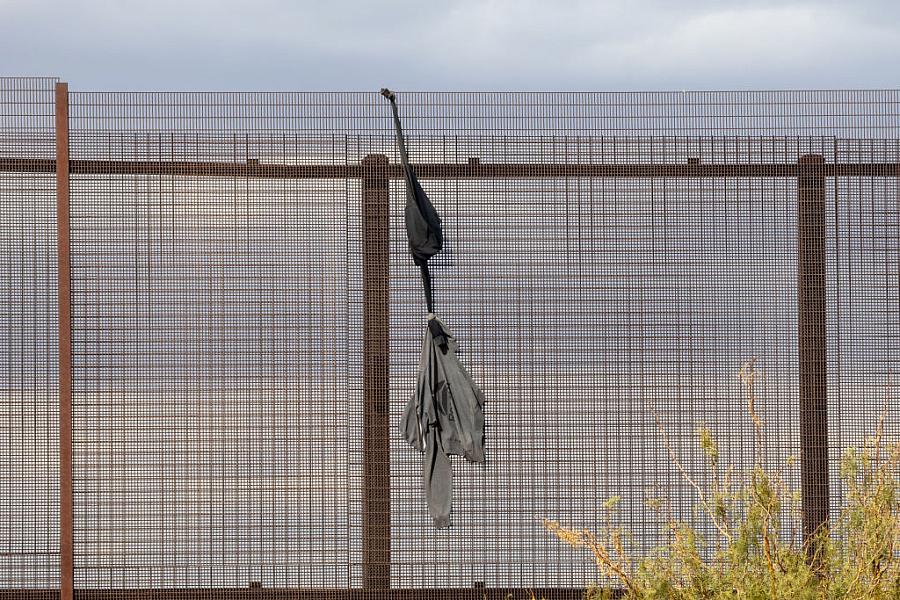
A sweatshirt dangles the border wall between Ciudad Juarez, Mexico, and El Paso, United States.
Photo by David Peinado/NurPhoto via Getty Images
In late 2023, while working on a piece about sudden and dramatic injuries to migrants falling from the Trump-built border wall near El Paso, Texas, I found a medical report that would become the subject of my recent fellowship story for The Guardian.
Falls from the newly built wall weren’t the only peril facing migrants at the border. The report, written by a consortium of border-based trauma doctors from California to Texas, detailed a variety of severe injuries and deaths that were overwhelming medical resources. There is plenty of reporting on migrant deaths and injuries, too, but little about the medical community treating them. Doctors rarely speak out on immigration issues, which is among the most politically fraught policy debates of our time. And yet, here was a diverse group of doctors describing the situation at the border as both a humanitarian and a public health crisis. Could these doctors’ advocacy lead to policy change? That’s what I expected to find out.
I had interviewed several doctors before pitching my project, so I was reasonably confident this largely unreported topic would yield an insightful story told from the perspective of medical professionals. What I did not anticipate, however, were the number of personal and reporting challenges that would force me to pivot time and time again. The story I would ultimately tell was not the one I imagined.
It was a few months ahead of the 2024 presidential election, and the Biden administration, to undercut the top policy issue of the Trump campaign, had significantly reduced the number of border crossings. With fewer migrants arriving at the border, injuries and deaths fell, too. With fewer migrant patients, the doctors’ attention shifted; the issue, for the time being, was no longer urgent.
In the time since the consortium published its report, along with a flurry of other reports from trauma specialists in San Diego and El Paso, the most politically engaged doctors found there was almost no political will to address the well-being of migrants. One doctor in San Diego told me his approach had been to appeal to pocketbooks. Migrant care was straining hospital resources and costing taxpayers tens of millions of dollars, after all. In Texas, the response was to restrict hospital spending rather than focus on reducing the bodily harm caused to migrants at the border, hardly the outcome the San Diego doctor had hoped for.
The election of Trump only complicated matters. Border crossings plummeted even further, reaching decades-low levels. At the same time, doctors working at state-funded hospitals were under pressure to limit or avoid media interviews altogether. In this challenging and shifting landscape, the story I set out to write was no longer accessible. I had to pivot yet again.
From the outset, I expected I would narrow the scope of reporting to focus on El Paso or San Diego. A pair of doctors in San Diego has led research into the impact of Trump’s 30-foot border wall. These doctors had also been politically engaged; one had even testified before the U.S. House Committee on Homeland Security. Despite these efforts, doctors soon found that advocating for migrants was then, and remains now, politically toxic. And even as their research informed my understanding of the migrant health crisis, hospitals would begin to restrict interview access.
After two frustrating reporting trips to San Diego, I decided that I would tell the story of violent border enforcement from El Paso, Texas. As dangerous as the border wall in San Diego has been to migrant health, the landscape in Texas is far worse. Between 2022 and mid-2024, the city was overwhelmed with migrant arrivals, and for one brutal stretch, it was the deadliest border crossing in the country. For its part, Texas under Gov. Greg Abbott launched the border enforcement campaign known as Operation Lone Star in 2021 to criminalize migration while testing the limits of state-level policing. Eventually, doctors and hospitals came under scrutiny. In such a fraught environment, access to doctors would be a problem here too.
I spoke with doctors on the Mexican side of the border, and I interviewed medical anthropologists. I explored immigration through the lens of political violence, and I had a series of conversations with an international lawyer whose work focused on the violence of borders. Reflecting on the variety of research, I arrived at a deeper understanding of the US-Mexico border. Still, I was no closer to filing my story.
But, as it turns out, one of the first people I spoke with before applying to the fellowship was Brian Elmore. He was doing his medical residency at the Level 1 trauma center in El Paso. I had read stories he published in The Atlantic and Texas Observer about his work. He described severe injuries to migrants as a political pathology. Elmore was a trauma surgeon in El Paso, and he co-founded a migrant clinic in Ciudad Juárez. He was vocal in his criticism of border enforcement, and that had gotten him into trouble. If I could wait until the end of his residency, which was eight months down the road, he would be candid with me about his experience.
Even as I considered alternatives that didn’t center around him, we kept the conversation going. As the months passed by, Elmore’s residency neared its end. We met in person for the first time at a brewery of his choosing after one of his last shifts at the hospital. He was still dressed in blue scrubs. We talked for hours and explored the city that shaped his views on medicine.
“It was disheartening to see the same patients come into the emergency department every day, with the same traumatic injuries — like a perverse Groundhog Day,” he told me.
Over the next few days, my story began to take shape. In the end, the story you expect to find may not be the story, after all. More importantly, there will be unexpected challenges. To these I say, persist.