

Black Patients Describe Trauma And Dismissal In ER Care
The story was originally published in The Observer with support from our 2026 California Health Equity Fellowship.

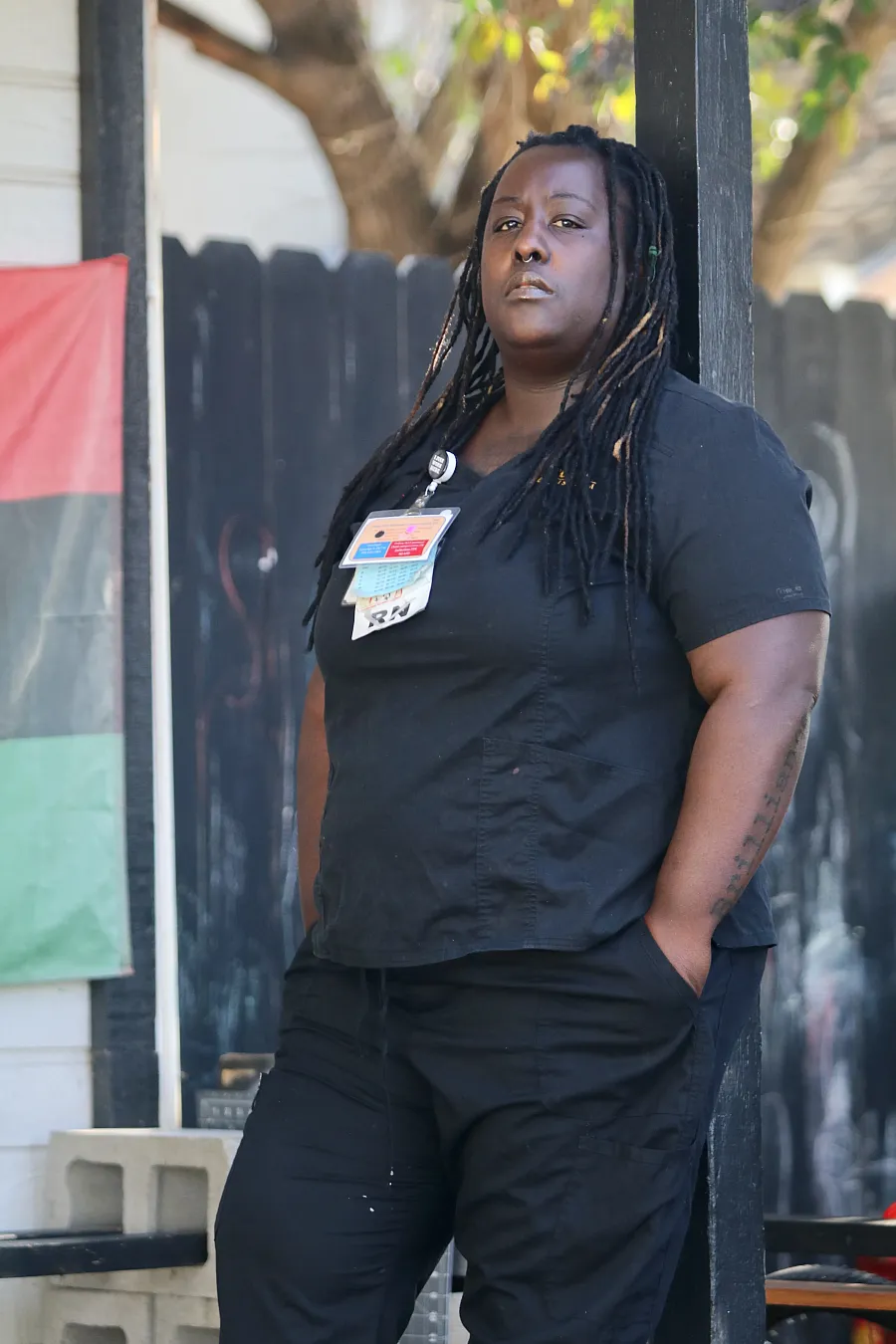
Asantewaa Boykin, an activist and local emergency room nurse, was struck by a vehicle in 2023 while leaving her shift in UC Davis Medical Center’s emergency room.
OBSERVER file photo
For many local African American patients, the emergency room has become a site of trauma rather than healing.
Those managing chronic, often “invisible” conditions, such as lupus and sickle cell, speak of an emergency room that often feels less like a place of care and more like a battleground for respect.
Dionne B. McNairy, who identifies herself as a former hospital employee who has lupus and other autoimmune issues, recalls an incident when she arrived at the ER at Kaiser South Sacramento with her legs swollen to “tree trunks” and dangerously high blood pressure.
“I was in a lot of pain. I couldn’t walk,” McNairy says. “The doctors and the nurses treated me like I was an addict looking for meds, even though they had full access to my records and even though I presented clearly in distress.”
She recalls pushing back.
“I kept telling staff to call the rheumatologist on call,” she says. “They acted like I didn’t know what I was talking about. I had worked there as a hospital operator for many years, so I knew what was right.”
McNairy says staff initially doubted her employment history, though she says she quickly provided proof. She and her family voiced their frustrations to the medical team, but the damage was done.
“There have been times since then I needed to go to the ER, but I adamantly refused,” she says. “I haven’t been back since.”
That skepticism extends beyond individual lupus patients. Participants at a recent Sickle Cell Advocacy Day at the Capitol shared similar stories of visiting ERs throughout California. They described facing accusations of being addicts or “doctor shopping” when seeking medication that had been denied by their primary care physicians or requesting refills for depleted prescriptions.
When medical staff label patients as “difficult” or “addicted” rather than listening to their medical history, it leaves a lasting scar. The struggle to be taken seriously is familiar to Crystal Runner, another local lupus patient. For her, repeated dismissals create a haunting dilemma: the fear of seeking help at all.
“I have so many stories it’s ridiculous, and witnesses to these experiences,” Runner says.
“I’m literally afraid to call 9-1-1, let alone ride in an ambulance alone or go to the hospital without someone. If it weren’t for my resilience, I would have been dead.”
An older Black woman who spoke to The OBSERVER, but asked to remain anonymous, says she faces serious health conditions that require frequent, often life-saving hospital care. Her experiences at local Kaiser and Sutter Health facilities have left her deeply shaken.
“They’ve almost let me die a couple times,” she says. “It’s scary every time I have to go there.”
During one emergency involving a severe reaction to medication and dangerously high blood pressure, she recalls her husband frantically demanding care while a staffer moved “like he was a tortoise.” Even more jarring was watching a white woman with significantly lower blood pressure be whisked to the back for treatment, while she was left waiting, phone in hand, trying to reach her own doctor as her condition worsened.
That ordeal reflects a deeper, layered fear that now complicates her medical visits: the anxiety of encountering providers whose personal biases might compromise her care.
She describes a constant, unsettling worry about being treated by a “MAGA nurse or doctor” who may view her with disdain because of her advocacy for Black communities. That fear is shared by many in her peer group, she says, who increasingly avoid emergency rooms not just due to cost, but because of a pervasive sense that they “won’t come out” due to catching secondary infections and because they’re treated as if they “don’t matter.”
“I hate going,” she says. “I hate it. I hate it.”
Perspectives From The Frontline
Asantewaa Boykin, an activist and local emergency room nurse, highlights a critical intersection between health care and broader societal issues. Boykin previously spoke to The OBSERVER about her experience inside the ER.
“One space that’s not being talked about in a way that’s robust is how policing, the prison industrial complex and white supremacy is infiltrating our health care system,” she said in 2020. “Any doctor’s office you go into, there might be a metal detector or security guard.
“And for folks, especially folks like us who have inherently negative relationships with police and law enforcement, how does that affect the way that we are getting health care? How are we deciding which patients get restrained? I am a nurse and I’ve grown extremely tired of watching my people being mistreated.”
Boykin was struck by a vehicle in 2023 while leaving her shift in UC Davis Medical Center’s emergency room. She spent months in a wheelchair and still deals with the physical fallout from her injuries. Boykin recalls visiting an ER as a patient in early July and working at another ER the next night.
“The experiences were not that different,” she says. “In the past, that hadn’t been so apparent to me, but having that experience back to back is when that epiphany hit me like a ton of bricks. I left the hospital feeling unheard and defeated. I left work feeling the same.
“Knowing both sides of our medical system so intimately has definitely been a headtrip.”
Boykin’s account offers a firsthand perspective on the challenges within emergency care.
These experiences align with broader structural concerns described by Dr. Georges Benjamin of the American Public Health Association, who characterizes systemic gaps as the “residuals” of a health care system built upon a foundation of exclusion.
Drawing on his years as an ER physician, he explains that health inequities stem from deep-seated differences in the quality of care and access, noting that half of U.S. counties lack adequate maternal services.
“There are also differences in health-seeking behavior — some of it’s cultural, some of it’s age,” he says. “A lot of people think a cancer diagnosis is fatal, so they avoid care; it’s a denial of services.”
He recalls one patient who illustrates the severity of these gaps: an older, uninsured woman who arrived complaining of chest pain.
“As we undressed her to get her EKG, she had an ulcerating breast mass. That sort of explained her chest pain. When we asked her about her mass, she said, ‘What mass?’ Total denial of care.”
Benjamin notes that these encounters often highlight why clinical care is only part of the solution.
“One of the more painful revelations as an emergency physician is that 80% of what makes you healthy occurs outside the doctor’s office … around housing, education, transportation, and environmental exposures. And racism and discrimination, both structural [and] individualized, are real issues that we have to deal with.”
Kaiser Permanente did not respond to multiple requests for comment.