

New Orleans health, environment officials consider plans to clean up toxic lead in playgrounds
The article was originally published in the Verite News with support from our 2025 National Fellowship.

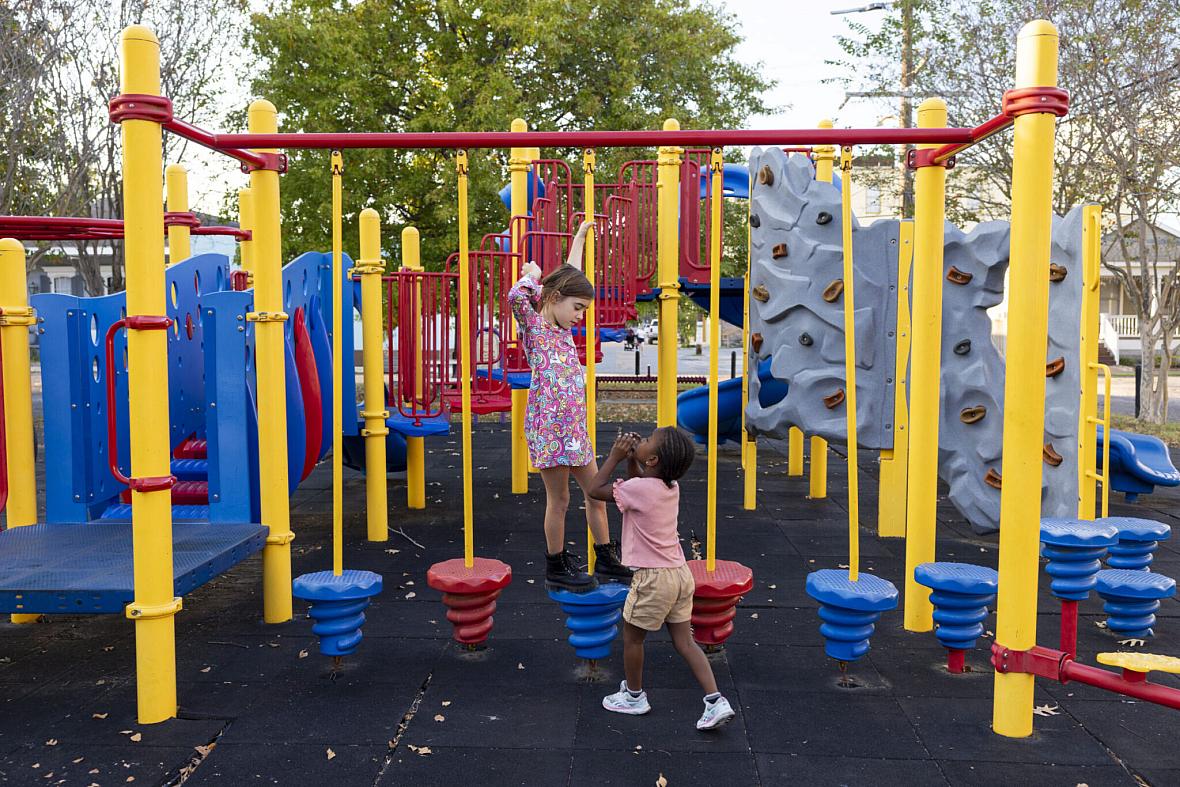
Ruthie, 7, left, and Justice, 6, play on the equipment at Soraparu Playspot in Uptown New Orleans on November 15, 2025.
Credit: Christiana Botic / Verite News and Catchlight Local/Report for America
After an investigation by Verite News revealed pervasive lead contamination in playgrounds across New Orleans, city officials have requested federal funding to help address the problem.
At an April 1 panel discussion hosted by Verite to highlight the reporting, Deputy Mayor of Health and Human Services Dr. Jennifer Avegno said city officials recently requested $5 million from Congress to pay for additional lead testing and possible cleanup of playgrounds with elevated levels of lead.
“We’re trying to figure out, with whatever pots of money we can get, how can we make a more sustained and meaningful impact than we have been able to in the past,” Avegno said.

Left: The Water Collaborative Executive Director Jessica Dandridge (with microphone) appears with New Orleans Deputy Mayor of Health and Human Services Dr. Jennifer Avegno at Verite News’ April 1, 2026 panel discussion on lead contamination in New Orleans. Right: Residents at the panel discussion, “Exposed: Lead in New Orleans,” a free community event hosted by Verite News.
Credit: Lavonte Lucas for Verite News
In February, Verite published an investigation into lead contamination at local parks where reporters tested more than 80 playgrounds for the heavy metal. The reporters documented unsafe lead levels at just over half of the playgrounds tested.
Since the investigation, parents across the city have called the New Orleans Recreation Development Commission (NORDC), their elected officials and other city offices to request action. In the Bywater neighborhood, a group of parents have been working with the neighborhood association, a community group and the city to do additional testing at a popular playground where reporters identified high levels of lead in the soil.
Avegno said her office is working to prioritize further lead investigations by reviewing past city records, working with the city’s in-house experts in the City Planning Commission’s Brownfields program and reviewing Verite’s testing results. On Tuesday (April 7), Mayor Helena Moreno signed an executive order creating a new task force aimed at improving and reforming NORDC. Among the task force’s duties will be to develop recommendations for assessing and remediating lead contamination at city playgrounds.
And on top of the $5 million the city is requesting for soil testing, Avegno said last week that the city was already applying for a grant to help address lead at early childhood education centers when Verite’s reporting was published.
“Your story was amazing timing,” she said.
Find out what the lead levels are at your playground
GPS was accurate to within a few feet depending on cloud and tree cover.
Data visualization by Dennis Dean.
Lead contamination persists in New Orleans soil, older buildings and drinking water, posing a significant public health threat to children. Children under 6 can absorb the toxic metal more easily than adults, contaminating their blood and harming the long-term development of their brains and nervous systems.
There is no known safe exposure level for children or adults. In children, even trace amounts can result in behavioral problems and lower cognitive abilities. Chronic lead exposure for adults can increase the risk of heart problems and other health issues.
On top of the effects on a single child or family, Avegno said the long-term implications of lead exposure, including its potential link to increases in violent crime, make the issue even more critical.
“We knew we had to exhaust every avenue,” she said.
Due to low rates of testing, it’s unclear how many children across New Orleans are exposed to lead. In 2023, just 17% of children were tested for lead poisoning in New Orleans, despite a state law that requires medical providers to test all children at ages 1 and 2.
Public health researchers recommend that parents avoid playgrounds with lead contamination because it can be difficult to prevent young children from placing dirt in their mouths or breathing in dust kicked up during play.
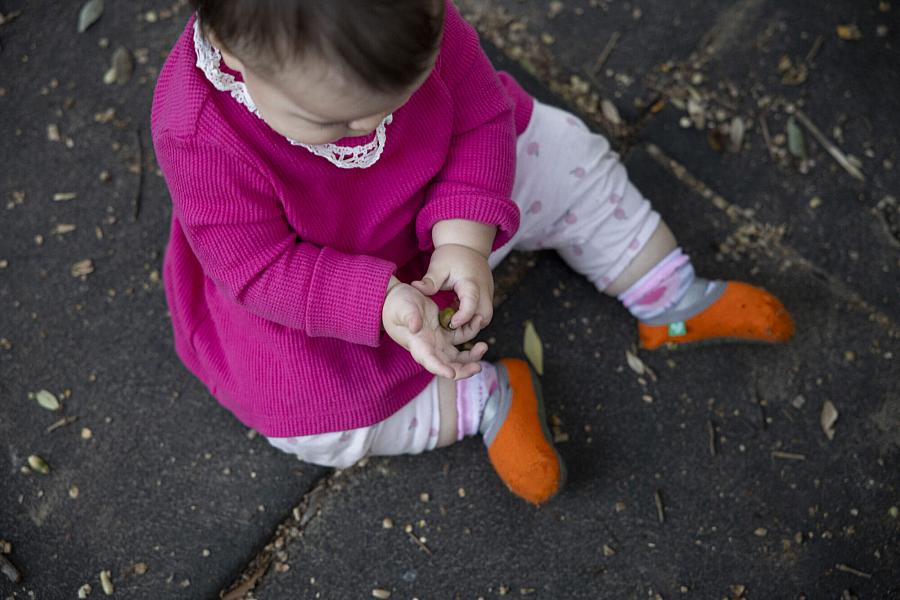
Edith, 10 months, plays with dirt and other debris scattered across the playground’s rubber tiles at Mickey Markey Park in the Bywater neighborhood of New Orleans on November 13, 2025.
Credit: Christiana Botic / Verite News and Catchlight Local/Report for America
In Bywater, a group of parents are working with the Krewe of Red Beans and the Bywater Neighborhood Association to fundraise about $8,000 to hire a contractor to do more extensive lead testing at Mickey Markey Playground, where Verite recorded samples above the federal hazard level of 200 parts per million. One sample was two times higher.
Verite found unsafe levels of lead in spite of the city’s remediation of the playground more than a decade ago. In 2011, city leaders under then-Mayor Mitch Landrieu pledged widespread testing of New Orleans playgrounds. Ultimately, the administration tested 16 playgrounds and remediated portions of 13 parks.
Vann Joines, a Bywater resident who often takes his two-year-old daughter to the park, said he knew lead was common in New Orleans soil due to his work in real estate development, but his freshly painted house and paved backyard reduced her risk of exposure.
Joines’ daughter has had her blood tested twice, and the results returned close to zero. But she, like many children, still eats a lot of dirt, and Joines wants to make sure Mickey Markey Playground is safe despite past remediation by the city. He’s also concerned about other playgrounds in the city with even higher levels of contamination, such as Soraparu Playspot in the Irish Channel. At Soraporu, Verite’s testing recorded levels more than 10 times higher than the current federal hazard level.
“It’s really important for us to be exceedingly mindful at public playgrounds and at public parks,” Joines said.
Krewe of Red Beans founder Devin DeWulf, a father of two who also lives in the neighborhood, said he and his wife remediated their home and their yard when they had children to try to prevent lead exposure. Since learning more about lead when his kids were born, he said it’s always in the back of his mind.
“Once you go down that rabbit hole, you don’t really unsee the problem,” he said. “Whenever I would walk by houses that were being repainted, and I would see somebody sanding the side of the house, I would just think about lead.”
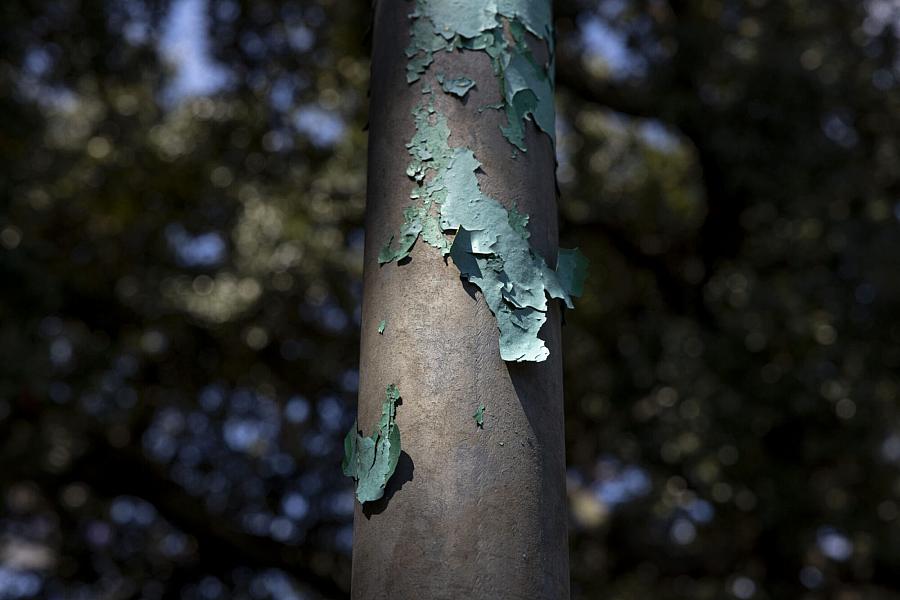
Lead paint peels off a pole at Hunter’s Field Playground in New Orleans on September 19, 2025.
Credit: Christiana Botic/Verite News and Catchlight Local/Report for America
His wife is a doctor, so they monitored their kids closely. Despite their efforts to prevent lead exposure, one of their children still had elevated levels of lead in their blood at one point.
“Even though we remediated our soil and did everything that we were supposed to do,” he said, now wondering if the child’s exposure came from the playground. “I took them to Markey Park almost every day when they were babies.”
DeWulf, Joines and other parents plan to raise the money for more testing to determine if the past remediation of Mickey Markey was sufficient. If higher levels are confirmed, then they plan to raise money for further clean-up, possibly across the full park’s footprint instead of just the fenced-in playground. Covering the full park could help prevent dirty soil from recontaminating the playground.
The parents and local groups are working alongside the city to plan the work. But with the city in the midst of a budget crisis, Dewulf and Joines said they aren’t necessarily relying on public funding.
“I’m aware of the city budget issues right now, and I’m also aware that fixing one playground in one neighborhood might not be a giant priority,” DeWulf said.
DeWulf and Joines also said they don’t expect an instant fix. Instead, they’re hoping to address any lead contamination at the playground within the next few years, and in that time create a playbook that other neighborhoods could follow for their own playgrounds.
“We could create a how-to guide on how we could effectively do this in partnerships in the city,” Joines said.
DeWulf said he also hopes they can gather a long list of parents willing to contribute to cleaning up playgrounds outside of their own neighborhoods.
“There’s so much inequality in New Orleans, so there’s gonna be some neighborhoods that have more resources versus others,” DeWulf said.