

Clancy’s case offers journalists a window into postpartum psychosis and mood disorders

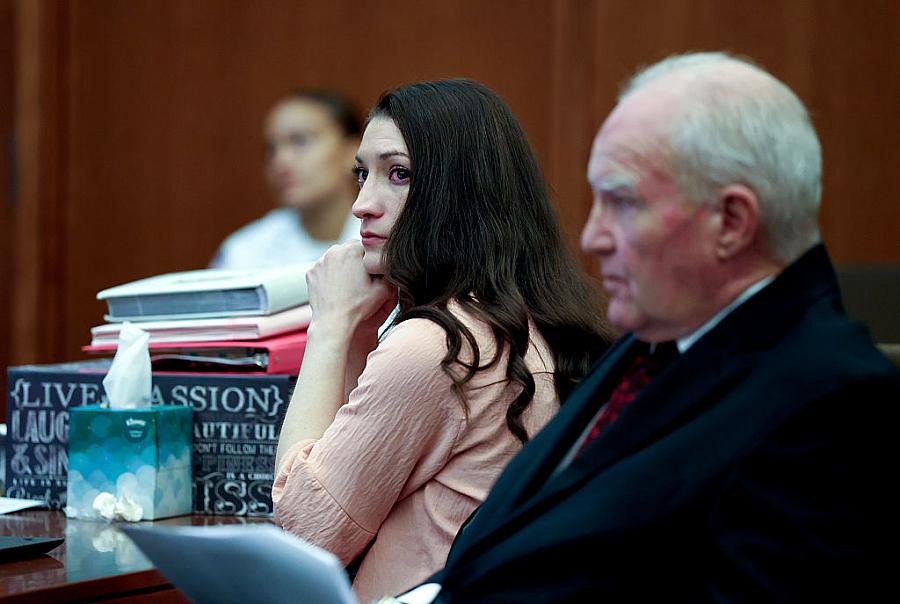
(Photo by Jonathan Wiggs/The Boston Globe via Getty Images)
It’s easy to get fixated on the sensational details of Lindsay Clancy’s case.
How, over a period of months, the mom of an infant sought help from a series of providers as she felt increasingly untethered from reality. The sheer inadequacy of the care she did receive.
In January 2023, in the basement of her home, she violently attacked her three young children, all under 6. The killings, and her subsequent attempted suicide, took place while her husband, Patrick, was picking up takeout food and medicine.
Prosecutors charged her with three counts of first-degree murder, alleging the crime was premeditated. The defense argued that the labor-and-delivery nurse was struggling with the rare condition known as postpartum psychosis, exacerbated by poor medical care.
The story has gripped the nation and spawned conspiracy theories. And it provoked a rare response of sympathy from the jury in her criminal case. Last Friday, the judge on the case declared a mistrial. It has since emerged that, except for one holdout, the jury favored acquittal with a verdict of not guilty by reason of insanity.
All the attention on the Clancy case provides an opportunity for journalists to step away from reveling in the shocking details and jury dynamic to explore a long overlooked topic — postpartum mood disorders, how poorly our health care system attends to them, and how consistently our criminal justice system fails to acknowledge them.
At the Center for Health Journalism, we’ve been nurturing reporting on maternal mental health and perinatal mood disorders since long before the Clancy case dominated headlines. I recently dipped into those archives in search of insights for journalists wanting to inform the policy conversation and bring desperately needed information to women experiencing symptoms.
Explore our reporting on maternal mental health
It’s well known how to prevent such extreme cases. Perinatal depression, a major mood disorder during pregnancy or in the first year after childbirth, needs to be identified quickly and treated immediately to “avoid devastating and preventable consequences,” including impacts on normal cognitive development for infants or extremes such as suicide or infanticide, researchers say.
Yet universal prenatal and postpartum screenings for maternal mental health remain elusive, despite recommendations from a decade ago by the U.S. Preventive Services Task Force. Drawing from 2025 federal data, the Policy Center for Maternal Mental Health notes that “an estimated 50-70% of maternal mental health disorders go undiagnosed, and 75% of those diagnosed go untreated.”
Even when treatment is given, the quality of care can be inconsistent.
In the Clancy case, Patrick Clancy, the children’s father, alleged in a civil suit that providers “exacerbated his wife’s mental health struggles,” while calling on the public to be sympathetic to her situation. “Indeed, the bevy of diverse and powerful medications they misprescribed, coupled with their abject failure to appropriately monitor Lindsay, resulted in Lindsay's mental health deteriorating to the point of suicidal ideation and requiring in-patient care,” the suit he filed against providers alleges. “Ultimately, negligent treatment of Lindsay, including their complete failure to recognize and address the radical erosion of her mental health … resulted in tragedy.”
Clancy’s case represents an extreme.
But as journalist Elissa Lee wrote in a Center for Health Journalism column, many more women are affected by perinatal mood disorders than is often acknowledged or understood. Mood and anxiety disorders “are the most common medical complication during and after childbirth,” she wrote. Left untreated, she noted, these conditions can harm the health of the mother and the child. They are more costly by orders of magnitude than conditions such as gestational diabetes. And they can cause significant economic costs if women are unable to work or help care for their child.
And then there’s the criminal justice system.
In 2018, psychotherapist Diana Barnes, a specialist in treating maternal mood disorders, wrote a column for the Center for Health Journalism that celebrated the passage of a new law in Illinois that allowed courts to consider postpartum depression and postpartum psychosis as mitigating factors in sentencing. The two other states debating a similar measure back then, California and Massachusetts, are still hosting meetings without any action in 2026. Perhaps the Clancy case will spur action.
When I caught up with Barnes this week after the Clancy mistrial, she shared her view of the status quo, including “the limited understanding” of the United States judicial system. “Unlike other countries in Europe that have specific provisions for cases involving infanticide,” she wrote me, “our laws on insanity still date back to the 1800s and are constructed to punish not treat and that only perpetuates misinformation and intolerance.”
Perinatal mood disorders are treatable, she emphasized. “Knowing your risks, informing family members what to look for and accessing social supports are all part of prevention,” Barnes added. “It is not the symptoms themselves, but untreated illness that poses the greatest risk to a mother and in cases of postpartum psychosis, her children.”