

The Health Divide: Who gets safe drinking water in America?

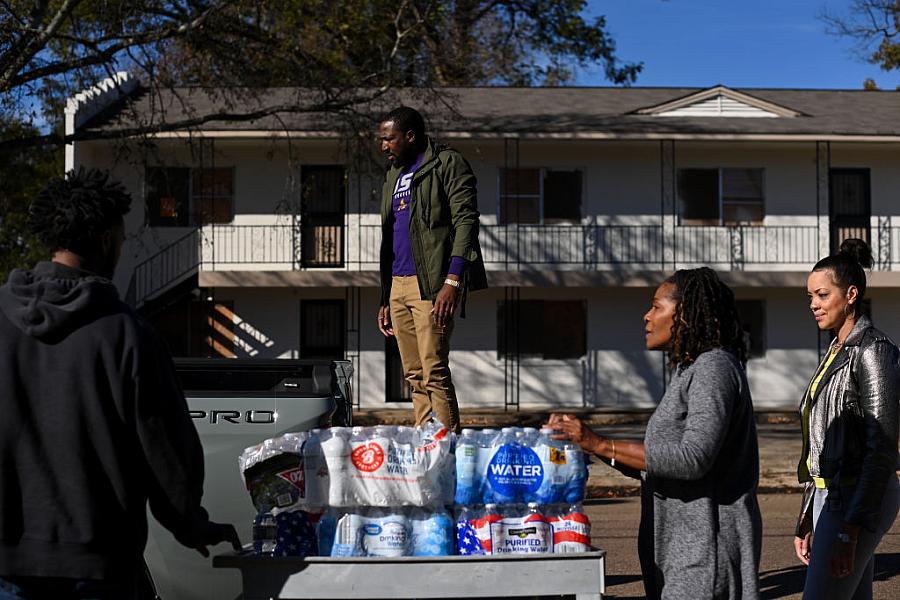
Residents place cases of water into a vehicle in Jackson, Mississippi, in 2022.
(Photo by Joshua Lott/The Washington Post via Getty Images)
When you turn on the faucet in your kitchen, you shouldn’t have to wonder whether the water is safe to drink.
Nor should you have to wonder whether your children are exposed to lead, arsenic, PFAS or another contaminant you can’t see, smell or taste. And you certainly shouldn’t have to wonder whether your community would receive the same level of urgency as another community if something went wrong.
But a growing body of research suggests that where you live and your community's racial and economic makeup can affect the quality of the water that enters your home.
Some of the latest research is giving us a clearer picture of America’s drinking-water divide. A national study published in PLOS Water last year analyzed more than 20 million drinking-water samples and seven water-quality measures, including lead, arsenic, nitrates, PFAS chemicals and health-based violations of the Safe Drinking Water Act.
“For all indicators of drinking water quality, we find meaningful differences across socioeconomic groups,” the researchers wrote.
Some of the largest disparities involved American Indian populations, who were served by water systems with roughly two to three times as many health-based violations as those serving non-Hispanic white populations.
I don't have to look outside Milwaukee to understand how a drinking-water problem can stay with you. I lived through Milwaukee's 1993 cryptosporidium outbreak, when contaminated drinking water sickened an estimated 403,000 people.
I was one of them.
More than three decades later, I still don't drink from public water fountains. That's how long it can take to regain trust in something as basic as the water we drink.
Where are the problems?
Another 2025 study approached the problem differently.
Researchers writing in the journal Risk Analysis described water injustice as “the unequal access to safe and clean drinking water that disproportionately impacts low-income households and people of color.”
Using federal drinking-water violations and measures of social vulnerability, they identified water-injustice hotspots nationwide.
The disparities became even clearer when researchers looked at where water problems overlapped with social vulnerability.
Researchers created a “water injustice” score that combined drinking-water violations with measures of a community's social vulnerability, including socioeconomic and demographic factors. Eight of the 10 counties with the highest water-injustice scores were in Mississippi, with the other two in Texas and South Dakota.
The finding matters because it shows that drinking-water problems aren't occurring in isolation. In some of the hardest-hit places, they overlap with communities that may have fewer resources to respond when their water isn't safe.
The researchers also found disparities in Native American water systems. Those systems averaged 1.6 violations per facility per year, compared with 0.6 for systems owned by local governments.
More research arrived in 2026.
A study published in Social Science Quarterly examined drinking-water and wastewater violations alongside socioeconomic and water-system characteristics. Researchers found “that race and health insurance coverage are associated with drinking water health violations.”
But more recorded violations don't always mean worse water. Differences in monitoring and reporting can affect what gets documented, with violations more closely tracked in larger, more politically engaged counties.
These different studies point to the same larger questions: Who has reliable access to safe drinking water, where are the problems concentrated, and what happens when something goes wrong?
What happens after the water fails?
Earlier research examined that last question.
A 2023 study in the journal Race and Justice examined 1,860 community water systems that violated the federal Safe Drinking Water Act between late 2015 and early 2019.
On average, those systems remained out of compliance for nearly 309 days. Some returned to compliance within two days. Others remained in violation for more than three years.
Researchers found that systems in counties with larger Black and Hispanic populations took longer to correct violations than those in counties with larger white populations. That relationship remained statistically significant after researchers controlled for factors including income, poverty, water-system size and ownership.
There are important limitations to the study’s findings. Not every violation meant residents were drinking contaminated water. Some involved unsafe contaminant levels or treatment requirements, while others involved monitoring, testing or reporting failures.
But the researchers suggest that “the legacy of racialized urban planning and long-term disinvestment in water infrastructure are responsible for the longer duration of water system noncompliance in areas with higher percentage of minority population.”
Clean water shouldn’t depend on where you live
We’ve seen what can happen when drinking-water problems aren’t taken seriously.
Flint, Michigan, a majority-Black city, remains one of the most painful examples.
Soon after Flint switched its water supply to the Flint River in 2014, residents complained that the water looked brown, smelled bad and tasted strange. Some reported rashes and other health problems.
But they struggled to get officials to listen.
“The more we complained about it to those in charge, the more we were told it was fine,” Flint resident and pastor Monica Villarreal Jefferson later recalled.
Imagine being told that while looking at brown water coming from your faucet.
Flint remained on river water for about 18 months before switching back to its previous source. The river water hadn't received the corrosion-control treatment needed to prevent lead from leaching from pipes and plumbing.
A CDC investigation later found that the percentage of blood lead tests showing elevated levels among children younger than 6 rose from 3.1% before the switch to 5% in the early months afterward.
Flint was an extreme case. Not every drinking-water violation poses the same health risk. But the ordeal showed what can happen when the people drinking the water see a problem before those responsible for protecting them are willing to acknowledge it.
Safe drinking water shouldn't depend on your ZIP code. Neither should being heard.
What journalists can do
For health journalists, these studies should raise questions about what’s happening in the communities we cover.
Start with the records. Check EPA compliance and enforcement records and local water-quality reports to see whether a system has violated federal drinking-water standards, what the violation involved, and how long it lasted.
Then talk to residents. Have they complained about their water? What were they told? How long did they wait for answers?
And ask officials what happened. If a problem took months or years to correct, why? What was done to fix it? Could it happen again?
The question isn’t simply whether America’s drinking water meets federal standards. It’s whether every community gets the same protection and the same urgency when its drinking water puts people’s health at risk.