

What my own story and reporting taught me about the language challenges immigrants face when seeking health care

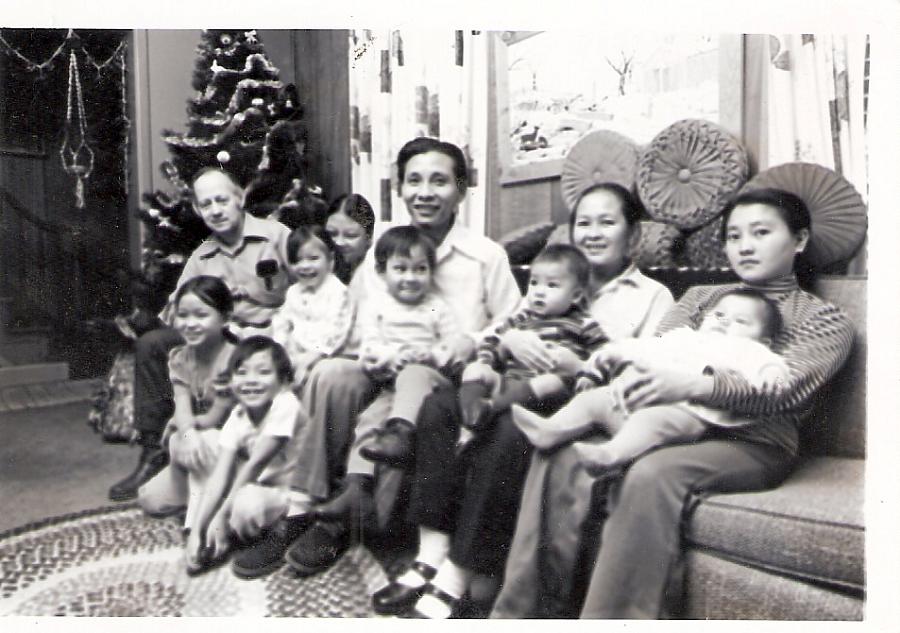
The author, second from left in top row, at age 4 with her family, shortly after arriving in the U.S. She would start interpreting for her parents during medical appointments and elsewhere at age 12.
As a 2024 National Fellow for the Center for Health Journalism, writing about language access felt personal to me.
I am a refugee that belongs to the “1.5 generation” of Hmong children and their families who sought asylum to the U.S. after the Vietnam War ended in 1975. The term “1.5 generation” describes individuals who were born in a foreign country and immigrated to the U.S. during childhood.
I have firsthand experience both as an English language learner and child interpreter at the age of 12, often interpreting in critical settings like medical appointments. In my recent reporting project for the 2024 National Fellowship, I reflect on a time before language access rights existed, and the implications for both child interpreters and the medical professionals who relied on them.
While my medical vocabulary was pretty limited, my parents trusted me to be their voice, so I did my best to help. I explained their symptoms and the doctor’s instructions as best as I could. At 12, I was definitely intimidated by the medical staff and all the big medical words they used.
My understanding of language access issues deepened when I began working for legal services as a law graduate. Public policies such as Executive Order 13166, issued by then President Bill Clinton in 2000, which addressed language access, were a central focus for legal services because of the significant immigrant communities it served. Only a handful of attorneys appreciated language access policies and even fewer engaged in litigation.
I took this project to examine how language access policies have evolved over the past 25 years. To tell the full story, I needed to include the experiences of children and families who didn’t speak English.
Chong Cha, whoe story I covered in my series’ first article, “Lost in Translation: Healthcare Challenges in Immigrant Communities,” was among the clients I had the privilege of serving. Although hospitals receive millions in federal funds each year, patients like Cha and others who don’t speak or understand English well often couldn’t get interpreters for their basic medical needs.
Following the Cha case in 2002, a local hospital started using color-coded bracelets to identify patients with language barriers. A patient’s primary language was written on the bracelet to help medical staff. Even though the hospital made this change, they still didn’t always get it right. For example, they labeled my mom, a Hmong patient, as “Miao,” which is a derogatory term often used to refer to Hmong people, with a connotation suggesting “uncivilized people.”
These are some of the reasons why language access is an important discussion and continue to be a discussion for immigrant communities 25 years later. In light of the policy shifts and ongoing education on the subject, immigrant communities often still struggle to access language services.
When I first started reaching out to local hospitals in the Sacramento area for this project, I had a feeling it wouldn’t be easy to get interviews — I either got the run-around or didn’t hear back at all in many instances. Initial questions about my project turned into unanswered emails.
“We will only respond to credentialed media” one hospital stated on their website.
After several emails, I was able to interview the department manager of interpreting services at UC Davis Medical Center for my second article. In “Gaps in Interpretation: Healthcare Challenges in Immigrant Communities,” I highlighted how patients still faced challenges, including a shortage of interpreters, English-only notices, and not being informed of their right to request language support. While hospital policies may be well written, they often fall short in practice for those who need them the most.
I faced another setback right before publishing my second article. A Clinton-era language access policy, which mandated that federal agencies and recipients of federal funds provide language assistance to individuals with limited English proficiency, was repealed. A new policy was signed on March 1 by the Trump administration, designating
English as the official language of the United States, and no longer requiring federal agencies to offer multilingual services. The executive order encourages newcomers to adopt English as the “national language.”
In light of this policy change, I went back to the individuals that I interviewed — one had left their job, another didn’t respond to my follow-up questions. I ended up having to reach out to other people for comment before I was able to publish the last article.
At the end, I received positive feedback on both series I published. A reader commented: “Wow, this article is such a perfect example of what my grandma went through… This article really hits home emotionally.”
Another said, “This is a VERY big issue and am surprised there isn't more being done to change the laws.”
The lesson I’ve learned is that while policies may look ideal on paper, their true value is revealed in how they are carried out in real life.