

There was so much I didn’t know about substance use in Appalachia after Hurricane Helene

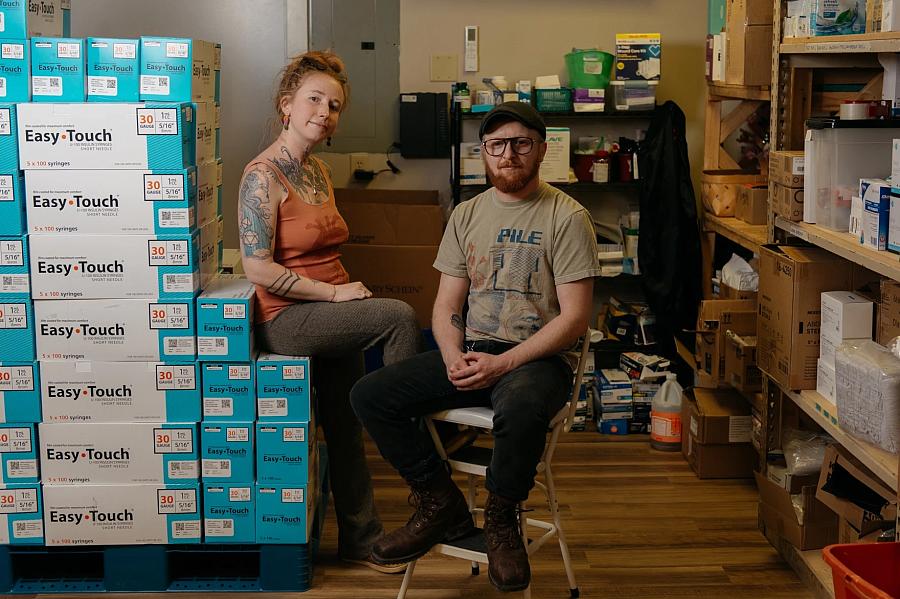
Harm reduction workers Kimberly Treadaway and Oscar Smith with a stack of needle boxes at Holler Harm Reduction in Marshall, North Carolina.
(Courtesy photo by Jesse Barber/Grist)
In reporting on substance use and disaster in Appalachia, I found myself constantly awash in new information. I was humbled by how much I did not know.
When I reported on the Kentucky floods of 2022 as a local reporter at WMMT and the Ohio Valley ReSource, I covered the network of disrupted and flooded recovery programs and rehab centers and spoke with people in those programs about their lives. Two years later, when reporting on Hurricane Helene with my team at Blue Ridge Public Radio, I traveled broken roads to meet people who were stuck at home, watched community members haul buckets of water up the stairs of public housing complexes, and noted closed hospitals, courthouses, and clinics. Even at the time, I knew that the worst times for a disaster survivor often come a year or two afterward, as stresses pile up — and for many the most difficult times had not yet arrived.
Recovery and safety for people with substance use disorder require stable, reliable forces like love, community connection, work, hobbies, or volunteering. Relapse and overdose also become more likely in times of instability, like losing a job or a home, and can worsen after traumatic events. And substance use often appears alongside other chronic mental and physical health conditions, such as work injuries, chronic pain, depression, and anxiety. It can aggravate those conditions while introducing new dangers.
As I embarked on my reporting as a Health and Climate Change Reporting Fellow, I quickly learned that reporting on substance use disorder is an entire beat in itself. There was the new language to learn, a dizzying array of acronyms to unpack. I consulted AP Style over and over again, but also kept my ear open to other reporters and health care professionals who had arguments around certain words and phrases.
The phrase “Meet people where they are” can feel overused, but it applied in this case. This was a delicate sourcing task, perhaps the most difficult I’ve ever had. I reached out to health care practitioners by phone and email, but in order to find people who were dealing with these issues firsthand, I relied on other means. I even attended a couple of local Narcotics Anonymous meetings, with permission from local leaders in the NA community, striking up conversations with participants and passing along my info. I printed flyers describing my story and gave them to harm reduction groups or hung them up in venues I knew were harm-reduction-friendly. I adjusted my outreach language over time, based on feedback from sources. I chatted people up in the line for hot food during a mutual aid fair. I found that people preferred to have the option to reach out to me rather than vice versa, and so I did not apply the usual reporter persistence, but rather awaited their call.
Sources were much more willing to share their stories than I had originally feared. Many felt their story could be an example for others, and maybe even lead to change. For Devon, a 40-year-old dad in recovery, that meant unpacking the post-Helene dissolution of his marriage and his reliance on his recovery community. For harm reduction staff, that meant going beyond Hurricane Helene to make sure I understood the social stigma that pervaded the environment many people grew up in, that made them afraid to seek help. I logged over 30 interviews, hours and hours of poignant tape, most of which were left, with difficulty, on the cutting room floor.
Every conversation yielded a new, surprising complication — like the fact that injecting heroin requires sterile water, and without that, a person can become infected and die. Or the fact that it’s illegal to distribute smoking supplies in North Carolina, despite the fact that smoking drugs can be safer than injecting them. Or the fact that many people in recovery are on methadone, a daily medication that requires physically going to a clinic, or Suboxone, which is a tightly controlled prescription drug that can’t be legally shared or stockpiled, so when pharmacies and clinics close, withdrawals can ensue.
There were also surprises. When I began in the winter, I came in braced for a lot of tragedy. However, in many cases, I heard stories of abundant donations and emergency provisions that brought people with substance use disorder into contact with more medical support than usual, or allowed them to access funds for home repairs or food. I also found that harm reductionists and health care workers, many of whom have their own histories with addiction, pulled out all the stops to reach people and make sure they were safe. Some drove their patients’ Suboxone prescriptions out to them on ATVs or walked over flooded roadways to deliver clean needles, knowing the alternative was infection or death, and knowing that any death was an unacceptable outcome.
These service providers were used to emergencies in a larger sense. The enormous wreckage of Helene came amidst the daily emergencies and changing political conditions they navigate every day. Those conditions both help them prepare for emergencies, and make it really hard to think ahead for the next one.
And through all of this, I realized that despite the fact that millions live with addiction to drugs and alcohol, there was little effort in emergency management to truly consider their unique needs during disasters. I began to ask questions like: What does it mean to put the most vulnerable at the forefront of emergency planning? How does substance use connect to disability and chronic health issues, and how can systems better contend with the unique health needs of disaster survivors? What policy changes might allow people with addiction or in recovery to navigate the aftermath more easily, so they can get to a stable place? How does stigma impact which disaster survivors get help first and most easily?
These questions impact all of us. No one in this region — and for that matter, probably few people anywhere, at this point — is untouched by overdoses and the health complications that come from substance use disorder. I’ve lost friends to it, and loved others through the roller coaster that is fundamental to substance use and recovery. I also have come to understand it as a very common chronic health condition — affecting friends, neighbors, family, parents, children, grandparents. Substance use is not part of some secret dark underbelly of society; it’s part of the fabric of life all around us, a reality that policy and health care systems must learn how to contend with as leaders work to save lives and improve emergency planning.