

Youth sudden cardiac arrest deaths are preventable, but the data on school responses is limited

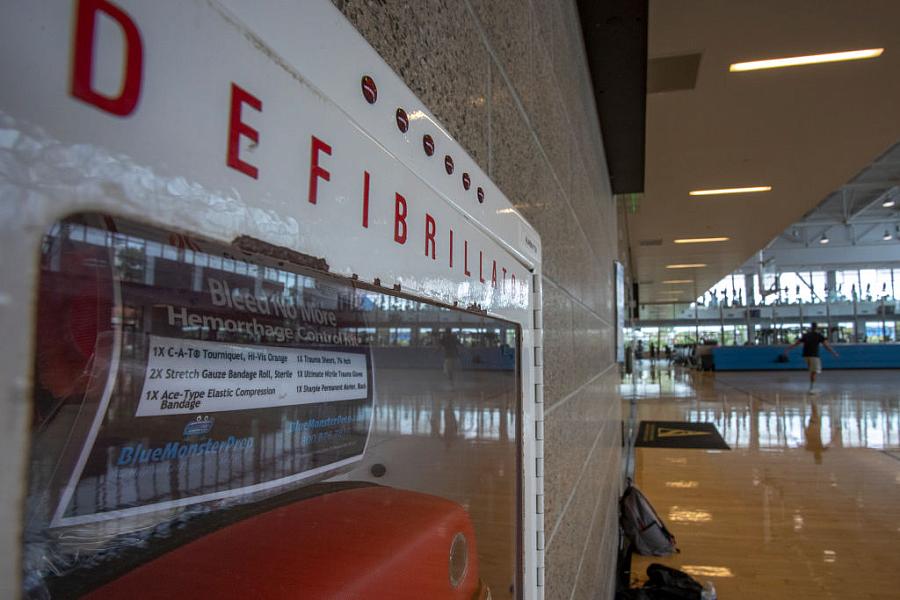
(Photo by David McNew/Getty Images)
Millions watched in shock when they saw the Buffalo Bills’ Damar Hamlin go into sudden cardiac arrest on live television last year during an NFL game. It’s since sparked more advocacy around sudden cardiac arrest, automated external defibrillators and CPR. But sudden cardiac arrest also happens in youth. The vast majority of young people who go into sudden cardiac arrest outside of a hospital die.
The rate of out-of-hospital pediatric sudden cardiac arrests in the United States is just over eight cases per 100,000 children annually. Many people say it’s rare. But when it happens to children, nine out of 10 times it’s fatal.
But this wasn’t the first time I heard about this happening.
I started looking into this topic after the death of a 15-year-old who volunteered with my friend in Indianapolis, Indiana. Legislators had introduced a bill to increase response rates when cardiac arrests happen at schools by requiring automated external defibrillators (AED) to be close by during extracurricular activities, but the bill failed. His death inspired me to look into a story about the difficulties of mandating AEDs in schools.
But there’s so much more to this story. Having accessible AEDs and an emergency response plan can boost survival rates to as high as 85% for students, 89% for youth athletes and 61% for adults. So how many are located in schools, and are schools with high populations of people of color prepared to respond to a sudden cardiac arrest? The cardiac arrest rate for Black students is more than four times as high as white children, my reporting found.
That was the main question I sought to answer during this project, supported by the Center for Health Journalism’s 2023 Data Fellowship. The Indiana Department of Education recently released data from a state survey that asked all of Indiana’s public, charter and private schools how many AEDs they had, and if they had an emergency response plan. Only 54% of schools responded, but researchers said it was still enough to provide a meaningful analysis of the situation.
Time constraints prevented me from reaching out and collecting more data on the schools that didn’t respond to the state survey. But if I could do this project over again, that is one thing I would aim to accomplish.
As I was analyzing this information, I sought out data from other states to see how Indiana compared to 13 other states in the Midwest. I found only one other state collected statewide data on the number of AEDs in schools.
I set out to answer a lot of data questions: How many children have died from sudden cardiac arrest in each state, and how many heart screenings have detected defects in children? But a lot of these questions couldn’t be answered in the timeframe of the project because there wasn’t sufficient data on some of these topics. The project was a lesson in going back to the drawing board and figuring out how to write meaningful stories with the data you do have.
If I report further on this topic, I would want to investigate the response times for first responders to arrive at schools and how long it takes them to reach sudden cardiac arrest victims. I downloaded statewide data on response times for each county, but I would suggest filing a records request to receive specific times for schools.
Surveying state policies around the country was also difficult. Some states require AEDs, while others only recommend or encourage them. Even if a state required them, the language didn’t always specify if AEDs were required to be accessible within three minutes, as recommended by medical professionals. The variations and intricacies in language made it difficult to determine how effective each law is for increasing response rates to sudden cardiac arrest.
I’m proud of this project and the value it has for the community. A bill to mandate AEDs in all Indiana schools was supposed to be introduced in 2024, but ultimately was held due to a short legislative session. It’s my hope this reporting will be referenced as lawmakers work to bring back legislation in 2025.