

He Survived Being Shot, Trauma Has Just Begun: ICE, Latinos, and a Public Mental Health Crisis
This story was co-published with Radio Bilingüe as part of the 2026 Ethnic Media Collaborative, Healing California.

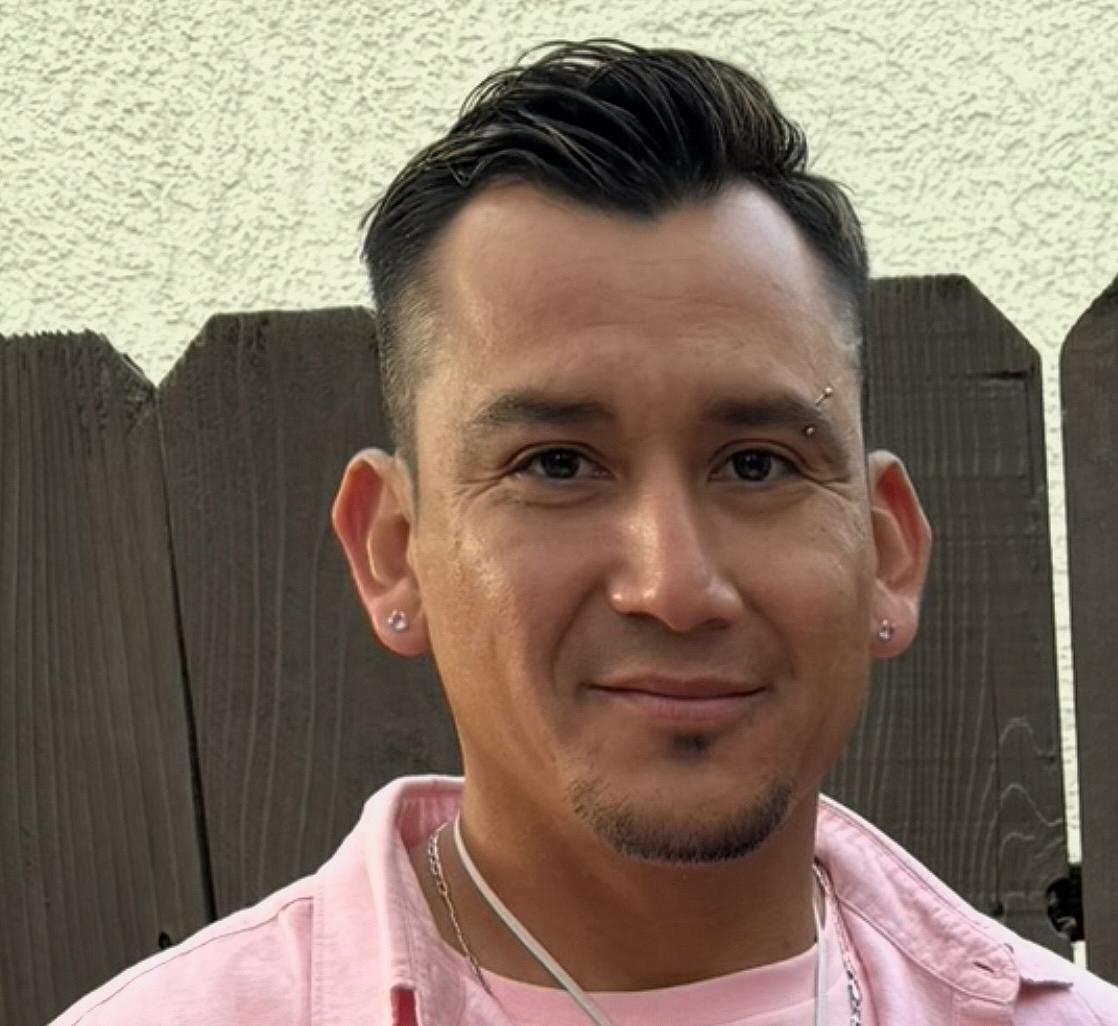
Carlos Iván Mendoza Hernández
Courtesy of the Hernández family
On the morning of April 7, Carlos Iván Mendoza Hernández was driving to his construction job in Patterson when ICE agents pulled him over. The situation escalated, and the agents shot him seven times. The 36-year-old Salvadoran has lived in the United States since 2020, is a parent to a 2-year-old daughter, and his partner, Cindy Ramirez, is a U.S. citizen.
Cindy: “That day, he woke up and left for work. I got up too, to get ready for work. On the way to work, I dropped our daughter off at daycare. It was a normal morning.”
Suddenly, what had been an ordinary day turned into a nightmare. Carlos and Cindy’s story is one of thousands across the United States where families live in constant fear of being torn apart before actually being torn apart. Research shows that these aggressive immigration policies pose an enduring threat to the health of Latino families creating everything from an elevated risk for suicidal ideation and alcohol use for adolescents to developmental regression and a long-term risk for psychiatric disorders in young children.
Even the threat of separation can generate profound emotional harm. Children in mixed-status families often live with chronic anticipatory anxiety that a loved one could be detained or deported.
Early Tuesday morning, ICE agents caught up with Carlos near Interstate 5 and activated their emergency lights. Carlos pulled over and parked on the right shoulder of the road.
Federal immigration agents were conducting an operation in Patterson, a city in California's Central Valley known as the world's apricot capital. Their target was Carlos. They wanted to arrest him, alleging that he was an 18th Street gang member wanted in El Salvador for questioning in connection with a murder. Carlos’ family and lawyer still have not determined why these accusations were made.
When the men identified themselves as agents with U.S. Immigration and Customs Enforcement (ICE), Carlos identified himself but refused to get out of the vehicle, according to the official report. Carlos attempted to flee, “violently collided” into an ICE agent’s car, prompting an officer to “jump out of the way to avoid being hit.” Carlos then pulled a U-turn and drove across the median, trying to drive away.
The video of the incident has no sound, but the footage shows an agent pulling out their gun; when the smoke cleared, Carlos had been struck in the face, mouth, and arm seven times.
Cindy: "Around one in the afternoon, I got a call from my sister saying that someone had called her and told her Carlos had been in an accident, that ICE had detained him, that he'd been shot, and that they needed to get in touch with me."
That someone was a reporter from KCRA News.
Cindy: "Honestly, I had no idea it was already all over Facebook and every other social media platform. No sheriff's deputy here in Patterson contacted me. The sheriff didn't contact me. No one from Stanislaus County contacted me. Nobody from the FBI contacted me either. I was the one who called the sheriff's office in Patterson myself."
Originally, according to the authorities, Carlos was being sought because they alleged he was a gang member—a claim for which no evidence has been presented, as his attorneys have repeatedly argued.
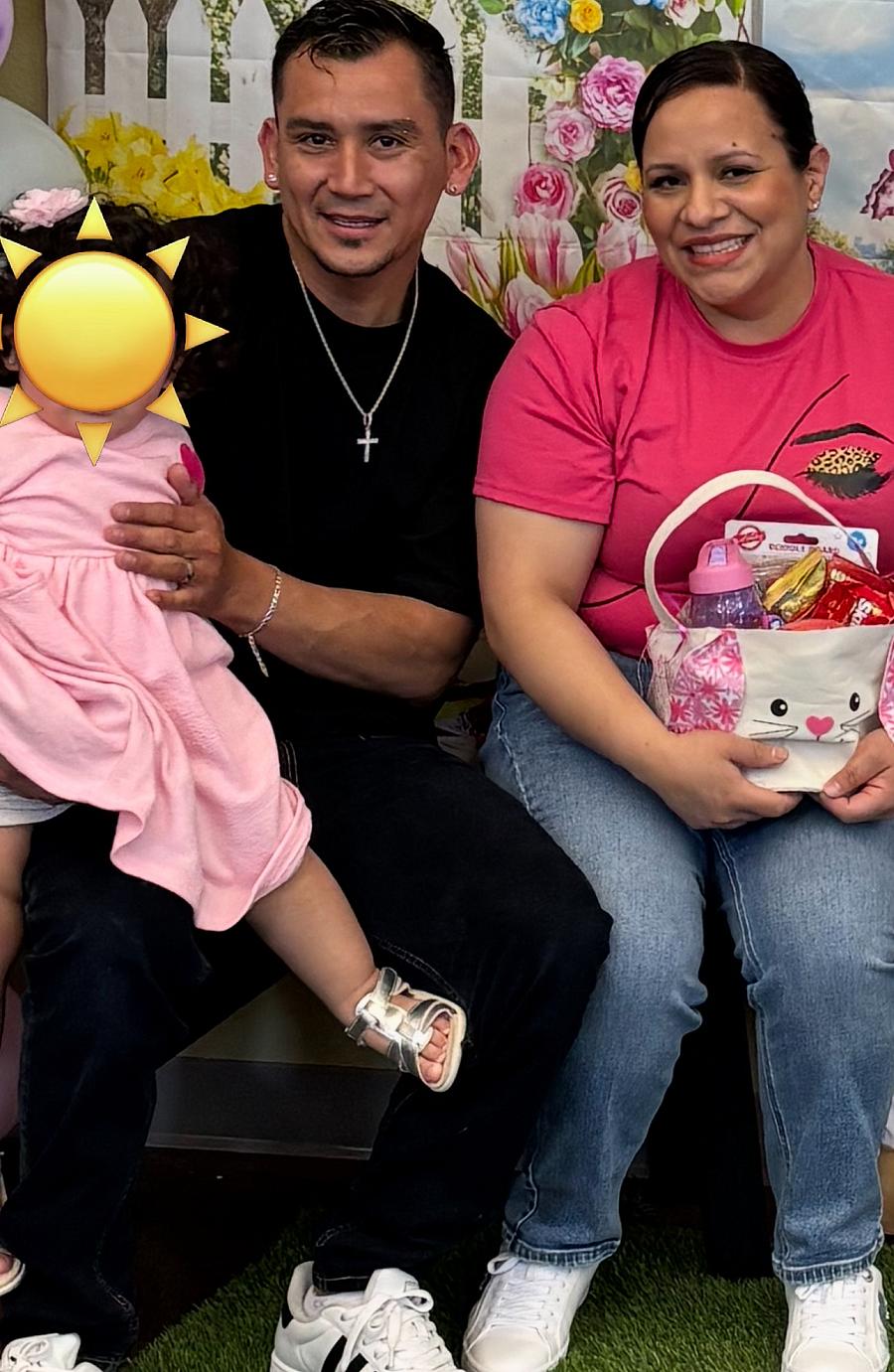
Carlos and Cindy sit with their two-year-old daughter on their lap. Cindy says that in the wake of Carlos' detention, their daughter has started displaying aggressive behaviors she never showed before.
Courtesy of Cindy
In the past four months Carlos' and his family's lives have become a blur of lawyers, paperwork, and a slow recovery from gunshot wounds.
Today, he is being held in California City facing charges of assaulting federal officers and destroying government property. As for his immigration case, authorities no longer link him to Salvadoran gangs due to a lack of evidence. Instead, his "offense" is that he lacks legal immigration status in the United States.
Meanwhile, his partner, Cindy, has taken on every responsibility at home. Like many women affected by the government's mass deportation policies — ICE arrests are 90% male — she has become the family's sole provider. She works six days a week as a regional director for a restaurant chain. She has had to rearrange her schedule so that at least once a week she can drive four hours each way to visit Carlos in California City Detention Facility for one hour. She depends on her mother and sisters to care for their daughter, who at 2 years old is not yet speaking but is already showing signs of trauma.
Cindy: "I do everything I can to stay strong and keep moving forward. But I've definitely been feeling more exhausted—physically and mentally."
The Hernández family's case is not an isolated one. Since the beginning of his second term, President Donald Trump has pledged to deport and detain as many people as possible, with a target of 3,000 arrests per day and at least one million each year. During the first year, the number of people detained by immigration authorities increased from 40,000 to 73,000—a 75% rise, according to the American Immigration Council.
These numbers have created a climate of fear for immigrant communities. A survey by the Kaiser Family Foundation found that four out of every ten immigrants worry about a family member being detained or deported.
Wendy: "We talk about immigration policies and immigration raids as political issues, but children and their families experience them every day through constant fear."
This is Wendy Cervantes, director of immigration and immigrant families at the Center for Law and Social Policy, a national organization that advocates for low-income families.
Wendy: "The effects of immigration policies are also an issue of child well-being and public health. It's important to recognize that shootings, violence, kidnappings, the absence of students, coworkers, and neighbors—all of this affects the entire community. And when communities no longer feel safe and families begin abandoning their routines and withdrawing from everyday life, that becomes a public health crisis."
The organization published a study detailing the impact of immigration raids on children. It concluded that the trauma children experience has long-term effects on their development.
Wendy: "Over the years, I've spoken with children who have lost a parent to detention or deportation, and they've told me, 'Sometimes it feels the same as losing a dad because he died. But every day I still worry because I don't know what's going to happen to my dad. I don't know if I'll ever see him again, or if he's okay'—or whether she's okay, if it's their mom. They live every day with that uncertainty and that worry, along with the feeling of an absence that was caused by the actions of their own government."
According to a report, forcible separation is recognized as an adverse childhood experience (ACE) and “abrupt caregiver loss has been linked to sleep and appetite disturbances, emotional dysregulation, and developmental regression.”
Not long ago, Cindy and Carlos's daughter turned 2 years old. Her mother described her as a happy, independent little girl who, until recently, could quietly entertain herself in the living room or her bedroom. She shared a special bond with her father.
Cindy: "Her priority was always her dad. Every afternoon when he came home from work, she knew he had arrived because he'd whistle as he opened the front door. She would come running to hug him, and from the moment he got home, she wouldn't leave his side. Now that he's gone, her behavior has changed. It's like she's afraid people are going to abandon her."
Dr. William López is a professor at the University of Michigan School of Public Health who studies the effects of deportation on Latino families and communities.
Dr. López: "Living with this uncertainty increases the likelihood of anxiety, depression, and PTSD."
PTSD stands for post-traumatic stress disorder.
Dr. López: "Because we don't know exactly what's going to happen to our parents, our cousins, our mothers—whoever it may be."
The day Carlos was shot and never came home, his daughter refused to go to sleep.
Cindy: "Our bedroom is upstairs. She went to the door and stood there crying in front of it."
Since then, Cindy says a lot has changed in her behavior.
Cindy: "She got sick, and she stopped eating too. She used to enjoy whatever food she picked up. It didn't matter what my mom cooked for her—or whatever little snack was around—she always wanted to eat. Now she throws it away or says she doesn't want it. She gets upset and throws tantrums. Her behavior is completely different."
Cindy told me that her daughter sometimes seems angry and frustrated, and has started displaying aggressive behaviors she never showed before, like hitting and slapping. Even dropping her off at daycare has become difficult.
Cindy: "Every day when I take her, it's a constant struggle because she doesn't want to stay. She clings to me and hugs me tightly. The daycare provider has to distract her with toys or activities so she'll feel safe enough to stay."
Wendy, from the Center for Law and Social Policy, says that very young children really feel the loss of a parent.
Wendy: "They feel that absence. That's when you see things like children who don't want to separate from their parents when they're dropped off at school. Children who can't sleep, who cry constantly, who stop eating. Those are the ways very young children express their anxiety."
When Cindy took her daughter for a medical checkup, the pediatrician referred her to a specialist.
Cindy: "Those changes in her relationship with her dad have been so drastic for her. From her perspective, her dad abandoned her—that's what the doctor explained to me. She also feels rejected when she talks to him."
Since Carlos was wounded and taken into custody, most of his contact with his daughter has been through video calls. Cindy tries to make sure they talk every day, but it isn't always easy. Their daughter isn't used to interacting that way.
Cindy: "Some days she wants to see him, and some days she doesn't. I feel like she's the one who's suffered the most from his absence. It's hard for him too. Every day he calls me and asks about her. He wants to see her on camera. He says, 'It's the only way I have to stay connected so she won't forget me.'"
Cindy and Carlos's story illustrates how closely mental health and immigration policy are intertwined. On one hand, there's what happens behind closed doors—the family's private pain and grief. On the other, there's what happens in the broader community.
After Carlos was taken on April 7, simply trying to move forward and rebuild what had been shattered became one challenge after another for Cindy. Even something as simple as going to the neighborhood grocery store filled her with anxiety because of how neighbors in Patterson reacted to the accusations against Carlos.
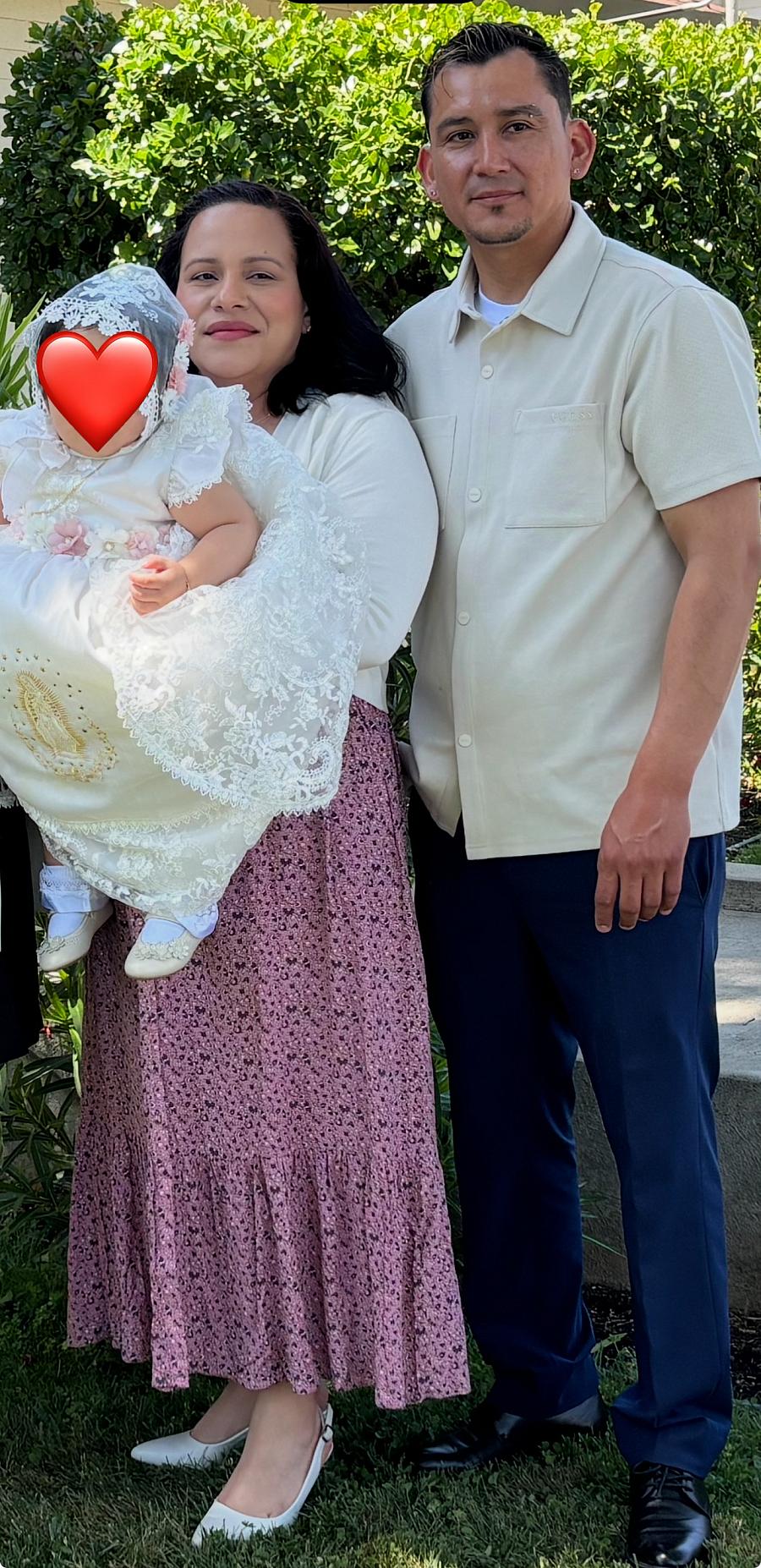
Cindy says the changes in her daughter have been drastic. "From her perspective, her dad abandoned her—that's what the doctor explained to me."
Cindy: "People's first reactions—because of all the labels they put on him—were hatred. They wished he would die. They wished the worst for all of us. People from our own town were basically against us."
Remember that Carlos was accused, without evidence, of being connected to extremely violent gangs. Dr. López explains how losing one's social support network can harm a person's health.
Dr. López: "You can't maintain your health if you're afraid to leave your house, if you can't be with your community, attend church, or spend time with your family. What happens after a raid, an arrest, or a deportation is a profound loss of trust—in the government, in neighbors, and in the life you had before that event."
Cindy says she knows exactly what he means.
Cindy: "I've definitely felt that way—especially the anxiety. Anxiety that makes me constantly check social media, trying to find more information. Anxiety that pushes me to educate myself about immigration law. At night I'm often awake looking up new cases, trying to figure things out. Whenever I see members of Congress or senators talking about cases like ours, I click on their profiles and try to reach out to them. I send them information directly. It's mentally exhausting."
The lack of information—and what she describes as misinformation about Carlos's case—has only added to Cindy's anxiety. During one of their phone calls, Carlos told her he might be transferred to another state. That night, she didn't sleep.
Cindy: "We were terrified that they might have moved him. The problem is that they don't give us any information about his detention. I called the attorney directly and asked, 'Is this really happening? Can you find out?' He said, 'They won't even give me any information.'"
Because Carlos had been shot, he also required ongoing medical care—care that was not guaranteed in the detention center.
Cindy: "They knew Carlos had already undergone four surgeries before he was taken into detention. They knew he still had stitches that were supposed to be removed after a certain number of weeks. They didn't remove them until almost a month later, and that only happened because we kept pushing. It's a constant source of stress for us—not knowing how he is, where he is, especially after everything he's been through. In my mind, I'm afraid that one day they'll do something to him to erase the evidence and completely wash their hands of what happened."
Meanwhile, the family is waiting for a court hearing scheduled for October 19—more than six months after the April confrontation.
Cindy is now attending therapy. As she waits for the hearing, she carries the responsibility of keeping herself, her daughter, and Carlos hopeful.
Cindy: "Right now I feel like my hands are tied. I don't even know how to describe it. It feels like doors keep closing. Every day I'm going to have to keep encouraging him because there are days when he's completely overwhelmed. He says, 'I can't do this anymore. I just can't anymore.'"