

The Post-Roe Surprise: More Abortions
The story was originally published in Reveal with support from our 2026 National Fellowship.

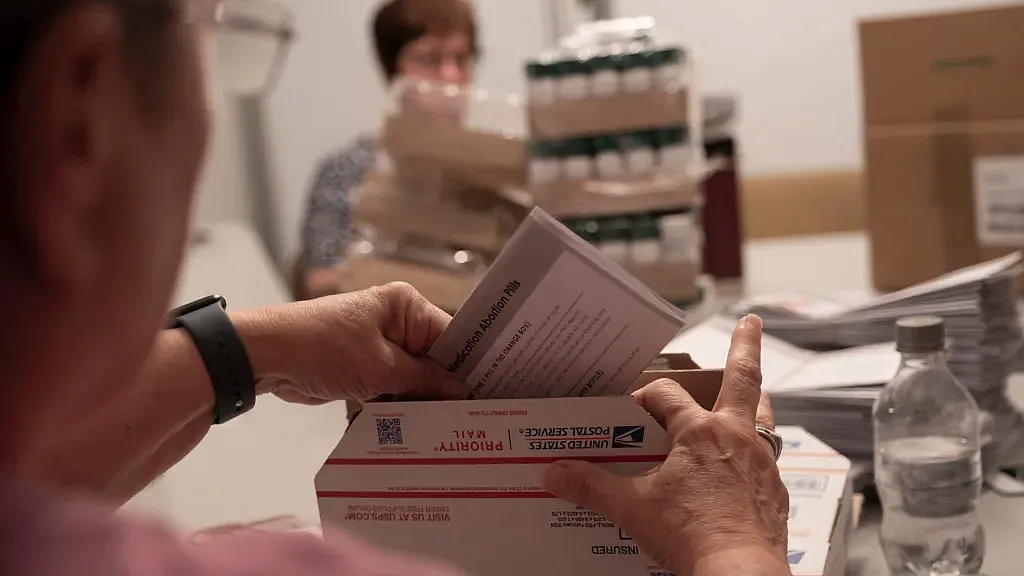
Volunteers at an abortion pill provider work around a conference table to pack 500 boxes to be sent to people in all 50 states.
Credit: Emily Schiffer
Access to medication abortion in the years since Covid and the fall of Roe v. Wade has completely reshaped the abortion access landscape in America.
“There’s this irony that’s actually happened,” says Dr. Angel Foster, an abortion provider and researcher. “Tragically, 33 to 40 percent of women of reproductive age now have less of a right to an abortion. But access for many people has increased.”
Foster is the founder of the Massachusetts Medication Abortion Access Project, a clinic whose work is one major player in why abortions are up. Massachusetts and almost half the states in the US have passed shield laws that legally protect abortion providers. The one Foster operates under allows her to prescribe abortion pills to patients in states with abortion bans.
And while the battleground may be shifting as medication abortions grow more common, the war is far from over.
This week on Reveal, we explore post-Roe America through the eyes of three women with three very different missions: Foster, who offers medication abortions nationwide; a courier who risks arrest to stockpile abortion pills for an uncertain future; and a conservative activist whose life’s work is trying to stop them both.
On this Aug. 1 episode, we explore post-Roe America through the eyes of three women with three very different missions, including reporting by reporter Rebecca Grant on a courier who risks arrest to stockpile abortion pills for an uncertain future; and a conservative activist whose life’s work is trying to stop them both.
Transcript
Reveal transcripts are produced by a third-party transcription service and may contain errors. Please be aware that the official record for Reveal’s radio stories is the audio.
Al Letson: From the Center for Investigative Reporting and PRX, this is Reveal. I’m Al Letson.
Judith Arcana: In the early summer of 1970, I thought I was pregnant.
Al Letson: This is writer, teacher, and activist Judith Arcana. In 1970, she didn’t want to be pregnant, but she was living in Illinois where, like most of the U.S., abortion was illegal.
Judith Arcana: I called a friend of mine who was a medical student, and he said, “Everybody here says call this number and ask for Jane.”
Al Letson: So she did. The woman she spoke to wasn’t really named Jane. She was a part of an underground network of women in Chicago who helped people get abortions in the years before Roe v. Wade. Today, they’re widely known as the Jane Collective after the pseudonym they used over the phone.
Judith Arcana: Ultimately, I discovered after a very long time that I was not pregnant and called her back to tell her that, and I was extremely interested in what they were doing. And she said, “Well, we’re taking in new counselors in the fall and I’ll call you.”
Al Letson: So Judith became a Jane. The Janes started out as a referral network, fielding phone calls, making appointments, and counseling patients on what to expect. They found a guy they trusted to perform most of the abortions, and eventually he taught them how to do it themselves. While they were active, the Jane Collective helped over 11,000 people have safe abortions. Here’s one of Judith’s collaborators interviewed in the same 1995 documentary, Jane, An Abortion Service.
Speaker 3: We wanted to change the system. We wanted to create a reality in which women were in control, and we did.
Al Letson: In 1973, after Roe v. Wade protected abortion rights, the Janes disbanded, but their legacy lived on. Fast-forward to early 2022 when Roe was under threat. Reporter Rebecca Grant suspected that the U.S. was about to see a resurrection of Jane-like networks, and she was right, but this time they’d have different tools, the internet and medication. Now, as attacks on abortions escalate, these networks are scaling up too. Here’s Rebecca.
Rebecca Grant: When Lena walks into the cafe near the airport, she looks like any other traveler ordering coffee before catching a flight. It’s early, and Lena is tired after a night of tossing and turning, mostly from jet lag, but she’s here for an important meeting, one she can’t miss.
Lena: I am a sweaty girl. So the first meetup, I was sweating pretty profusely, but I’m much more comfortable now.
Rebecca Grant: This isn’t Lena’s first meeting like this. It doesn’t always happen in a cafe. It could also be another public place, like a hotel lobby, or once a parking garage. But Lena’s been to this cafe before. It’s convenient, and since it’s so close to the airport, there’s nothing weird about walking in with a suitcase. Lena sits at a table and tries to remain incognito. About five minutes later, she spots the person she’s meeting, walking in with their own luggage. They’ve met before.
Lena: I’m watching for them. They always come and say hi first.
Rebecca Grant: Lena’s not her real name and this isn’t her real voice. We’ve hired an actor to protect her identity because these trips could get her in legal trouble. I also can’t tell you much about her, where she flew from, or where the meeting took place. What I can tell you is Lena is a courier, an activist who helps sneak abortion pills into the U.S. And this meeting is with an abortion pill supplier. Lena is part of a community network that mails abortion pills around the country for free. These networks are listed on some of the same websites as official telehealth providers, but they aren’t run by doctors and they don’t abide by the same regulations. Their goal is to make safe abortions as low barrier as possible, even and especially in states with bans.
Lena: I think to sum it up, community networks are not bound by the law, and especially unjust ones. I mean, these laws never stop abortions. They only affect the health and wellness of pregnant people. So we are here to do what we can for those who are turned away from standard medical healthcare.
Rebecca Grant: You can’t just bring prescription medication into the U.S. and distribute it without risking arrest, prosecution, and jail time. That’s true for any drug, not just abortion pills, but it’s hard to think of other medications that are as intensely politicized. So when I first started reporting on the modern abortion underground, I was surprised anyone was willing to talk to me.
In the spring of 2022, I received a message on Signal from a new source. She told me she got her start during COVID when abortion clinics across the country shut down overnight. She had a way to get Misoprostol and took it upon herself to mail the pills to people locally who needed them. At first, it was mostly a one-woman operation. She served a couple of people a month who all found her through word of mouth. But around the time we started talking, when it was clear that abortion rights were on borrowed time, her vision got bigger. She started a recruiting effort, and one of the people who joined up was Lena.
Lena: I broke up with my boyfriend. That’s when I started. And I think that that really made a difference where I was like, “I have all of this extra time and energy and feel this purpose to be doing something.” I mean, I always felt like I should be doing more, but you know how boyfriends can be draining.
Rebecca Grant: When I first spoke to Lena, it was 2023, and she was not a courier yet. Her first job with the community network was as a mailer, a person who packages and ships the medication to people who need it. Over time, she proved she was trustworthy and was invited to take on more responsibilities.
Lena: It was a small group of us at a table, a very intimate conversation going into pretty full detail about what couriering would require. And it took a little bit of consideration and a little bit of thinking about what you would do if something went wrong and coming up with kind of a story if you were to get asked questions in the process. And then from there, it was a pretty easy decision.
Rebecca Grant: Lena is well aware of the risks and sees herself as well positioned to take them on. Some people in the network have partners, kids, important jobs, elderly parents they care for.
Lena: I would rather be the one taking the risk where I don’t have as much to lose as many other folks. That’s a big factor.
Rebecca Grant: In the early days, when the networks were just getting off the ground, they connected with a prominent and very public abortion activist in Mexico named Veronica Cruz Sanchez or Vero, who offered to share medication from her own supplies. All the network had to do was pick up the pills and bring them back across the border. And they did, hidden in decoy prescription and over-the-counter pill bottles. But when demand for pills surged in the months after the fall of Roe, the networks couldn’t rely on Vero’s reserves anymore. They had to establish supply chains of their own.
And because they aren’t doctors and nurses writing prescriptions, it’s not like they can source from FDA regulated pharmacies. So they turned to India where most of the world’s generic drugs are manufactured, and there was no shortage of pharmaceutical entrepreneurs willing to sell both mifepristone and misoprostol, what’s considered the gold standard for medication abortion?
Lena: The drugs are high quality generic pills. They’re carefully packaged and an excellent price.
Rebecca Grant: So it turned out that the challenge wasn’t sourcing the medication. That was surprisingly easy. The real issue was getting it into the U.S. The networks have experimented with a few different approaches like international shipping, but it tends to be slow and expensive, and they’ve had packages get confiscated by customs. Smaller quantities get through okay, but limit how many people they can serve.
Lena: So we luckily were able to find this workaround.
Rebecca Grant: The workaround is Lena and other couriers, people willing to fly abroad and pick up the pills in person. Believe it or not, it winds up being cheaper, even with the expense of international travel. And as a courier, Lena can hide in plain sight, another anonymous traveler in a sea of millions. The more trips she takes, the more dialed in her travel routines get. She’s invested in more durable luggage, so she never has to worry about her stuff getting wet or smushed. She packs lighter than she used to, and she always parks in the same place at the airport, so she’s not anxious about finding her car later. She even has specific music she listens to settle her nerves.
Lena: I’m going to out myself, I’m a Swiftie, so I do have particular poppy song playlists of hers.
Rebecca Grant: A lot goes into these trips and a lot is riding on them. But for all the planning and high stakes, the meeting at the cafe on Lena’s recent trip is quick and easy, uneventful.
Lena: I usually empty one of my suitcases and bring that with. The supplier will go into the bathroom and do the transfer into my suitcase that way.
Rebecca Grant: It only takes a couple of minutes, and then they hang out and talk.
Lena: Most of the time it’s almost like we could be medical people discussing innovations and research.
Rebecca Grant: Right. You could just be two people on a normal business trip type thing.
Lena: Yes, hopefully. Hopefully that’s what it looks like.
Rebecca Grant: Has anyone ever seemed too interested?
Lena: No, but at one point there was a technician working on something in the same room, and that made me uncomfortable. Is this their cover, that they’re a technician? But that was just the unwarranted paranoia creeping in.
Rebecca Grant: The meetings can be anywhere from 45 seconds to two hours. Her usual contact is a good talker and will linger if they don’t have another appointment to get to. And Lena savors their conversations because of the sense of freedom she feels.
Lena: It is nice to nerd out in safe places with safe people because no one in my real life knows what I do.
Rebecca Grant: Community activists practice strict operational security. They use aliases even when talking to each other, which they only do on encrypted channels. The same goes for their conversations with me. And the different roles like mailers and couriers are kept separate. That way, if someone in one role gets caught, the entire network doesn’t have to shut down. And no one Lena knows has been caught yet.
Lena: I don’t want to say anything that will jinx us. That’s why I’m not going to say what I want to say, but it’s been very successful so far, and we are hoping it continues to be.
Rebecca Grant: Before her return flight, Lena runs through rituals to help her stay calm. She mentally reviews her backstory for why she’s traveling in case anyone asks. And she does an exercise a therapist’s friend recommended where she visualizes herself arriving home with no issues. When she actually lands in the U.S., that’s when the anxiety really sets in. Because if she’s going to be caught, this is probably when it would happen. That’s why she describes this part of the journey as moving through steps of relief.
Lena: I get off the plane and there’s no one waiting to take me into questioning, and that’s a bit of relief. And then I go through customs, and then that’s a bit of relief. And then I go through and get my bags, and that’s a bit of relief. And then I actually make it to the car and out of the parking garage, and I fully relax. We are rolling the windows down. We are putting on the music, and we are taking big, deep breaths.
Rebecca Grant: Are we putting on Taylor Swift?
Lena: We are. Not The Tortured Poets Department, just the pop.
Rebecca Grant: Lena puts herself through all of this because she believes abortion access needs a fail safe. If the Comstock Act gets enforced or another challenge to abortion pills by mail is successful, it will be a major blow to telemedicine abortion, but it won’t stop these activists. In fact, they anticipate that volume to their networks will double, maybe even triple. They’re preparing accordingly, in part by recruiting new couriers and by sending established couriers like Lena on more supply runs.
Lena: No one’s coming to save us. We have to save ourselves. This is one of the most tangible acts of resistance you can get. I mean, who doesn’t love a protest and a sign waving exercise? But I’ve done a lot of those and I’ve knocked on a lot of doors. I’ve made a lot of phone calls and you can’t feel any of those results. And this has real results.
Al Letson: That story came to us from Rebecca Grant. Kirsten Salpini is the voice actor who played Lena. You can read more of Rebecca’s reporting on community networks and abortion activism in her book, Access: Inside the Abortion Underground and the Sixty-Year Battle for Reproductive Freedom. Our lead producer for this week’s show is Sophie Bridges. Additional field recordings were done by Rachel de Leon, Anna Yo, and Peter Berger. Jenny Casas edited the show. She had help from Nina Martin and editorial support from Marianne Szegedy-Maszák.
Additional production support from Maddie Oatman and Steven Rascon. Kate Howard was the executive producer for this episode. Artis Curiskis is our fact checker. Victoria Baranetsky is our general counsel. Our production manager is the great Zulema Cobb. Score and sound design by the dynamic duo, Jay Breezy, Mr. Jim Briggs, and Fernando “My Man, Yo” Arruda. They had help today from Claire “C. Note” Mullen and Cameron Smith. Taki Telonidis is our deputy executive producer. Our executive producer is Brett Meyers. Our theme music is by Camarado Lightning.
Rebecca’s reporting was supported by the USC Annenberg Center for Health Journalism. Support for Reveal is provided by The Reva and David Logan Foundation, the John D. and Catherine T. MacArthur Foundation, the Jonathan Logan Family Foundation, the Robert Wood Johnson Foundation, the Park Foundation, the Smith Family Foundation, and the Hellman Foundation. Support for Reveal is also provided by you, our listeners. We are a co-production of the Center for Investigative Reporting and PRX. I’m Al Letson. And remember, there is always more to the story.