

Beyond the Headlines: Reporting on immigrant children’s mental health in a moment of crisis

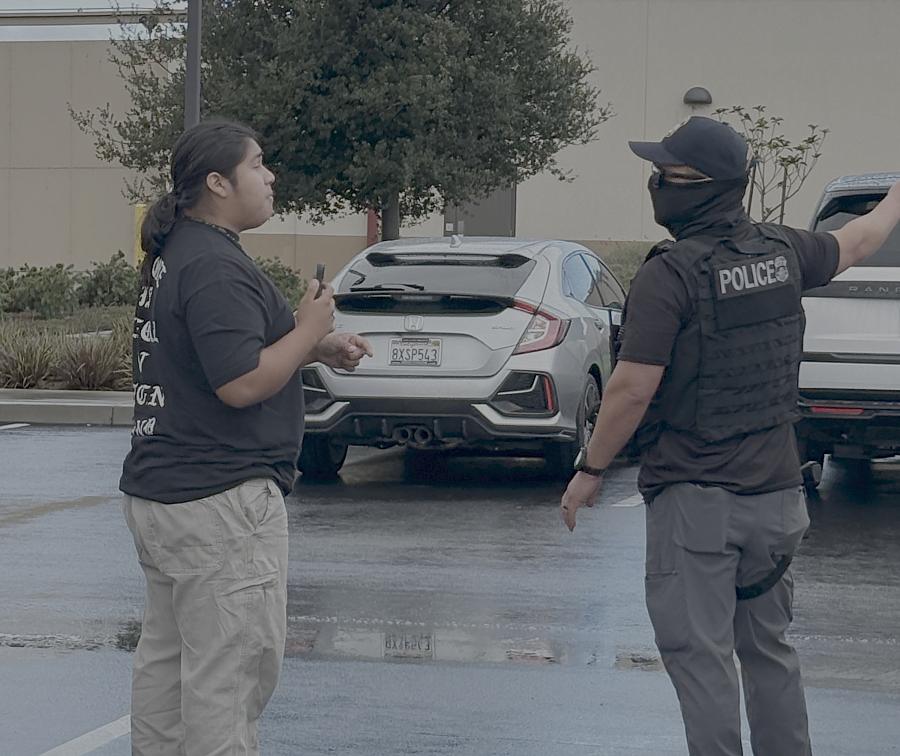
Cesar Vasquez, an 18-year-old rapid response organizer from Santa Maria, California, confronts an ICE officer in front of the Santa Barbara County Jail.
(Photo by Jennifer Chowdhury)
When I began reporting what would become the “Invisible Burdens” project on the immigration crisis and mental health, I knew the relevant research existed. What I didn't know was whether families would talk to me or whether, given the political climate, they could afford to.
The project grew out of a simple observation: Immigration and mental health were both front-page stories, but almost no one was covering them together, and almost no one was centering children. My goal was to document how immigration enforcement shapes the psychological lives of kids — not just undocumented children, but U.S.-born citizens in mixed-status households, DACA recipients, TPS holders, and their families. The resulting work included a longform investigation published by PRISM on the mental health crisis among children of immigrants, a reported piece on my newsletter, Port of Entry on what happens to children taken into ICE custody, and a profile for The Guardian of Cesar Vasquez, an 18-year-old organizer in Santa Maria, California.
Here's what I learned:
Lead with the child, not the policy
The instinct in immigration coverage is to anchor the story in policy. But readers reach the policy more readily when they arrive there through a person.
Lily Martinez, a 16-year-old from Queens, told me she no longer wanted to leave home for college. That single sentence from her — the collapse of a teenager's future ambitions into fear — communicated what no statistic could. With Cesar Vasquez, I spent time understanding the full arc of his life: his mother's border crossing at 13, his own fourth-grade education in warrant law, the ICE agent who taunted him through a car window. Those details gave the story emotional resonance with readers while the policy context gave them weight.
Build trust before you need it
In a reporting environment where families have real reason to fear visibility, access comes from building relationships. For the Santa Maria piece, I spent time with Vasquez before asking him to introduce me to his family and community. I interviewed him a few times over Zoom and developed a rapport before I flew out to California to ride along with him for a few days. For the PRISM piece, community organizations and nonprofits were essential bridges.
Trust compounds. Once one family spoke with me, others were more willing. And once sources saw that I handled their stories carefully, that I didn't sensationalize things, didn't expose details they hadn't consented to share, didn't flatten their experiences into data points, doors opened faster. I am working on follow-up pieces from this project because sources who previously refused to talk to me are now coming around. This is slow reporting that often resists the news cycle. But for a project covering vulnerable children, it's the only kind of approach that’s ethical in my view.
Be transparent about what you don't know
The research on immigrant children’s mental health is growing but still sparse, and I tried to say so plainly in my reporting. The studies I cited were real and rigorous — a 2021 national study linking childhood parental deportation to adult PTSD, the European Child & Adolescent Psychiatry study on detained children, the Journal of Marital and Family Therapy findings on Latinx children of undocumented parents. But I was careful not to overstate causality or imply the science is more settled than it is.
For journalists new to this beat: familiarize yourself with the difference between correlation and causation in mental health research, and be precise when you write about it. “Associated with higher rates of” is not the same as “x causes y.” Readers trust you more when you’re honest about uncertainty.
Find the expert who also has skin in the game
Several of my most valuable sources were researchers who were also personally connected to the communities they study. Herlin Soto Matute, a psychologist I interviewed for the PRISM piece, grew up in a mixed-status family herself; her doctoral work was motivated by her own experience with TPS precarity. Leisy Abrego, a UCLA sociologist, has spent decades inside these communities. Their insights were sharper and their quotes more vivid because they were speaking from lived and professional experience. Proximity to a lived experience is its own form of expertise.
Let children speak for themselves
Interviewing minors for stories about trauma requires extra care. I always obtained parental or guardian consent, was transparent with families about how the story would be published and distributed, and gave sources the opportunity to review direct quotes attributed to them before publication. I also thought carefully about what details to include. When Claudia Santos disclosed past suicidal ideation, I included it because she offered it herself and because she was speaking about her own history in the context of a public advocacy role — not because I solicited it. There was more that she offered but wasn’t necessary for the piece, so I didn’t include it.
When in doubt, err toward protection. A detail that makes a story more vivid is not worth exposing a child to risk.
The story is never just local
Each of my pieces was rooted in a specific place — Queens and Santa Maria, for example. But the mental health crisis I was documenting is national, and I tried to make that legible without losing the texture of the local.
For the Port of Entry piece, my entry point was Yuanxin, a 6-year-old boy who entered 26 Federal Plaza in Manhattan for a routine ICE check-in with his father and didn't come out. He was transferred to the Office of Refugee Resettlement while his father was sent to a county jail more than an hour away. It’s a New York story: Yuanxin was a first grader at a school in Astoria, his teacher described his absence in the classroom every day — but it's also a story about what happens to children in federal custody everywhere. Federal data showed more than 2,600 immigrant children arrested nationwide that year. Cesar Vasquez is from Santa Maria, but his march against ICE raids drew participants from 17 states. Find your entry point geographically, but structure the piece so readers understand the scope.