

Reporting on gender exploratory therapy challenged my preconceptions

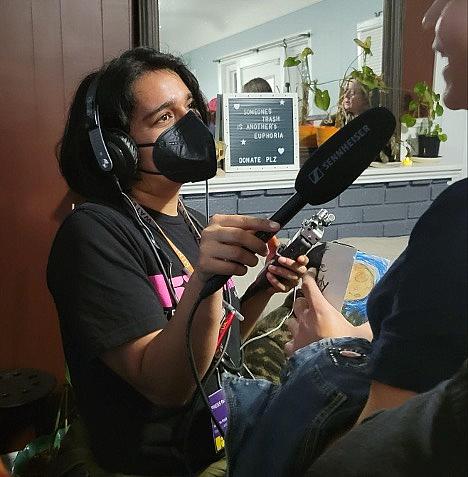
Reporter Hanisha Harjani interviews a community member in Cincinnati, Ohio at a Trans Day of Remembrance event made possible by a Center for Health Journalism engagement grant.
Photo by Teena Apeles/Center for Health Journalism
I pitched a story about gender exploratory therapy after falling into a rabbit hole.
I first heard about the practice from Aly Gibbs, a columnist and researcher at Assigned Media. I was interviewing her in 2024 for a story I was doing for Trans Day of Visibility. I wanted to talk to trans journalists about how the media was portraying trans people.
Aly noticed that a lot of times, when she was reading news about trans people, groups with anti-trans ties were portrayed as a neutral third party. And so she started working on a project that documented these ties. She told me that she thinks it’s important to place these people “in the context of their anti-trans rhetoric.”
Aly gave me the example of gender exploratory therapy, which she said was basically conversion therapy rebranded. It’s a practice that emphasizes the use of talk therapy as the first (and sometimes only) treatment for gender dysphoria.
When I learned about the practice, my mind immediately went to the trans youth on the therapist’s couch. I wanted to understand how the practice impacted them. From the start, one of my main goals with this project was to get trans kids on the record, speaking for themselves. In so much media, I noticed that trans kids were talked about but not heard from. I did not want to replicate that in my reporting.
I was lucky enough to get an engagement grant, which allowed me to spend time dedicated to doing outreach work. I knew I would need to be intentional and patient with how I reached out and built relationships in this community if I wanted to tell the story of someone who had gone through the practice.
That’s when I learned my first lesson.
Control can make you rigid. Stay curious, instead.
I had a lot of ideas of what this story was going to be about when I first pitched it. I started working on it in the lead up to the election, when Trump was campaigning on a platform built on anti-trans rhetoric. There was a lot of fear in the air, in the conversations I had with sources — many off the record. It got worse when Trump was elected.
I had dozens of one-on-one conversations with people who supported trans youth across the country. I made a questionnaire that I distributed to them as well as to other LGBTQ+ groups. Through the engagement grant, I even helped coordinate an open mic gathering in Ohio for Trans Day of Remembrance.
When I said that I wanted to interview trans youth about their experiences with gender exploratory therapy, I was looked at with weariness, suspicion, and doubt. I could see the mental calculations people were doing in their heads. For many of them, going on the record in any capacity felt risky. Bad news coverage can and had done damage to the trans community before.
Many youth experiencing this kind of therapy might not be in family situations where their guardians would provide consent to speak with the media. I was once almost connected to a family, but they ended up deciding they did not want to talk to me because they were feeling shame about the experience.
I was experiencing a quintessential reporting experience — I was getting rejected. And, as a journalist, I’m used to getting rejected. I practically expect it. But this rejection was getting to me in a way that I hadn’t ever experienced before. There was a stretch of weeks where working on this project felt impossible. I realized that I felt like I was being rejected by my own community which impacted me more deeply than I was anticipating.
I took some intentional time off to recenter myself and I also let go of the idea that this project had to address gender exploratory therapy through a specific story frame. I stepped back, zoomed out, let myself be curious, and learned another lesson.
Get creative about who your experts are
During the time I was taking off from the project, I saw that the term gender exploratory therapy was popping up more — and in some significant places, too. The Department of Health and Human Services mentioned the concept in a on pediatric gender dysphoria published in May 2025.
I decided to rework the story to explore why this relatively new and controversial therapeutic modality was now being recommended by a federal agency. To tell this story, I needed to talk to the architects of the document, but my messages to the Department of Health and Human Services went unanswered. I thought about who else could talk to me about the HHS report. I decided to interview Lindsey Dawson, who analyzed the report for KFF. By interviewing someone who analyzes and researches LGBTQ+ health policy, I was able to paint a picture of the report and the context under which it came about.
I also reached out to Liv Raisner. I had seen a video of them going undercover to see a gender exploratory therapist. Being able to talk to them about their experience helped me represent the experience of someone who had gone through the process. They were very open to talking, in ways that more vulnerable youth were not.
Getting creative about who I interviewed about the practice allowed me to tell the story even when certain sources were being withholding.
I came across this issue again when reaching out to the people who shaped the concept of exploratory therapy. I contacted several people for interviews but no one I reached out to would go on the record with me. This time, it wasn’t enough to find experts who could represent their perspectives. That’s when I learned lesson number three.
Archives are your friend.
The architects of gender exploratory therapy also would not speak to me on the record, but there was a lot of content out there on the internet where they talked at length about their beliefs. From podcast episodes to keynote speeches at conferences, there was a plethora of information that could help me paint a picture of the people behind this picture.
Fair use allows limited use of copyrighted material without permission for purposes like commentary, criticism, or news reporting. I consulted with the Reporters Committee for the Freedom of the Press to make sure that the sound bites I clipped were covered under fair use.
Using archives to shape this part of the story allowed people to speak for themselves and let me represent the perspective of the side I was investigating more fairly. I was also finally able to see the story take form.
My final and fourth lesson was simple.
Trust the process.
At times, this story felt impossible but it came together with creativity and support from editors, mentors, and peers. There were times when I felt like I was reporting myself into a corner, but I found that I can always get myself unstuck by looking at things through a new perspective.
I came into this project thinking that I was going to be telling one kind of story — what I ended up with was very different but it allowed me to see that stories will take the shape they are meant to.
It showed me that sometimes reporting looks like curating and contextualizing other people’s work in a new context. By tapping into the research that had come before, my reporting was able to connect dots that hadn’t been connected before and build a more robust narrative to explain the growing phenomenon of gender exploratory therapy.