

‘We are losing kids’: In the wake of a devastating storm, a mental health crisis hits Alaska's Yup'ik villages
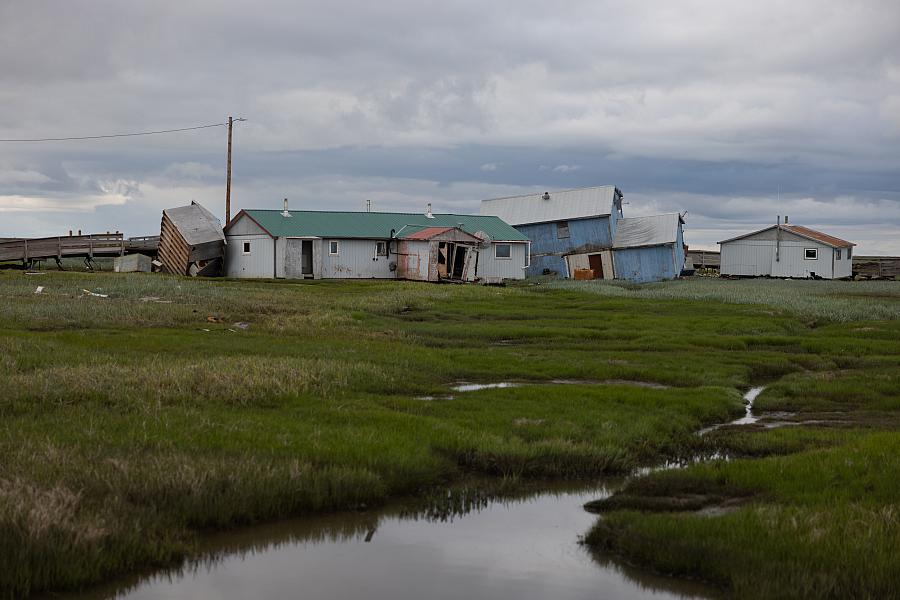
Buildings shorn off their foundations in Kwigillingok, Alaska.
(Photo by Katie Basile)
On October 11, the remnants of Typhoon Halong slammed into Alaska’s western coast. It was one of the most destructive storms to impact the state in over three decades.
For the small, predominantly-Yup’ik villages in the region, Halong destroyed critical infrastructure and ripped homes from their foundations. But the toll wasn’t just physical. In the six months after Halong, at least two young people displaced by the storm have died by suicide, and at least one other young person has attempted suicide. During the state’s spring legislative session, Rep. Nellie Unangiq Jimmie, the state lawmaker for the region, identified mental health as an area of urgent need amongst many of her constituents who evacuated from the storm. “We are losing kids,” she said, describing these tragedies as “catastrophic” for small village communities.
In March of this year, I traveled to Bethel, a rural hub where many storm survivors evacuated to, and Kwigillingok, one of the villages hit hardest by Halong. During the reporting trip, I spoke with 10 young people, as well as numerous mental health professionals, about how the disaster and subsequent evacuation impacted youth mental health and escalated risk factors for suicide. This reporting was published in The Margin, an independent environmental justice magazine, and co-published by local outlets KYUK, The Alaska Beacon and The Anchorage Press.
The emotional impacts of climate disasters are well-documented in research. Yet most recovery stories focus on the logistics of rebuilding rather than the emotional toll. And even fewer emphasize the long tail of mental health recovery — the idea that it can take time for post-disaster trauma to fully materialize. A 2026 Harvard review of Psychiatry study, for example, used data from over 70 global disasters to identify how mental health problems like depression, sleep problems, grief, post-traumatic stress, and anxiety peaked at two critical points: in the initial months following a disaster and a decade later.
The Harvard paper speaks to the importance of prolonged attention on mental health in the wake of climate disasters. In my interview with families displaced by Halong, I heard about how in the initial weeks after the storm they were focused on their immediate needs — securing housing, getting food, accounting for what’s missing. When evacuated youth were first transferred to new school districts after the disaster, many were reluctant to talk to school social workers about the night of the storm. The trauma bubbled up later. Six months after Halong, youth are reporting a wide range of symptoms, including nightmares, flashbacks, trouble sleeping, and symptoms of depression and anxiety. One 18-year-old whose house had floated during Halong remembered a dream he had following his evacuation. “I was alone in the house. There was nobody to help me,” he said. “I woke up crying for some reason.” My conversations with youth spoke to the slow and often non-linear ways that trauma responses manifest after a catastrophic event.
Acknowledging the potential for these interviews to bring up unprocessed emotions, I centered trauma-informed journalistic practices in my reporting. The Center for Health Journalism’s fellowship program connected me with an experienced mentor, who directed me to resources created by the Campaign for Trauma-Informed Policy and Practice and the Global Center for Journalism and Trauma. We also discussed ethical ways of framing the story. Research has shown that sensationalized reporting of suicides can engender “suicide contagion,” or copycat suicides, especially amongst young people. Because of this, I framed the story broadly around youth mental health, rather than the suicides themselves.
These decisions were also made in collaboration with community partners. Indigenous scholars like Max Liboiron have emphasized the importance of anticolonial practices in research and knowledge production. According to Liboiron, anticolonialism “means working in a way that does not assume settler and colonial access to Indigenous land for settler and colonial goals, even when those goals are benevolent, well-intentioned, or environmental.” I take Liboiron’s guidance seriously in my journalism, embedding participatory approaches throughout the reporting process. I consulted with Tribal leaders to refine my framing and scope, identified solutions and pathways forward with impacted community members, and got involved with mutual aid efforts for evacuees. This is my third feature story in the region, and building relationships with Tribal groups and local journalists has strengthened my reporting. I’m immensely grateful to the staff at KYUK, the local public radio station, who have greeted me with open arms and lent me their office and equipment. And my stories would be nowhere without my photographer, Katie Basile, who has deep connections with Yukon-Kuskokwim Delta Tribal communities and is always willing to look over drafts to provide feedback and deeper cultural context.
My story identified the dearth of resources available for youth mental health support in southwest Alaska, especially in the wake of a traumatic event like Halong. In some ways, rural health care gaps are endemic across the country. But the geographic isolation and declining public funding contribute to a particular lack in crisis response options for villages in the Yukon-Kuskokwim Delta. Young people in crisis are often met with law enforcement intervention. As a school social worker told me, “ I’ve had young girls wait two to three days [...] in the public safety office.” Even when youth are routed to a mental health provider, they face wait times of up to six months. Because of this, school counselors, state lawmakers, and Indigenous mental health advocates worry that unaddressed trauma will lead to long-term mental health issues for youth. However, I didn’t want my story to obscure all the great work that is happening in the Delta region. In my reporting, I encountered social workers and staff at the Yukon-Kuskokwim Health Corporation, the Tribal health care provider in the area, who are employing many trauma-informed interventions with resources they have.
It was also important for the story to illuminate pathways forward and to take a holistic view of mental health. In Bethel, I spoke with Rose Domnick, a Yup’ik trauma intervention expert who founded Calricaraq, a preventative services program that centers Indigenous ancestral wisdom to address suicidality and other behavioral health issues. According to Domnick, western mental health frameworks may not be the most effective for Yukon–Kuskokwim Delta communities because they adopt a compartmentalized, short-term view of mental health. There are separate initiatives to treat suicide prevention, substance use, and other behavioral health issues. These programs are often reactive rather than proactive — aimed at short-term crisis management rather than prevention. As a result, they lack the structural lens to address the root causes of mental illness amongst Indigenous communities, according to Domnick. In contrast, Calricaraq acknowledges the role that colonization and intergenerational trauma plays in the high rates of mental health issues and suicide amongst Native youth.
As Domnick said, “Our healing must utilize our identity, our culture, and our wisdom to move us away from the impacts of historical trauma and colonization.”