

25 years after deadly heat wave, many in Duluth still lack air conditioning
The article was originally published by Duluth News Tribune with support from our 2025 Data Fellowship.

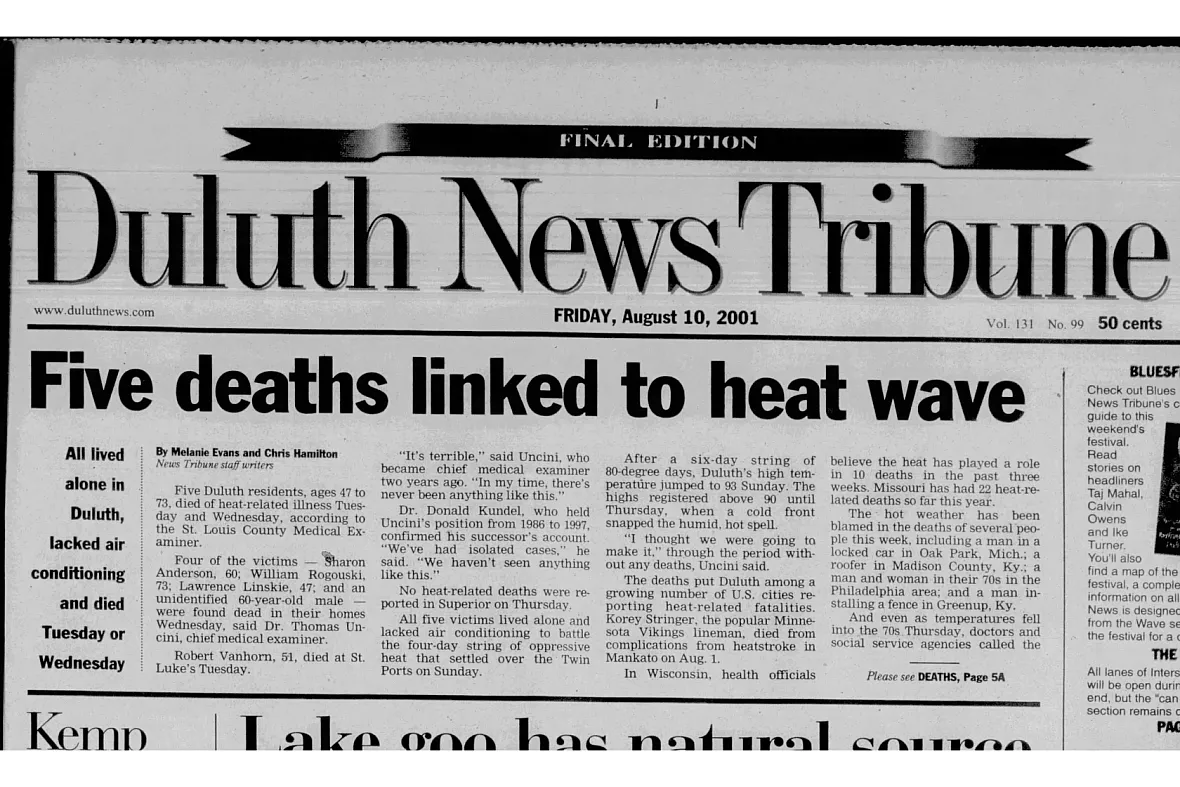
The Aug. 20, 2001, cover of the Duluth News Tribune reports on five Duluth residents who died in a heat wave that month.
Duluth News Tribune archive / Newspapers.com
DULUTH — By the time the oppressive August 2001 heat wave ended, five Duluth residents had died of heat-related illnesses.
The victims, ages 47 to 73, lacked air conditioning, lived alone and likely all had underlying health conditions, the News Tribune reported at the time.

A pedestrian walks past the Providence Building thermometer reading 101 degrees on Superior Street and Fourth Avenue West on Friday, July 28, 2006.
Clint Austin / Duluth Media Group file photo
Duluth, with its reputation as “the air-conditioned city” that’s “cooler by the lake,” was caught off guard when high temperatures exceeded 90 degrees for four straight days.
A quarter-century later, much of Duluth still lacks air conditioning, especially in neighborhoods that are built in ways that store heat and have populations that are more vulnerable to heat illness.
That comes as human-caused climate change pushes average temperatures higher and is projected to make heat waves more common.
Dr. Nick Lehnertz, a medical specialist at the Minnesota Department of Health, said he’s already seeing climate change’s effect on heat illnesses in the state — from southern Minnesota to International Falls.
“It’s already playing a role,” Lehnertz said.
Unequal access
A 2022 study by researchers at Boston University estimated the prevalence of a household’s air conditioning — both central and room — across U.S. metropolitan areas, including Duluth.
It modeled the probability of air conditioning to the census-tract level, and found that the “urban core” of metro areas is less likely than their suburbs to have air conditioning.
Areas that lack air conditioning also had a higher social vulnerability ranking — a combination of socioeconomic, demographic and other data published by the Centers for Disease Control and Prevention. The ranking is used in emergency planning to determine what communities might be more affected by a public health emergency or natural disaster.
Additionally, tracts with less air conditioning tend to have a greater urban heat island index. That is, they are full of buildings and surfaces like concrete and asphalt that absorb energy from the sun and radiate it back into the air, warming the surrounding area more than less-developed and more vegetated areas nearby.
“Our results suggest further evidence that extreme heat risks are systematically unequally distributed within U.S. cities,” the authors wrote.
Duluth was no different, a News Tribune analysis found. Census tracts in the city’s core — covering portions of the Lincoln Park, Central Hillside, East Hillside and Endion neighborhoods — had some of the lowest rates of air-conditioning probability, with about four in 10 households likely lacking it.
Those areas also have higher social vulnerability and urban heat-island rankings. Areas with the lowest rates of air conditioning are also among the oldest areas of the city, many older 100, the median age for Duluth houses. Similarly, these tracts tend to have more renters, higher rates of poverty and are less white than the rest of the city.
Rates of people age 65 and older living alone, making them particularly vulnerable to heat waves, are also higher in these areas, according to the U.S. Census Bureau 2020-2024 American Community Survey.
“There are disparities in who is at most risk of heat,” said Heidi Roop, director of the University of Minnesota’s Climate Adaptation Partnership. “That’s well documented.”
But Hoop does not want the conversation to end at access to air conditioning.
By insulating homes, shading playgrounds, installing white roofs, and adding trees and green space, communities can help cool and alleviate some of those heat-island effects, helping prepare them for a warmer future, Roop said.
A surge in air-conditioning use could also spike energy demand, and if the power grid hasn’t fully transitioned to renewable energy, it could lead to burning more fossil fuels, which release greenhouse gases and cause the underlying issue of climate change to worsen.
“It can be a maladaptation, meaning it’s solving one problem but amplifying another,” Roop said.
More heat waves expected
In the Northland, the effects of climate change are most apparent in the warming winter.
But average summer temperatures are also up, rising 3.3 degrees since 1970, according to a Climate Central analysis of historical weather data.
On average, the Duluth International Airport only exceeds 90 degrees about two days every year, but that’s likely to increase, too.
“We do expect in the future for there to be more frequent and more severe heat events, including heat waves,” Roop said.
Duluth could see an average of a week per year by mid-century under an “intermediate” emissions scenario, according to climate projections by the U of M’s Climate Mapping and Analysis Tool.
But under a “very high” emissions scenario, projections for the end of the century show Duluth may see, on average, a month exceeding 90 degrees annually.
Beyond a single day’s high temperature, other factors play a role in a heat wave’s severity.
Humidity will make temperatures feel hotter as it prevents sweat from evaporating and cooling the body, and days on end without heat relief can worsen outcomes.
The four hottest days of the August 2001 heatwave were preceded by a stretch of days in the 80s, and temperatures remained relatively high overnight.
With no relief, that cumulative, prolonged heat exposure adds up.
“If it doesn’t cool down at night, if you don’t get that break … you can have this continual slow rise of heat-related illness that develops this classic heat stroke,” Lehnertz said.
It is even more difficult for vulnerable populations — in particular, older residents with underlying health conditions — to cool down without central air conditioning, Lehnertz said.
People with disabilities, young children and people who work outside are also at greater risk of heat illness.
Lehnertz suggested people with window air conditioning units establish a “cool room” in their home or apartment so there is always a place to escape the worst of the heat, especially at night.
In addition to a lack of air conditioning, the five Duluth residents who died in the 2001 heat wave all lived alone.
Both Lehnertz and Roop agreed on one uncomplicated task most people can do in a heat wave, regardless of access to air conditioning: Check on your neighbors.