

An Arizona commission will consider rules for workplace heat safety this week
The article was originally published in the KJZZ Phoenix with support from our 2025 Health and Climate Change Reporting Fellowship.

The Industrial Commission of Arizona building in Phoenix.
Katherine Davis-Young
Temperatures in the Phoenix area climb above 100 degrees 111 days out of the year, on average — some parts of Arizona endure even longer heat seasons. And more than 1 million people in the state work in jobs where they’re regularly exposed to these extreme temperatures, according to an estimate from the Natural Resources Defense Council.
“You take a breath and feel the heat go into your lungs and your whole body, drying out your muscles. It’s just indescribable,” said Trina David, a longtime crew chief at Phoenix Sky Harbor International Airport. “Your shoes melt every summer walking across the tarmac because it is so hot.”
Many workers face health consequences from working in these conditions.
“We see probably 50 to 60 heat illness cases [among postal workers] throughout the Valley every year,” said Eric Gregoravic, who delivers mail for the United States Postal Service in Phoenix. “It is absolutely burning.”
Tucson-area day laborer Luis Cruz recalls a frightening experience when he was hired to pick up trash and do maintenance work in a trailer park in triple-digit heat.
“The heat was intense,” Cruz said. “My arms start twisting and my legs start twisting and I ended up in the hospital.”
Heat is the top weather-related killer in the U.S. and the U.S. Occupational Safety and Health Administration estimates about 559 workers die from heat exposure on the job each year. Tens of thousands more are estimated to suffer illnesses or injuries related to heat.
In Arizona, where outdoor workers face some of the hottest temperatures in the country, there have never been state regulations to require specific protections from heat in workplaces. Labor rights groups want to see that change. But actions from the state have so far fallen short of what workers have called for.
Research shows regulations can save lives
As climate change drives even hotter temperatures, outdoor worker deaths appear to be increasing in Arizona.
The same is not true everywhere, according to a recent study in the journal Health Affairs.
“Heat standards can significantly reduce worker deaths,” said George Washington University associate professor of political science Adam Dean, one of the study’s authors.
California has regulated workplace heat safety for more than 20 years, enforcing requirements for water, shade, and heat illness training. Dean and his coauthors found those rules are saving lives.
“Governments looking to protect these workers need to pass these laws but to make sure they’re enforced and that worksites are inspected to protect the most vulnerable workers among us,” Dean said.
But which level of government can most effectively regulate heat safety?
A federal standard is stalled and city ordinances are narrow
At the federal level, OSHA was pursuing a heat safety standard under the Biden administration. But there is no clear timeline for OSHA to take action to implement the federal heat standard.
“OSHA has been decimated by cuts made early in the Trump administration,” said David Michaels, professor at the George Washington University Milken Institute School of Public Health and a former OSHA administrator. “It will take far longer to write a standard.”
Michaels said the Trump administration has little interest in the heat standard and may choose not to move forward with the plan at all.
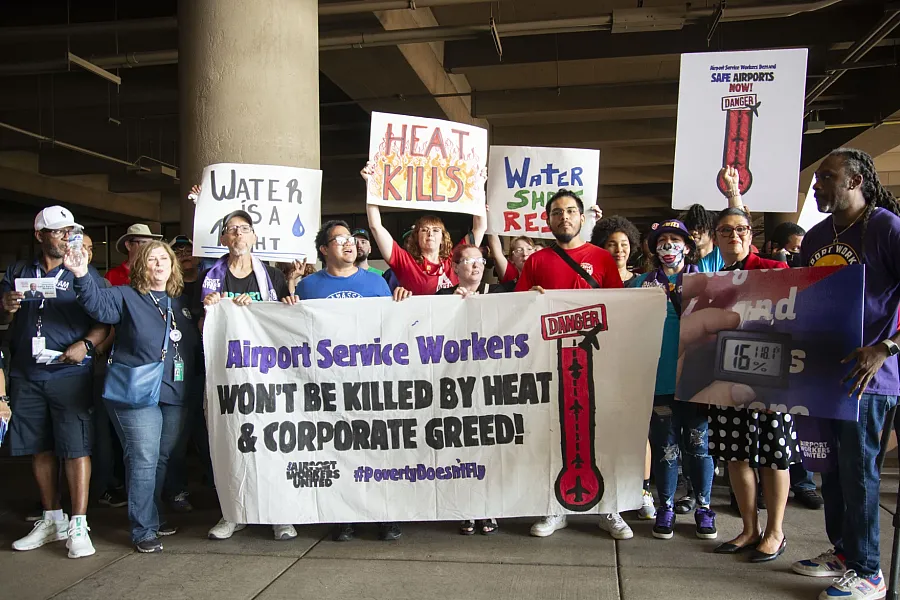
Workers at Sky Harbor airport call for more protections from extreme heat on Aug. 13, 2024
Katherine Davis-Young/KJZZ
At the municipal level, Phoenix, Tucson and Tempe, along with Pima County, have all enacted their own workplace heat ordinances within the past few years. But those are narrow in scope, applying only to city or county employees or contractors.
“These local ordinances are super important. But they only cover a really small group of workers,” said Katelyn Parady with the labor organization, National Council for Occupational Safety and Health.
So organizations like Parady’s have been pushing for regulations at the state level.
Democrats in the Arizona Legislature have failed to advance bills
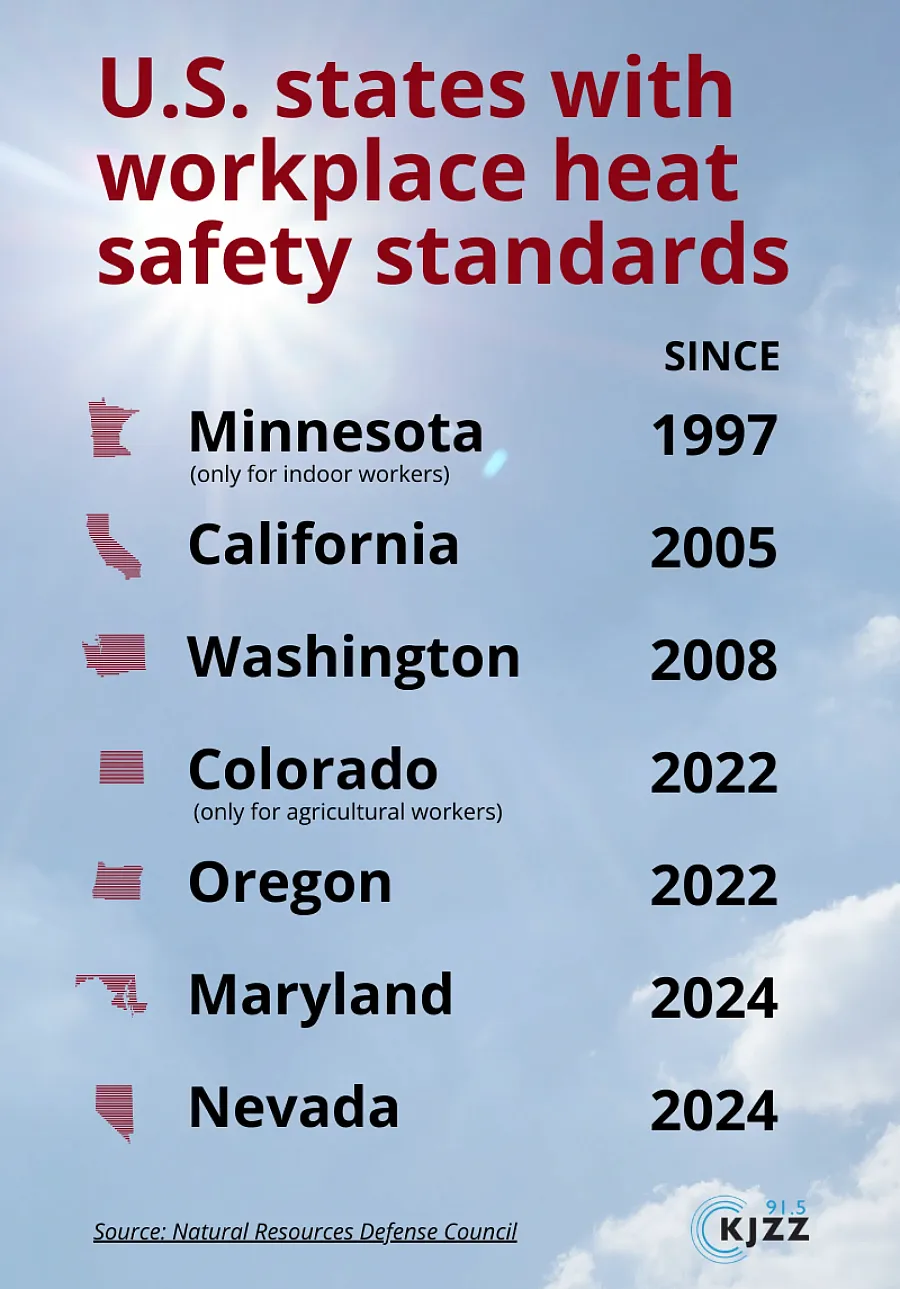
In a letter to Democratic Gov. Katie Hobbs last year, more than 30 labor groups called for the state to adopt a heat safety standard, like California and six other states have now done. They said they wanted regulations around water, shade, and training for how to respond to heat-related emergencies on the job. They said regulations should also include clear measures for enforcement.
Most of the other states that have established heat standards have Democratic majorities in state governments.
Sky Schaudt
Democrats in the Republican-majority Arizona legislature have been unsuccessful when they have proposed heat regulations.
For three years in a row, Democratic Rep. Mariana Sandoval has sponsored a bill that would require the Industrial Commission of Arizona to establish a statewide heat standard for workplaces.
But her bill has never made it out of committee, or even had a hearing. The Republican chair of the committee to which her bill was assigned this session did not respond to KJZZ’s requests for comment.
Sandoval said she has reached out to Republican colleagues, asking them to co-sponsor the legislation but so far has not found support from across the aisle.
“This is an election year, [Republican lawmakers] are like, ‘No, I can’t. I support the idea but I can’t have my name on it,” Sandoval said. “That’s always the answer I get.”
Gov. Hobbs asked a task force for heat safety recommendations
But the Industrial Commission of Arizona could establish heat safety regulations through rulemaking, without any action from state lawmakers.
Gov. Katie Hobbs last year convened a task force to make recommendations to the Industrial Commission around workplace heat safety.
The task force included 24 Arizonans representing industries including agriculture, construction and firefighting.
The task force in December submitted recommendations which said the state should require employers to create workplace heat illness prevention plans, provide potable water at no cost to workers, provide shade and encourage workers to take rest breaks. The task force also recommended employers should provide acclimatization periods and training to help workers stay safe in the heat.
But the task force recommendations did not specify if, or how, employers should be held accountable to those rules.
ADOSH did not recommend enforcement measures
Labor groups hoped that an advisory committee to the Arizona Division of Occupational Safety and Health might add details about enforcement measures before advancing the task force recommendations to the Industrial Commission of Arizona.
The ADOSH committee heard lengthy public comments about the proposals during a February meeting.
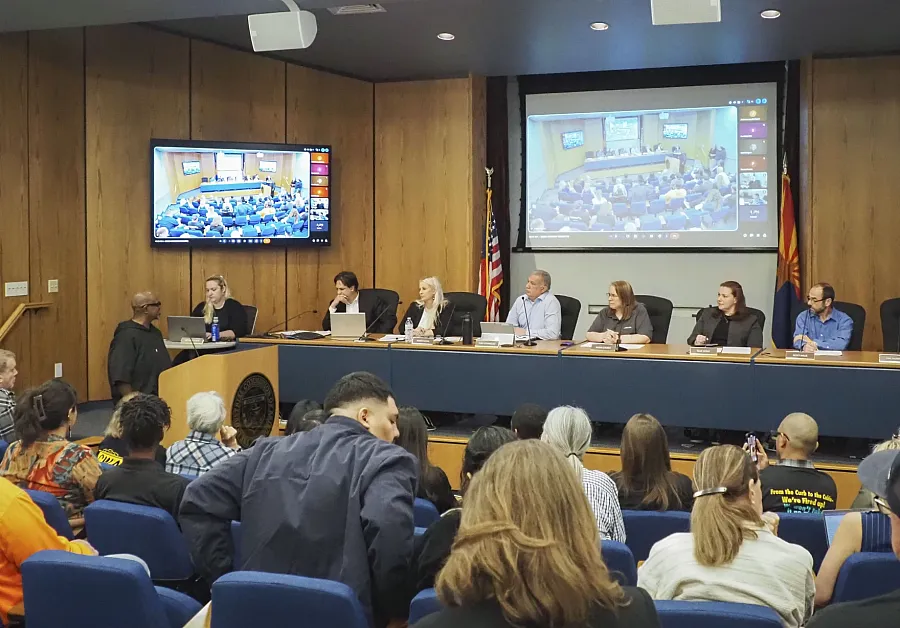
The Arizona Division of Occupational Safety and Health advisory committee hears public comments about workplace heat safety during a meeting on Feb. 4, 2026.
Katherine Davis-Young/KJZZ
A representative from the Arizona Farm Bureau voiced concerns about potential overregulation. But most commenters said they wanted the state to establish an enforceable heat safety standard.
“We need mandatory heat protections. Not suggestions, not recommendations, but real rules that protect us all before it’s too late,” day laborer Tony Pineda testified, speaking in Spanish with an interpreter.
ADOSH advisory committee co-chair Amber Pappas cautioned that rulemaking to establish new state heat regulations would be complicated.
“None of us sit here thinking that we don’t understand the need, or that we don’t understand that something needs to be done, however, there is a process,” Pappas said.
Pappas said some other states that have enacted heat safety standards have had to revise their rules because they weren’t clear enough.
“If we were to rush something it would have to be written in a vague manner. That gives a lot of room for employers to possibly abuse, but then also makes it challenging for compliance officers to enforce,” Pappas said.
One ADOSH advisory committee member, Paul McKee, said he did think the committee should expand upon the recommendations from the governor’s heat task force and suggest that the Industrial Commission of Arizona consider creating an enforceable heat standard.
“This is probably one of the most important things that’s been in front of me and I’ve been on this committee for decades,” McKee said. “So I think it behooves us to put a standard in front of the ICA and if they choose to turn it down, that’s their prerogative.”
But in a March meeting, the committee voted unanimously to advance the governor’s heat task force recommendations as written, without adding a recommendation for enforcement measures. The vote disappointed labor groups.
Parady described the vote as an unfortunate delay.
“This is absolutely a matter of life or death,” Parady said. “We needed this rule 10 years ago; we need it today. It was 90 degrees at the end of February and workers can’t wait.”
The Industrial Commission is next to weigh heat recommendations
Now, the recommendations go before the full Industrial Commission of Arizona, a policy-making body that includes two members appointed by former Gov. Doug Ducey, a Republican, and three members appointed by Hobbs, a Democrat.
Their review process is expected to begin during a public meeting Thursday. While the recommendations before the commission still do not include enforcement measures that would make heat safety mandatory in workplaces, labor groups still hope the commission might opt to begin a rulemaking process to establish a state heat standard under which employers could be penalized for failing to take certain precautions around heat.
But whatever the commission might do will likely take more time.
So, for now, Arizona’s outdoor workers are heading into another summer, without any specific protections from the heat.