

Louisville kids with asthma are missing school at 'horrifying' rates
This article was originally published in Courier Journal with support from our 2026 National Fellowship, the Fund for Reporting on Child Well-Being and the Dennis A. Hunt Fund for Health Journalism.

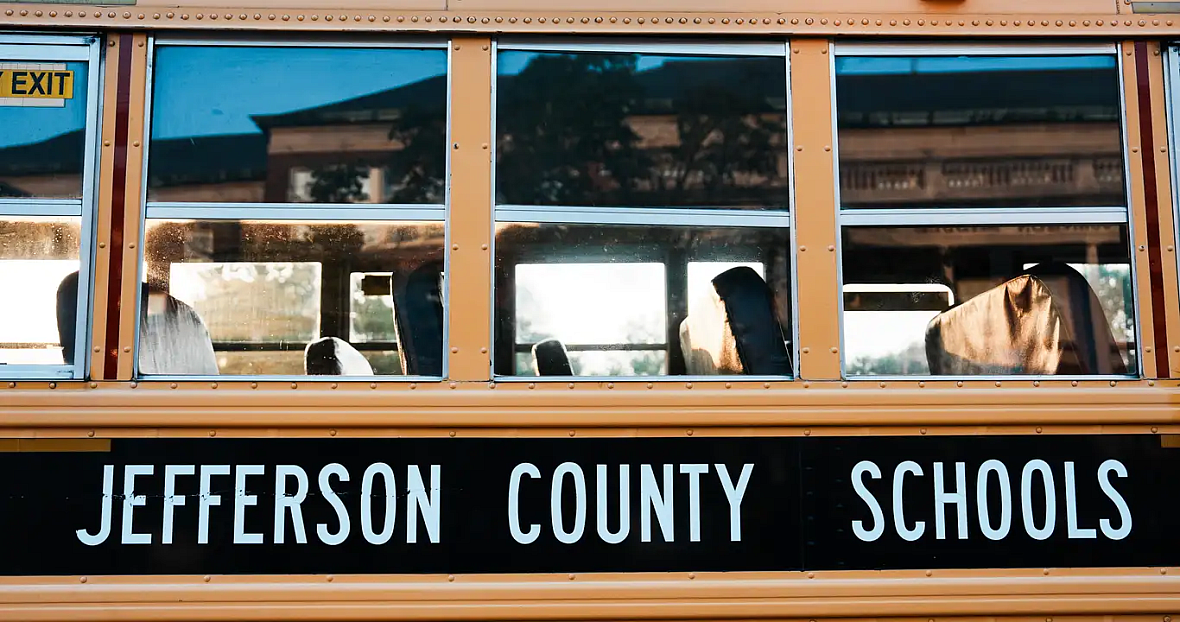
A JCPS school bus parked outside a school on the first day of classes.
August 6, 2026 Matt Stone/The Courier Journal
Stephanie Rogers remembers her first year as a middle school teacher, when she noticed a student – "a really smart kid," she said – missing class again and again.
A day or two at a time, week by week, the absences started to stack up. His performance slipped. "He started getting Bs," she said, "when he probably should have been getting As."
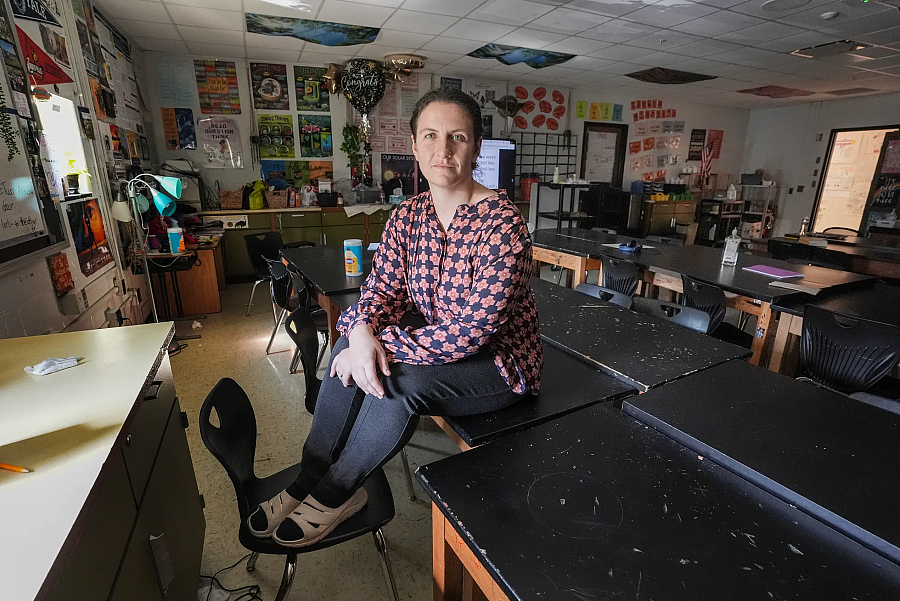
Noe Middle School science teacher Stephanie Rogers has witnessed asthma affect her students’ ability to succeed in school. Michael Clevenger/Courier Journal
Michael Clevenger/Courier Journal
"School becomes this thing where he has to catch up on missing work," Rogers said, while losing out on "the other joys of school."
Years later, Rogers has taught in more schools, and has continued to witness asthma and other health conditions affect her students. Louisville teachers see chronic disease in every classroom, and in the average JCPS class, one or more students are likely to have asthma. The disease is reported to the district with more frequency than ADHD, food allergies and diabetes combined, according to state data (although chronic conditions are often underreported).
Of the thousands of JCPS students with asthma, almost half are chronically absent, according to data from 130 schools. While the figures do not point to asthma as the direct cause of missed school, the correlation suggests many Louisville kids could be struggling to manage their asthma or access necessary care.
Eva Stone, who led health services at JCPS until she left the job this year, has previously examined absenteeism among students with chronic diseases. In some schools, the rate of chronic absenteeism among students with asthma is "horrifying," Stone said as she reviewed a spreadsheet of the data from recent years.
Read the entire series: Courier Journal investigates asthma's burden on Kentuckians in 'Breathless'
Rates commonly exceed 50%, and reach as high as 70%. Asthmatic students were chronically absent at higher rates than their easy-breathing peers at the vast majority of schools, sometimes by margins of 20 percentage points or more, according to a Courier Journal analysis.
"That is an absolutely identifiable problem that needs to be targeted for intervention," Stone said.
Absenteeism among children with asthma is hard to pin down and harder to remedy, doctors and other experts said. Asthma may be contributing to missed school days, but it's almost always layered with other barriers, like a family's overall lack of access to health care, or even the necessary transportation and time off work to bring a child to a doctor. Absenteeism is also linked to poverty, trauma and other factors.
The burden is felt by parents and guardians, too, who may miss work and lose wages when a child has an asthma attack at school or needs to stay home due to breathing difficulty. Missed school and work days due to asthma cost Kentucky more than $100 million every year, according to the Centers for Disease Control and Prevention. Due to the difficulty of tracking asthma-related absenteeism, the figure may be underestimated.
JCPS has struggled to improve attendance and curb truancy for years, and districts across the country have seen absenteeism rates spike since the COVID-19 pandemic. A mountain of research links absenteeism to worse reading proficiency, risk of dropout, and difficulty finding employment. And when student attendance falters, schools lose out on state funding.
JCPS has made significant progress on asthma in recent years, including stocking potentially life-saving inhalers in all its schools, improving data collection and expanding its school nurse staff.
But budget deficits have forced spending cuts across the district, which could leave fewer resources to support students with chronic diseases. JCPS employs fewer nurse practitioners this year than it did last year. Stone urged leaders to consider the full weight of a child's health on educational success.
"Why do we provide meals for kids at school? Because if they're hungry, they can't learn. And why do we have family resource centers? Because if we don't address the social needs, that impacts their academics," she said. "Health needs to have that same credibility and recognition in schools."
Louisville kids caught in a web of asthma and illness
The stress melted from Tynica Smith's voice when she began to talk about her daughters, 10-year-old J'Ziyah and 2-year-old De-zaire. J'Ziyah is a "shy, beautiful little girl," who enjoys tumbling and cheerleading. De-zaire loves to dance and watch music videos. In her "terrible twos," Smith said she's "trying to do everything on her own."
But recently, J'Ziyah's breathing became strained. Smith worried her symptoms could be the result of persistent mold growth in their apartment in southwest Jefferson County, which she said has gone unaddressed by their landlord for months. J'Ziyah's respiratory trouble has caused her to miss school this year.
"She was complaining about her breathing. Her chest was hurting real bad, so I had to make her a doctor's appointment," Smith said. J'Ziyah has asthma, said Smith, who has asthma herself. Having a parent with asthma significantly increases likelihood of developing the disease, and mold exposure can trigger symptoms.
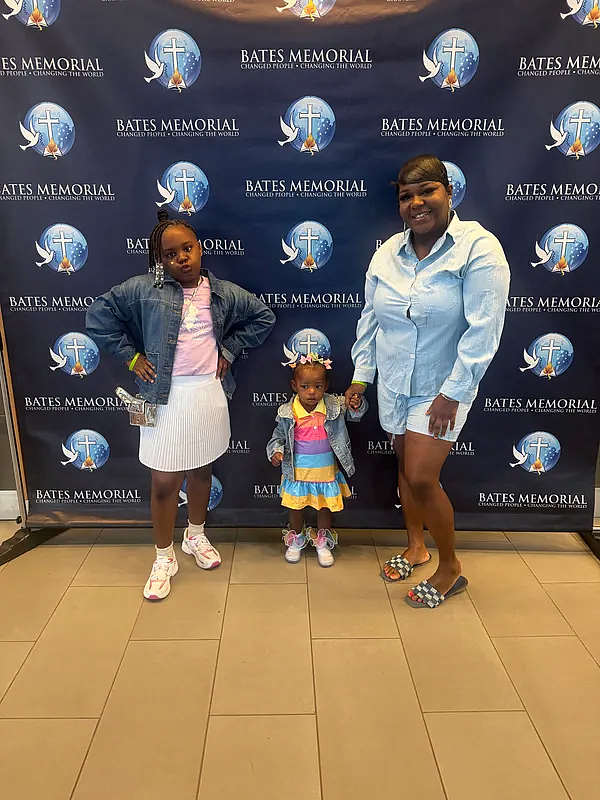
Tynica Smith, right, with her daughters J’Ziyah (left) and De-zaire, on Easter Sunday, April 5, 2026. J’Ziyah has missed school because of her asthma.
Provided By Tynica Smith
"With her missing school, of course she's not learning," Smith said. She doesn't want her daughter to fall behind on reading comprehension, which Smith herself struggled with growing up, she said. But when her daughter is struggling to breathe, "I'd rather keep her home, so I can watch over her."
J'Ziyah attends Cane Run Elementary, where nearly 60% of students with asthma are chronically absent. But the ways in which asthma contributes to absenteeism, and even affects students in the classroom, are complex and hard to trace back to the disease itself.
Sleepless nights of wheezing and coughing can leave students too tired to focus during the school day. When children lack access to medication and professional care to manage asthma, they're more likely to miss school, or even end up in the hospital.
"At the most basic level," Stone said, "if a child's not well, they're not going to learn."
Asthma tends to compound with viral illnesses, keeping kids home from school for longer when they catch a cold or flu. Dr. Kristina Bryant, associate medical director for the Louisville Department of Public Health and Wellness, emphasized immunization to curb asthma in schools. Less than one-third of children in Jefferson County were vaccinated for the flu in the 2024-25 season.
"Flu can be the trigger for the asthma exacerbation, and yes, that can contribute to absenteeism," Bryant said. "With flu vaccination, we want to take away the trigger and prevent as many episodes of flu as we can."
A child with well-managed asthma should be able to attend school and participate in other activities just like any other student, experts said. Schools have attendance committees that work to identify gaps in attendance and intervene, often including nurses to address health-related barriers. Staff are working against a big absenteeism problem in a huge school district, one student at a time.
"Every student matters. For me, if a student is struggling with attendance because of a chronic health condition, that matters," said Michelle Vittitow, a JCPS nurse practitioner with a specialty in allergies and asthma.
"It really is about the student that is standing in front of me every day," she said. "If I go in and I see a kid who is suffering or struggling, then my job is to identify what it is that they need, and to treat them. I think it really is about that one kid at a time."
'It's everybody's issue'
School nurses are at the forefront of efforts to protect children with asthma, administering thousands of doses of asthma medication to students each year and serving as a bridge between families and care outside of school.
They can also play a key role in identifying when chronic illness is hindering a student's education or causing them to miss class. School nurses may be the first to recognize a student's unmanaged asthma.
When a child makes unusual, repeat visits to the nurse's office, staff may see a red flag, Vittitow said. Nurses can connect with families and try to bridge gaps in health care access and other barriers.
Reducing asthma and impacts on education requires coordination between parents, school staff and health care providers. Patrick Rich, executive administrator of environmental health at the Department of Public Health and Wellness, emphasized the value of schools using electronic health records, which JCPS recently integrated. Norton Children's also operates a telehealth program with JCPS, allowing students to see a provider virtually from a school nurse's office.
"Education can't say, 'This is a health care issue.' And health care can't say, 'That's an education issue,'" Stone said. "Because it's everybody's issue. It's a child issue."

Eva Stone, former manager of Jefferson County Public Schools’ Health Services, said many students cannot access the traditional health care system, often leaving their asthma uncontrolled.
Jeff Faughender/Courier Journal
Gaps in health care access are apparent in schools, experts said. Many Louisville families cannot afford multiple inhalers to keep at school and at home. Some are rationing daily asthma medication, using it only when a child is sick and in urgent need. "They feel like they don't want to waste it, and it costs too much," said Kimber Knight, a community health manager with the public health department.
"We want you to take your medicine as prescribed," said Knight, who also has asthma. "But we understand that everybody doesn't always have that luxury."
For kids without health insurance, or families without access to a doctor or critical asthma medication, school nurses and health staff become even more vital.
"In JCPS, there's lots of kids that do not have health insurance, that do not have access to a health care provider. Their parents may be working two or three jobs. They can't access the traditional health care system," Stone said. "We have to acknowledge and recognize those kids are out there, and make sure that the community has systems in place to address and meet those needs."
Gaps in health care for children seem poised to widen. Since last year, tens of thousands of Kentucky children have fallen off Medicaid and the Children's Health Insurance Program. Further declines are expected in the coming years as nearly $1 trillion in Medicaid cuts, approved by Congress last year, take full effect, said Joan Alker, executive director of the Center for Children and Families at Georgetown University. As kids drop off the rolls of those programs, some may be left uninsured entirely.
"Asthma is the perfect example of why we want children to have health insurance," Alker said. It's a "treatable condition, but it does require having access to a primary care provider so that you can be screened, so that you can be prescribed the medications you need and hopefully stay out of the emergency room."
Keeping schools healthy
A “Welcome” sign hangs on the door of a JCPS elementary school classroom.
Marty Pearl/Special To Courier Journal
The average JCPS school building is about 60 years old, and maintaining facilities can be challenging and costly. For students with asthma, the quality of those buildings is a matter of health.
"When buildings have problems, like a leaky roof, or water pooling, or no ventilation system, or poor maintenance, you're going to have poor indoor air," said Claire Barnett, founder and former executive director of the national Healthy Schools Network. "And poor indoor air makes asthma worse."
From January 2025 through the summer of 2026, JCPS fielded about 250 work orders across its facilities related to indoor air quality issues, including more than 100 categorized as mold-related, according to records obtained by The Courier Journal through Kentucky's open records law. A few entries described odors and allergic reactions among students and teachers.
Some work orders referencing mold did not result in a finding of mold, according to JCPS. The district declined a Courier Journal request to interview Rob Fulk, who oversees facilities as chief operations officer.
The facilities problem has frustrated districts nationally. The Government Accountability Office in 2020 found half of U.S. school districts are in need of building upgrades or repairs, and an estimated 36,000 schools are in need of HVAC updates.
For some aging facilities, JCPS has opted to simply start from scratch. In 2020, as JCPS prepared to tear down the old Indian Trail Elementary School, former Superintendent Marty Pollio cited problems with air quality, allergens and an aging ventilation system. "Our children should not be going in a school like this right here," Pollio said at the time.
Betsy Ruhe, a member of Louisville Metro Council, taught at the former Indian Trail Elementary School for much of her career in special education. "Some of the classrooms were just miserable," she said, "for teachers, for students. And the only solution really was to just take it down and start over."
Ruhe saw the impact of asthma and illness in the classroom. She has asthma too, often triggered by Louisville's ruthless allergy season.
"It just seems to be a part of living in Louisville. Everybody's got allergies. If you didn't have allergies when you moved here, you will now – that's kind of the running joke," Ruhe said. "But it's not a joke when your kid can't breathe."
As JCPS makes progress on asthma, gaps in state policy persist
Before she graduated high school five years ago, Habiba Darur was a student with asthma, struggling to find relief.
Attending Jeffersontown High School, she remembers feeling strain in her breathing, and visiting the school nurse. But the school didn't have medication for asthma on hand. Darur returned to class, and tried to manage her breathing on her own.
"The most frustrating part about that was: You need help, and you're talking to your teacher, and you go to the place you expect to get help from, and you don't get it," she said. "I'm glad, in that moment, there wasn't an emergency. But had it been, I don't know what I would have been able to do."
Since Darur's time in school, JCPS has made major improvements. The district now stocks Albuterol, a fast-acting rescue medication, in every school. Last school year, nurses administered those rescue inhalers nearly 500 times, in addition to thousands of doses for students who supplied their own medication.
Keeping the medicine on hand has allowed schools to help students with asthma quickly, instead of sending them home or to a hospital. In some cases, Vittitow said, "those are kids you ended up keeping out of the emergency room."
Schools are able to stock rescue medication and administer it to students thanks in part to a 2021 change in state law. The Kentucky General Assembly, which previously acknowledged asthma as a leading cause of pediatric hospitalizations and school absences, overwhelmingly approved legislation allowing staff to administer emergency inhalers to students when needed and encouraging schools to stock them.
But the law does not require schools to stock the medication, and does not provide funding for schools to do so. Kentucky also lacks numerous other statewide policies that could help students with asthma, according to a 2025 analysis from the Asthma and Allergy Foundation of America.
The state does not require districts to staff nurses in every school, for example, and some Kentucky school districts employ one school nurse for every 1,000 students or more. State laws also lack certain requirements for indoor air quality in schools, including provisions for HVAC maintenance and mold remediation, according to the AAFA.
Kentucky additionally lacks statewide restrictions on idling school buses, which produce harmful diesel emissions. Young children are especially vulnerable to diesel pollution, and they "stand about tailpipe high," said Elizabeth Hauptman, an advocate with Moms Clean Air Force, a national group. Very few Kentucky school districts have made efforts to electrify their bus fleets, according to data from the Electric School Bus Initiative.
Even improving education around asthma in schools, Darur said, could go a long way in helping prevent the worst impacts. "We have first aid. We learn things like CPR," she said. "And yet we're behind when it comes to things like asthma, which is common, especially among younger kids."
Already this school year, seats in Louisville classrooms have been left empty due to asthma. Missed instruction shows up later, on report cards and in less-visible ways: social engagement, academic motivation and opportunities later in life.
A chasm in asthma across Louisville communities leaves some families more exposed to the costs than others. As respiratory distress holds Kentucky children back, local and state policies have allowed strain on the lungs to continue.
Tell us what you think. Submit your letter to the editor.
In Part 3: Louisville's asthma burden is felt unevenly. Decisions made decades ago, and continuing today, help explain why.
Read the entire series: Courier Journal investigates asthma's burden on Kentuckians in 'Breathless'
Connor Giffin is an environmental reporter at The Courier Journal. Reach him directly atcgiffin@courier-journal.com.