

How I overcame my fear of spreadsheets to expose the limits of LA’s signature homelessness program

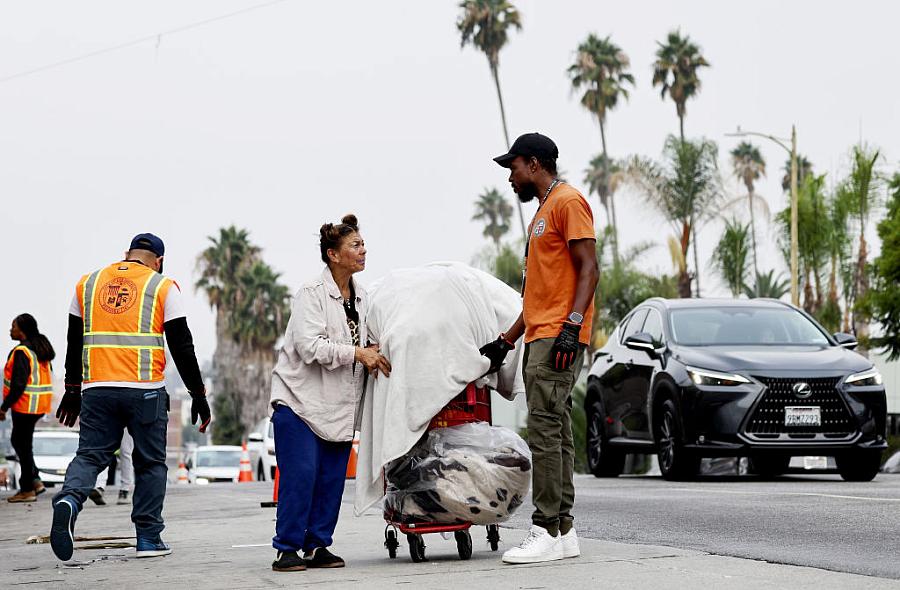
A city worker speaks to an unhoused person during an ‘Inside Safe’ operation as workers help bring unhoused people from an encampment to interim housing.
(Photo by Mario Tama/Getty Images)
When Los Angeles Mayor Karen Bass took office in 2022, she quickly launched Inside Safe, an initiative aimed at moving homeless Angelenos out of sidewalk encampments and into temporary housing. That program became the cornerstone of her effort to address a humanitarian crisis that had ballooned over the prior decade, particularly during the pandemic.
As a beat reporter assigned to cover City Hall for the Los Angeles Times, I had been tracking the mayor's program. But I wanted to take a deeper dive, exploring the program's effectiveness on its two main goals: bringing unhoused people indoors while also removing encampments from L.A. streets and sidewalks.
I applied for the USC Center for Health Journalism’s Data Fellowship to develop skills I had never really acquired, despite my years in the profession. The timing was fortuitous: Inside Safe was reaching the end of its third year, and the mayor was ramping up her reelection bid.
Bass had already committed hundreds of millions of dollars to the initiative. As the campaign was ramping up, she needed to show the public concrete results.
As someone with three decades of experience writing for daily newspapers, I had somehow missed the boat on the use of spreadsheets. The Data Fellowship team helped me face my fears. After some false starts, I found some straightforward strategies for examining the mayor's initiative.
At the heart of the program is the process called an encampment resolution: moving dozens of residents from the same location all at once and getting them into motels, hotels and other interim housing sites.
When I began, I knew that a major portion of Inside Safe's participants were returning to the street. What I didn't fully grasp was how those results had evolved over time. I worked with my mentor, provided through the fellowship program, to create a spreadsheet that showed Inside Safe's monthly numbers over a nearly two-and-a-half-year span.
The results were eye-opening. After the first year, nearly 20% of Inside Safe participants had returned to homelessness. By the end of year two, the number topped 30%. By the end of the program's third year, it exceeded 40%. Without a course correction, the long-term prospects for the program were grim.
To show what that meant on the ground, I spoke with a wide range of stakeholders: people who had returned to homelessness after chafing at the program's rules, such as the ban on guests in Inside Safe's motel rooms.
I heard from nonprofit leaders who explained why they viewed the rules as critical for the residents' safety. I found statistics showing that many Inside Safe participants, after signing up for a 90-day stay, were staying in the motels for more than a year. I heard complaints about a lack of services for Inside Safe participants struggling with addiction and mental health issues, including from the mayor herself.
I first met Jonathan Torres when he was living in an Inside Safe motel and worried that he might get kicked out. I followed him as he was expelled from the facility and then moved back to the streets. After his encampment was cleared by sanitation crews, he was hospitalized for stomach issues.
Torres told me his health issues had largely subsided while living in his Inside Safe motel. But he also kept breaking the rules, having guests in his room even in the face of warnings from the program managers. His story, and several others, showed the challenges the city faces as it seeks to serve some of the city's neediest.
By the time the first story published, I had begun gathering data showing the other major challenge facing Inside Safe: Dozens of streets that had been cleared of tents were repopulating, with new encampments taking hold. Some had already lived in interim housing, while others were new to the streets.
Through a public records request, I obtained the data for the Inside Safe operations that had been collected by the mayor's team, along with maps showing where each of the original Inside Safe operations had taken place.
With help from a co-worker, I was able to standardize the information collected by the mayor's team to understand how many times Inside Safe teams had returned to the same locations. In some cases, a single Inside Safe location turned out to be a subset of another, larger one. In other instances, an Inside Safe area was later carved into two separate locations. And so on.
The numbers were revealing. By the final quarter of 2025, four-fifths of Inside Safe's operations were being carried out in areas that had repopulated. Those numbers raised serious questions about the city's ability to continue launching encampment operations in new locations.
The data showed nearly two dozen locations where Inside Safe had returned five or more times. Along a 1-mile stretch of freeway, outreach teams had moved people indoors 25 times.
I used this data to explore other questions: Why were people returning to the same overpass or desolate stretch of sidewalk?
The numbers had political implications. Bass said early on that her program would not be viewed as a success as long as the city's sidewalks were lined with tents.
Near some of the Inside Safe locations, housed residents had grown demoralized over the lack of progress. They voiced frustration about nighttime noise, trash and open-air drug use near their homes. Those complaints offered a serious warning sign for a mayor who staked her reputation on the clearing of encampments.
I am grateful to the Data Fellowship program for giving me tools to illuminate L.A.'s fight against homelessness. As a beginner in the world of data analysis, I don't have any savvy advice for reporters looking to strengthen those skills, other than to say: Find something that scares you and seek to overcome it.