‘Invisible in plain sight.’ Childhood cancer upends Iowa families
This article was originally published in the Des Moines Register with support from our 2026 National Fellowship.

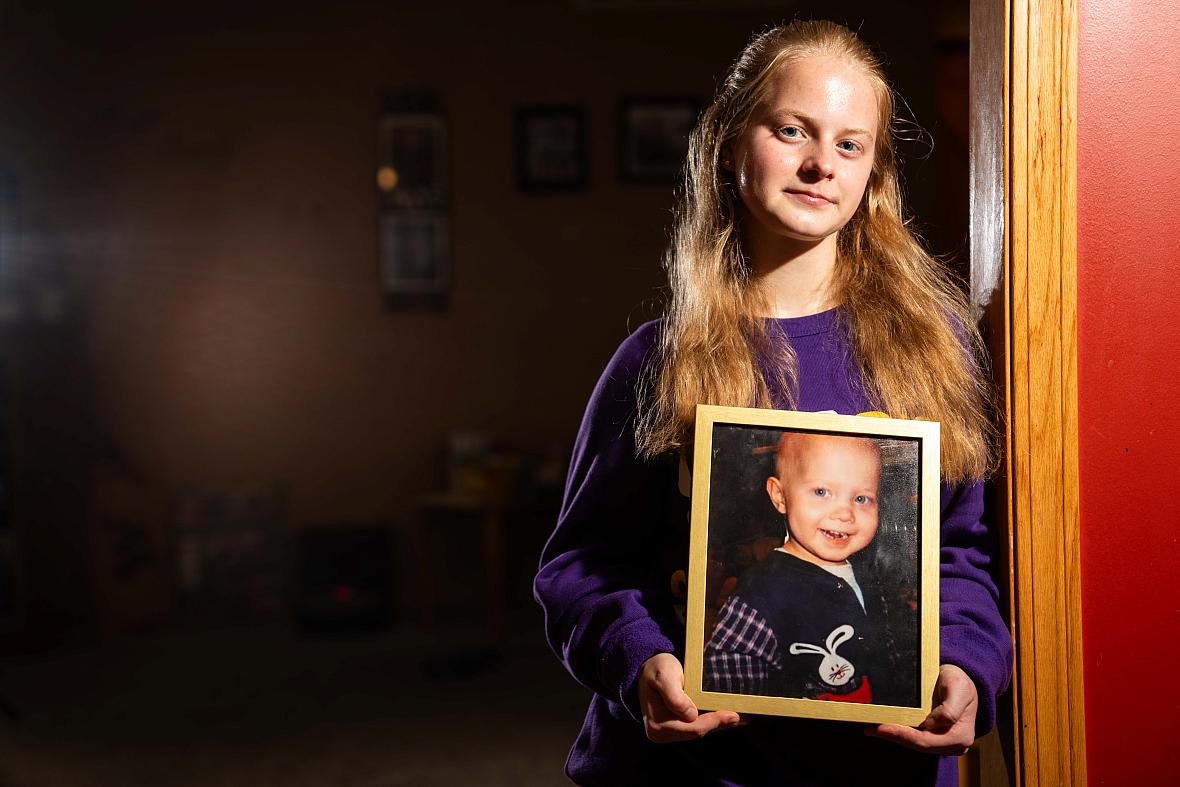
Addison Whipple holds a photo of her identical twin sister, Ashlyn Echo Whipple, on Sept. 25, 2026, in Pleasant Hill. Whipple was diagnosed with neuroblastoma, and her sister, who was diagnosed with the same cancer, died at age 2 from complications of treatment.
Cody Scanlan/The Register
Ophelia's pediatrician was crying on the phone.
"'I'm really sorry, but there's nothing else that this could be,'" Ophelia's mother, Bobbi Anderson, recalled the doctor saying.
Anderson's world crashed in that moment. Only hours earlier, she had wondered whether her 4-year-old daughter had strep throat.
Instead, Ophelia was diagnosed with B-cell acute lymphoblastic leukemia, a fast-growing cancer of the blood and bone marrow. The family was told to get their peppy little girl to the hospital immediately.
It was Jan. 14, 2022, and a record-breaking blizzard known as the "Saskatchewan Screamer" was busy burying the Andersons' Norwalk home and central Iowa beneath more than a foot of snow.
"I'm driving her, and I'm upset, like trying to hold it together. Keep the car on the road. Get to the hospital," Anderson recalled. "And I hear Ophelia just saying from the back seat, 'It's OK, Mommy. I'm not sick.'"
Anderson remembers it as the longest drive she had ever taken.
Ophelia was among the roughly 150 Iowa children and teenagers diagnosed with cancer in an average year — enough to fill more than seven classrooms.
Not all of them make it. In the five years between 2018 and 2022, childhood cancer claimed 94 lives across Iowa. That is nearly five classrooms of children.
They are the youngest Iowans caught in a cancer crisis that has put the state second in the nation for cancer rates, according to the National Cancer Institute. Iowa is one of only three states where rates are still rising.
The crisis looks different among children. Iowa's childhood cancer rate remains close to the national average. Children make up only a small fraction of the 21,700 Iowans expected to develop cancer this year and the roughly 6,400 expected to die from it, according to the Iowa Cancer Registry.
Iowa's rising adult cancer burden has set off a statewide search for answers and ways to prevent more cases, with attention focused on everything from genetics, smoking, and alcohol to radon, agricultural chemicals and polluted water.
For childhood cancer, though, even prevention is harder to pin down. The cancers that strike children are often biologically different from those diagnosed in adults, and most have no known cause or inherited predisposition.
"We really don't have a good grasp of any factors for childhood cancer in Iowa," said Nick Fustino, a pediatric oncologist at Blank Children's Hospital. "It just hasn't been studied enough."
And surviving cancer does not always mean leaving it behind. For most children with cancer, the treatment that saves their life can also leave permanent, and often debilitating, damage.
'It's not enough just to save the child to lose the family'
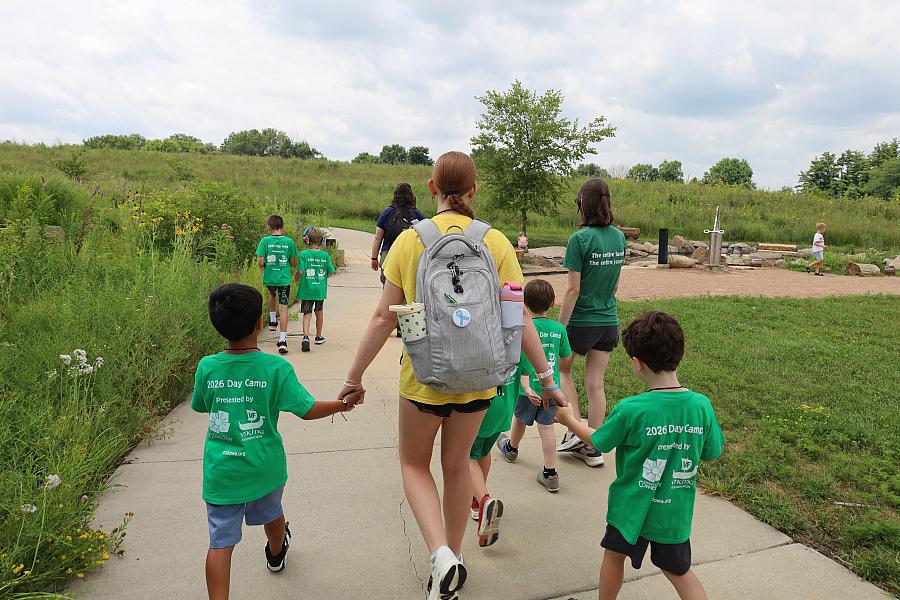
A Children's Cancer Connection volunteer holds hands with two children as the group walks through Jester Park near Granger in Polk County during the nonprofit's 2026 summer day camp.
Provided by Children's Cancer Connection
As dawn eased into daylight over Children's Cancer Connection's summer camp in Johnston, there was hardly a sound.
For a few fleeting moments, the quiet held. Then, the children arrived.
Games and toys spread across tables and floors. Plastic food piled onto plates as imaginations took over in the play kitchen, and toy trains raced around their tracks while kids chased one another between tables.
The activity for the day was percussion, which unleashed an escalating racket of maracas, drums and whatever instrument could make the loudest, most ear-piercing noise.
For Jake Al-Mazroa, the camp and youth program manager at CCC, the ruckus was a reason to smile.
"They have to grow up so fast, but when they're here, they get to be kids," Al-Mazroa said as he watched young campers laugh and play around him.
CCC has spent decades building a world around everything cancer takes from childhood. What began with an Iowa cancer camp in the 1980s now reaches more than 850 families a year, serving children with cancer from 85 of Iowa's 99 counties as well as siblings, survivors and grieving families.
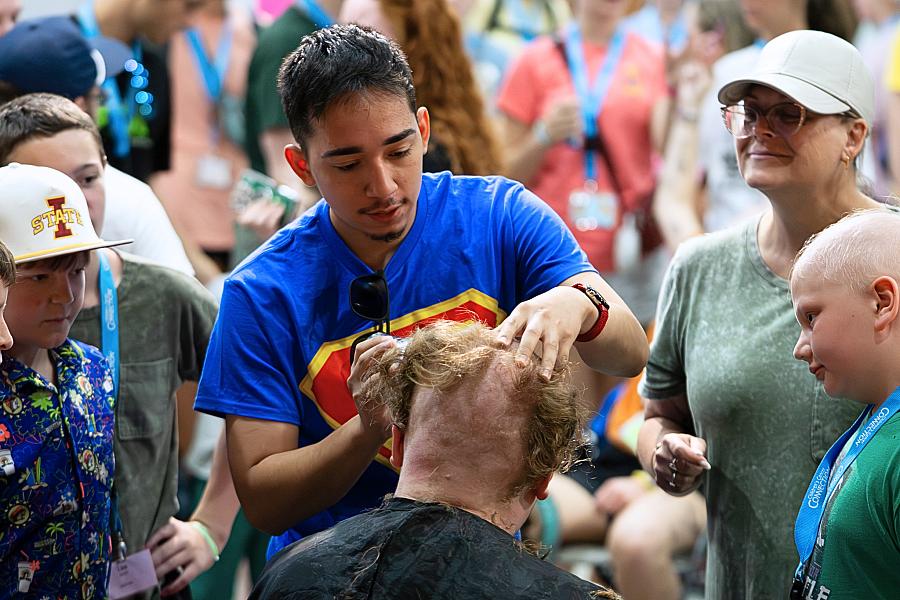
Former camper and current Children's Cancer Connection volunteer JC Arias-Medina shaves fellow volunteer Noah Ford's hair during a hair-cutting ceremony at the nonprofit's 2026 oncology camp. Both Arias-Medina and Ford attended the camp as children.
Provided by Children's Cancer Connection
Perpetua Willard, 17, of Grinnell, and her younger sister Felicity, 16, first came to CCC as little girls, after Perpetua was diagnosed with leukemia at 3. Felicity was about 2 years old.
"We literally learned to walk in the hospital, in the hospital halls and everything," Felicity said.
The siblings, now back at CCC as volunteers, said cancer was so woven into their childhoods that they did not initially realize other children were living differently.
"It was just my normal," Perpetua, who has been cancer-free for about 11 years, said. "It felt like this is just what everyone did. Everyone goes to the hospital, like, three times a week."
Research has found children with a sibling diagnosed with cancer are more than twice as likely as their peers to develop emotional or behavioral problems, and nearly one in three experience symptoms of post-traumatic stress.
"We always say it's not enough just to save the child to lose the family," Fustino said.
CCC opened its first sibling cancer camp in 1989, when the organization was still known as Heart Connection. Today, siblings can attend whether their brother or sister is in treatment, has survived, or has passed away.
The Andersons' three sons have attended many of those camps. They ranged in age from elementary school to their teens when Ophelia was diagnosed. The parents traded shifts at the hospital while the other kept the boys moving through school, sports and whatever remained of ordinary family life.
"You have three other kids who still need you. I think that was the hardest part," Anderson said.
At CCC, Anderson said her family found "the best group of friends-slash-family that you never want to have."
Outside that community, cancer could make the family feel conspicuous and invisible at the same time.
"When she was really sick, I felt sometimes like it was easier for people to not want to look at a little bald girl in the grocery store," Anderson said. "That just made us feel invisible in plain sight. It was isolating. It was as if it's contagious or something."
Ophelia is now 8 and two years removed from treatment, her hair long again as she runs and plays.
'There is no before.' Childhood cancer treatment can come at a lifelong cost
Addison Whipple, 20, has never liked the phrase "losing the battle." She was 5 months old when doctors diagnosed her with stage 4 high-risk neuroblastoma, an aggressive cancer of the nervous system.
"When everyone was little and learning how to speak and walk, I was just trying to survive," said Whipple, who lives in Pleasant Hill and is now a CCC volunteer.
As Whipple neared the end of treatment, her identical twin sister was diagnosed with the same disease. Both girls underwent stem cell transplants.
Whipple survived. Her sister developed a severe complication of the transplant. She died at age 2.
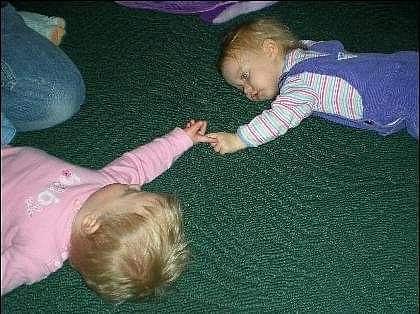
Addison Whipple, left, reaches toward her identical twin sister, Ashlyn Echo Whipple. Both were diagnosed with neuroblastoma, a childhood cancer, as infants. Addison survived, while Ashlyn died at age 2 from complications of treatment.
Provided by Addison Whipple
"She didn't pass away from the cancer, but because of how toxic the treatment is," Whipple said. "The treatment was just so harsh that her body couldn't take it."
The sisters' outcomes capture what doctors say is one of pediatric oncology's hardest challenges: the toll of treatment.
Fustino compares conventional chemotherapy and radiation to an "atomic bomb approach." The treatments “kill cancer cells, but many times, they don't spare other healthy organs and tissue," he said.
Nearly two-thirds of children who undergo treatment develop a chronic health problem, while more than one-quarter suffer a severe or life-threatening one.
Whipple said she now suffers from hearing loss and kidney disease. She worked through developmental setbacks, graduated near the top of her class at Southeast Polk High School and now attends Northwestern College in Orange City, where she works as a psychology researcher and teaching assistant.
"Adults will be like, 'This was my life pre-cancer and after cancer,'" Whipple said. "Whereas with me, there is no before. Cancer has affected my whole entire life."
She is part of a growing generation of survivors created by pediatric oncology's success. Nearly 500,000 Americans diagnosed with cancer before age 20 were alive as of 2020. But even a close to 90% cure rate leaves pediatric oncologists confronting the children behind the other 10%.
"What that means to me is one in 10 kids that I meet are going to relapse or die," said Michael Halyko, a pediatric oncologist at University of Iowa Stead Family Children's Hospital. "Which is horrible and really not acceptable."
Cancer remains the leading cause of disease-related death among American children, and its incidence has risen by more than 43% over roughly the past 50 years.
Iowa lawmakers this year committed $3 million to pediatric cancer research. Halyko said the money could help fund research aimed at reducing long-term side effects, though he said questions remain about exactly how it will be used.
CCC supports survivors in navigating the consequences of their treatment, while also making room for those who do not survive.
Outside its Johnston facility, about 250 gold-colored pavers carry the names of children connected to CCC who have died since 1988. When another child dies, the organization adds another name to the walkway.
Whipple spoke with the Register at a CCC picnic on Aug. 2, the anniversary of her sister’s death.
"I've been cancer-free as long as she hasn't been here," she said. "A lot of people outside of the community will be like, 'Oh, she lost her battle, and you survived yours because you were strong.'"
Whipple rejects that.
"It's not like she was less strong than me or anything. We were both babies," Whipple said. "She's cancer-free. And that's the goal. And though she is cancer-free, she's just not here."
The dragon would have to wait
Younes Najeeb could hardly stop bouncing — the 4-year-old was finally going to Indonesia. He would meet his mother's parents for the first time and, if he was lucky, see the animal he had dreamed about for years: a Komodo dragon.
But with only three days left before the trip, everything changed.
"It was a bit of a shock," Younes' father Najeeb W. Najeeb said. "He got diagnosed on a Friday, and our flight was Monday. He was so excited to go there, but all those flights had to be canceled."
Instead of boarding a plane, Younes was admitted to UI's children's hospital for about a month. He would return again and again for treatment.
His family's world became much smaller.
The Najeebs live in Iowa City with Younes, now 5, and his 2-year-old brother. After the diagnosis, they became uncomfortable venturing more than an hour from the hospital, afraid they might be too far away if something went wrong.
So nine months later, the roughly two-hour drive from Iowa City to a CCC picnic in West Des Moines marked the farthest they had traveled since Younes became sick. Najeeb held back tears describing the milestone.
"You can't put a price tag on that," he said. "Cancer keeps you on edge. A lot. You're already thinking of so much. You're worried about so many things. But seeing him smile for a second makes it all worth it."
One of the biggest challenges for Iowa families is distance. With only two major pediatric cancer centers, Blank Children's Hospital in Des Moines and Stead Family Children's Hospital in Iowa City, treatment can mean hours on the road for families from elsewhere in the state.
About 40% of Iowa children with cancer live in rural areas. For a family in Algona, for example, reaching Blank Children's Hospital, the nearest major pediatric cancer center, means a roughly 130-mile, two-and-a-half-hour drive.
One study found nearly one in five Iowa children with cancer lived more than 100 miles from their treatment center. Among children in Iowa and Louisiana, those with the heaviest travel burden had about a 40% higher risk of dying from cancer than those traveling shorter distances, with the burden falling heaviest in rural and poorer communities.
"You've got families for whom just getting back and forth and paying for gas is a struggle," said oncologist Halyko, who treats Younes in Iowa City. "You can't work if you're coming to the clinic five days a week. Now all of a sudden you're going from a low-income family to a no-income family."
Iowa, Halyko said, has far less home-care infrastructure than places where he previously worked, including Wisconsin. The children's hospital has begun teaching some parents to administer chemotherapy injections themselves, and Halyko said he routinely writes letters to prevent electricity from being shut off at patients' homes.
The hardest question: Why?
Lydia Lee was 2 when she became unusually tired and wanted only to sit in her mother's lap. Her parents thought it might be an ear infection. Tests revealed acute lymphoblastic leukemia.
Treatment lasted about two years and involved more than 13 types of chemotherapy, steroids and blood transfusions. Nearly 13 years later, Lydia, now 17, is cancer-free but lives with hearing loss, short-term memory loss and neuropathy in her feet.
"Definitely, throughout my childhood, I got bullied a lot just because people didn't understand it," Lydia said.
Cancer also changed the future she imagined. Lydia once considered nursing, but medical PTSD made needles and blood difficult. Her hearing loss instead drew her to pediatric audiology, which she plans to study at the University of Iowa.
While Iowa's childhood cancer rate remains close to the national average, unlike its adult cancer rate, for Lydia's parents, Becky and Jeb Lee, that distinction does little to answer why hundreds of children like their daughter still get sick.
"We can't turn a blind eye to it," Becky Lee said. "We must as a society look at what's affecting generations to come. Healthcare, education, clean water, all of that is important for our next generation."
Doctors still cannot explain what causes most childhood cancers, and only about 8% to 10% are linked to inherited mutations. Unlike many adult cancers, often tied to lifestyle and aging, Fustino said childhood cancer can be "extremely random" and "spares no one. It affects all races, genders, socioeconomic classes."
That uncertainty complicates one of the louder questions surrounding Iowa's broader cancer crisis: whether agricultural exposures, including pesticides and fertilizer, play a role. For children, the answers are murkier.
Researchers have begun looking more closely at exposures before birth, a critical window of development. A 2026 University of Iowa study detected neonicotinoid insecticides, widely used to coat crop seeds, in 99% of 246 pregnant women tested in eastern Iowa.
That study is too recent to track the women's children long enough to assess their cancer risk. But a 2021 review of 55 studies found that maternal pesticide exposure during pregnancy was associated with a higher risk of childhood leukemia.
Another 2026 study, using cancer data from Iowa and six other states, found higher nitrogen fertilizer use was associated with higher rates of brain and central nervous system cancers diagnosed before age 1.
It may take years to understand what, if anything, those exposures mean for childhood cancer in Iowa. But back at Children's Cancer Connection, amid the bustle of camp, parents and children alike could set that uncertainty aside for a while. The kids were busy being kids.
How you can help
September is Childhood Cancer Awareness Month.
Children's Cancer Connection receives no state or federal funding, and families pay nothing to participate. The nonprofit relies on fundraising and volunteers to keep its camps and other programs free. It helps families find community through educational and hospital resources, camps and activities, scholarships and other day-to-day support.
People can support CCC by donating, volunteering, fundraising or contributing items from its wish lists.
People can also support Iowa children with cancer by donating to UI Dance Marathon and Blank Children's Hospital's Patient Assistance program.