

When I learned how to crunch the data on foster care in West Virginia, I found a system still in crisis

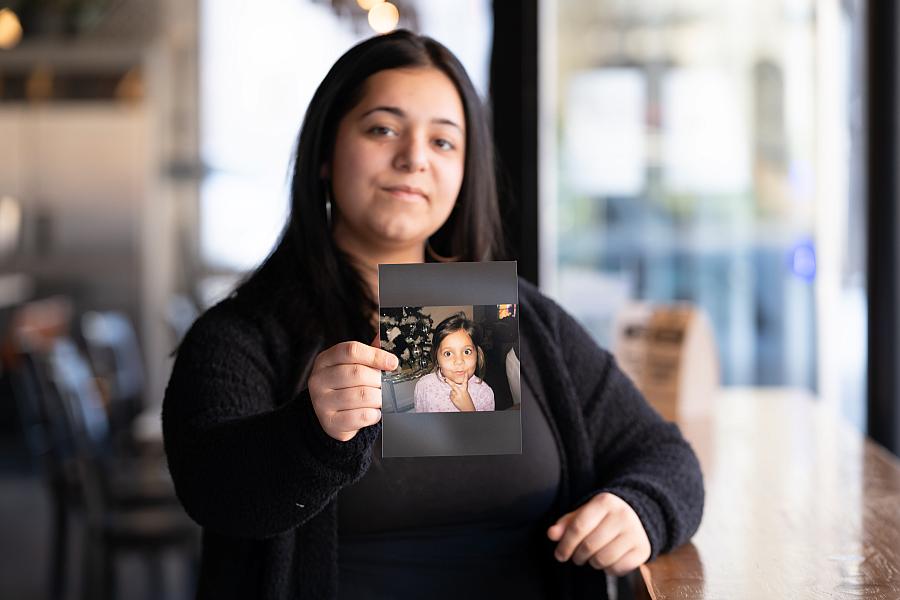
Olivia Frausto, now 19, holds a photo of her younger self, taken before she entered West Virginia’s child welfare system.
(Photo by Jenny Lynn Photography/Mountain State Spotlight)
For the past decade, West Virginia’s foster care system has made headlines — and not in a good way. There’s been a chronic shortage of child welfare workers. There aren’t enough foster families for the rising number of kids in care. And for years, West Virginia has been sending too many kids to group homes and in-patient treatment centers for mental health issues, when many of these kids don’t need that level of treatment.
For years, both the state foster care agency and elected officials have been arguing that the situation has improved, as they work toward an agreement with the U.S. Department of Justice to end federal oversight and fight a class action lawsuit. I wanted to see whether that was true.
I obtained the massive treasure trove of data from the federal Adoption and Foster Care Analysis and Reporting System earlier in 2024. But it was a data set that exceeded my intermediate Excel skills. For each year of federal data, there were hundreds of thousands of entries. Each represented a child that had touched the foster care system that year. I knew there were answers to my questions in this data, but I had no idea how to unlock it.
That’s where the Center for Health Journalism’s Data Fellowship came in: After three days of training in Los Angeles, I had enough of a foundation in R to generate some useful scripts. Then I started poking around — all in all, I ran more than two dozen separate analyses, answering my initial question and raising new ones.
I discovered it was necessary to really spend a lot of time with this data, as well as with the codebook, understanding what it could and couldn’t tell me. There were analyses that were best done year by year, to examine how things changed over time. There were other analyses where it made sense to consider each unique child, and either their first or last encounter with foster care. And there were other analyses where I wanted to determine whether a child had any year where a certain condition or experience applied — like trying to isolate a group of children that had spent any time in an institution during their years in foster care.
I was greatly helped in this process by talking with outside experts: academics and statisticians who were already familiar with AFCARS, and could help point me toward some interesting blips in the data.
I found that it was accurate when West Virginia officials said they had made progress sending foster kids to non-institutional settings: From 2012 to 2022, there was a 23% drop in the number of kids in these types of placements. But the issue that had initially concerned the DOJ — warehousing kids with disabilities in institutional settings — was still very much a problem. By September 2022 (the end of the 2021 fiscal year, the most recent data available), half of West Virginia foster kids with disabilities were still in these types of homes. That was three times the national average for all kids with disabilities across the country for the same time period.
That point became the data underpinning of my story, but there was a lot more. In a system that’s only become more secretive as problems have compounded, the AFCARS data gave me foundational data about West Virginia’s foster kids that had been lacking. It told me how old they are, how long they had spent in the system, and why they were removed from their parents in the first place. It helped flag areas where I needed to seek out other data sources, like West Virginia’s monthly foster care placement reports and staffing numbers they provided to the state Legislature.
And the AFCARS data also flagged issues I hadn’t considered, such as raising questions about why there was a sudden jump in the number of kids who hadn’t been assessed for disabilities at all. That jump — from 6% to 26% — came right after the DOJ had concluded West Virginia’s treatment of kids with disabilities violated their rights. The state wouldn’t answer questions about why that increase appeared.
I’ve been a journalist and a reader of journalism long enough to know that data isn’t enough for a story. This story needed people, specifically the voices of foster kids that West Virginians tend to hear from very infrequently. I was really lucky to meet all three of the former foster kids spotlighted in my stories fairly early on in the process, through a combination of social media sleuthing, reading through court documents and interviewing the right people on the system’s periphery.
Once I found Sadie, Orion and Olivia, I worked hard to gain their trust. I made sure they knew what to expect from me and from the reporting process. We talked about what they were comfortable with including in the story, and we talked about the details I needed to know but would not include. When the stories were drafted, I called each of them and read them the sections about them, line by line. This is something I wouldn’t typically do — and something that as an editor I’ve advised my reporters against doing — but I made an exception here. It was really important to me that none of these three young people, all of whom were willing to trust me with really personal and difficult stories, would be surprised by any of the details I was publishing.
As satisfying as doing the data analysis, finding the key characters and publishing the story was, I still feel like there is much more work to do with this data. For one, it’s a few years old at this point. A representative from the National Data Archive on Child Abuse and Neglect — where the AFCARS data is maintained — said more recent data should be released sometime this year. I’m interested in looking more into outcomes, like how children exit the foster care system, and seeing what information potentially exists in other databases that can be used in concert with the AFCARS data.
And of course, the crisis that led to my requesting these datasets in the first place is still very much a crisis. West Virginia just began its annual 60-day legislative session, and lawmakers have only introduced a few foster care-related bills, all picking around the edges of this massive problem. We have a new governor and some new legislative leaders. But disappointingly, on the eve of the session, their most concrete plan on the foster care issue was to “spend a whole lot more time talking.”