

Explosions, cancer-causing gases: How regulators failed Jordan High students for decades
The story was originally published in Los Angeles Public Press with support from our 2026 California Health Equity Fellowship.

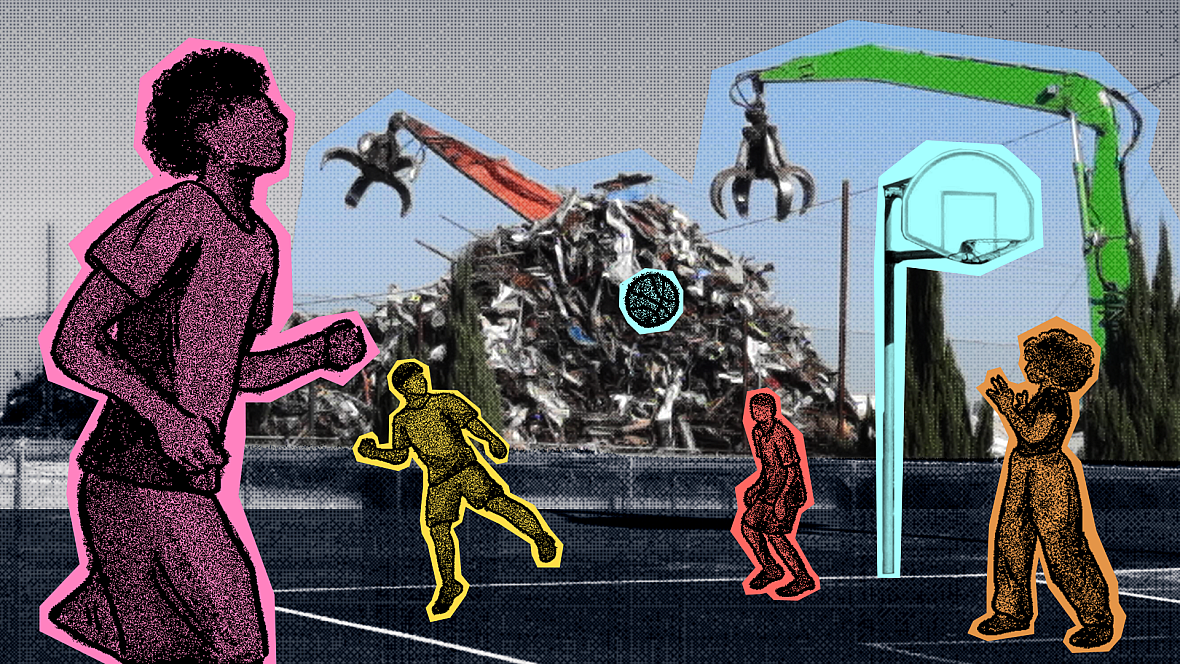
Illustration by Alyson Yee.
On a bright Tuesday morning in August after summer break, back-pack clad children and caffeinated teachers filed through the narrow concrete entranceway to Jordan High.
There were, of course, the all-too-familiar back-to-school hopes and worries. But alongside that was a more particular set of fears and frustrations that for too long have haunted the Watts community.
Cancer-causing chemicals in the soil like an industrial solvent and a refrigerant are crawling toward and onto the campus of Jordan High that court filings describe as “orders of magnitude” above state screening levels.
The culprit? S&W Atlas and Metals, a metal recycler that was allowed to operate next to the campus for 75 years until being shuttered last year, according to the court filings and the company’s own environmental reports. Years of processing metal scraps yielded dangerous chemicals that can seep up from the ground into the air. School officials said they fear the plume is already well onto school grounds and under buildings, where they can get sucked up and trapped inside rooms.
That’s because recent air monitoring in a Jordan High gymnasium and basement classroom identified a cancer risk in the air 48 times above California’s protective standard for children at their homes, according to court documents filed in February by the LA County District Attorney’s office.
This story, which many describe as a case study in environmental racism, has been years in the making.
A new LA Public Press review of court records, government documents, and extensive interviews found that for more than two decades, multiple environmental agencies and local elected officials missed repeated opportunities to potentially close Atlas. They also made several decisions that either prolonged or made the situation worse for the Jordan High community.
Only a brick wall separates the school campus, about seven miles south of Downtown LA, from the lingering stain of the toxic metal yard that made the lives of the students and teachers unbearable with a frequent haze of metal dust and loud, ground-shaking noises, sometimes bringing classes to a halt.
“There were days when they would burn stuff, the air smelled so thick and oily and nasty,” said Genesis Cruz, a Jordan High student who graduated in 2023.
Plant workers cut, welded, and sorted for reuse all sorts of scrap metal, including radiators, industrial equipment, and electric motors.
It wasn’t just the racket, odors, and toxic dust. In the last 25 years, three separate explosions at Atlas terrorized the school.
During one of those blasts in 2002, a piece of shrapnel shot onto campus. It was big enough “that if it hit a child on the head it could have killed them,” said Angelo Bellomo, who at the time was the Los Angeles Unified School District’s director of environmental health and safety.
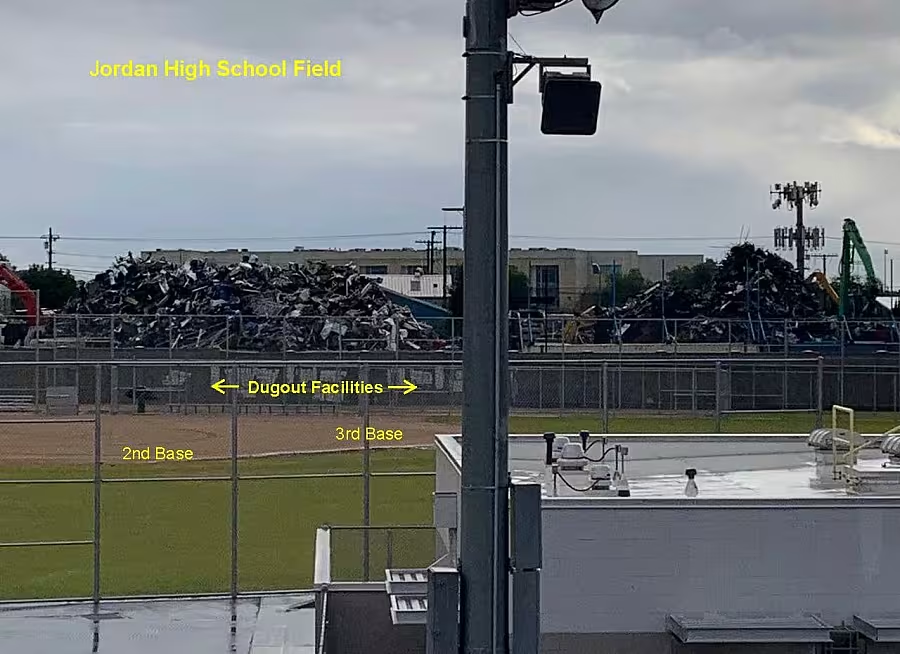
Loud ground-shaking activity within S&W Atlas and Metals would often disrupt classes at Jordan High school. According to LAUSD, this photo was taken between 2019 and 2020.
Photo courtesy of LAUSD.
At Jordan High, 77 percent of the some 747 students are Latino, and 19 percent are Black. The students already live in one of the most under-resourced and polluted neighborhoods in California.
Over a year ago, Atlas pleaded no contest in Los Angeles County Superior Court to five criminal counts related to the disposal of hazardous substances. With the plea, Gary and Matthew Weisenberg, the father-son owner operators of Atlas, accepted the charges and agreed to pay $2 million in penalties but did not admit guilt.
The Weisenbergs agreed to close Atlas and conduct a vast cleanup of toxic contamination as part of their plea agreement with county prosecutors.
LA County District Attorney Nathan Hochman promised in a press statement the shutdown and planned cleanup would mean that, “Watts is safer and the children and educators at Jordan High School can now breathe easier — literally and figuratively.”
But in February, the Weisenbergs were ordered back to court by the judge to address missed cleanup deadlines and more than $620,000 of the $2 million in unpaid fines and penalties. The judge ultimately didn’t charge the Weisenbergs with a probation violation.
Ask Tim Watkins, president and CEO of the Watts Labor Community Action Committee and a fiery opponent of Atlas over the years, why the cleanup has taken so long and he’s adamant: “No one gives a shit.”
Wright’s list of wrongs
For all of these failures, the story of Atlas and Jordan High is not one of indifference.
Concerned parents, students, community advocates, and school officials rallied to close Atlas for years, frustrated by state agencies they believed downplayed the problems. Few pursued the issue as fiercely as Dan Wright, a veteran environmental prosecutor with the Los Angeles County District Attorney’s office.
In April, Wright stood before an audience of more than 200 people at an April environmental justice symposium in LA and pointed the finger of blame squarely at the California Department of Toxic Substances Control, or DTSC. The state agency is responsible for policing hazardous waste and has an environmental justice mandate to “challenge existing disparities and the decision-making processes that keep historic injustices and present-day barriers in place.”
Wright’s presentation was astonishing for several reasons, not least because the audience included the department’s director, Katie Butler, who took the position in September 2024 and with whom Wright continues to work.
The crux of Wright’s frustrations centered on a July 2020 DTSC investigation where investigators identified multiple serious hazardous waste violations at Atlas. Three months later, the agents conducted soil sampling on and around Jordan High and found sites with lead as much as five or six times over the state’s residential soil lead standard.
Multiple officials told LA Public Press the 2020 investigations were severe enough for the agency to pursue a criminal case against the Weisenbergs, similar in effect to what they would eventually be found guilty of five years later.
To pursue criminal charges, the DTSC needed to refer the case to either the LA City Attorney or the District Attorney’s office.
Had the state quickly pursued criminal charges against Atlas and secured a mandatory injunction, DTSC could have closed the plant “almost immediately, upon a finding of non-compliance,” Bellomo, who was also DTSC’s former director of Southern California Operations, told LA Public Press.
Instead, the DTSC filed a civil case against the company, and took two years to do it.
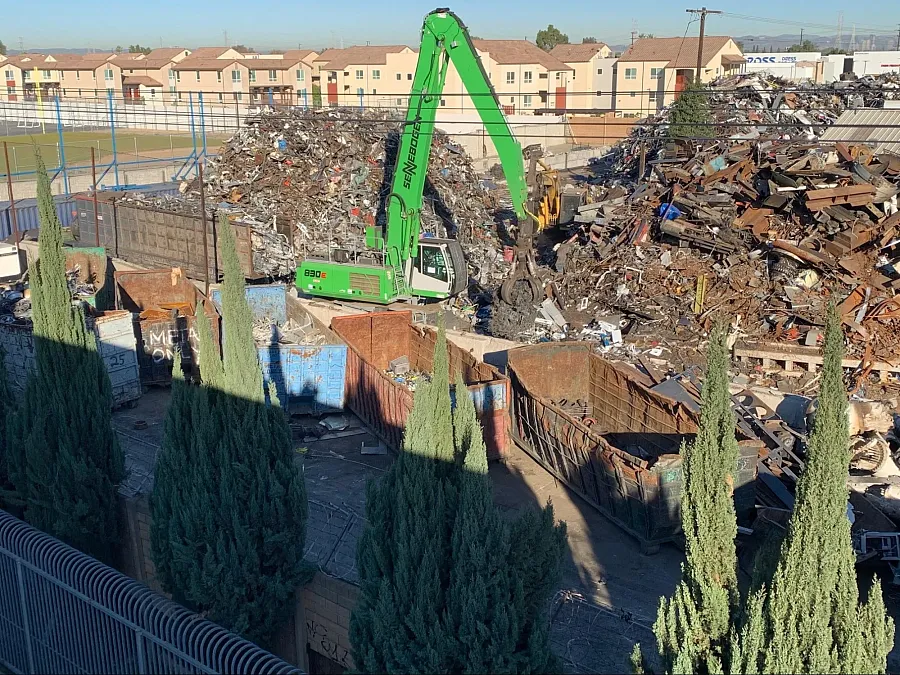
Metal junk piled high at the S&W Atlas and Metals property next to Jordan High school. According to LAUSD, this photo was taken between 2019 and 2020.
Photo courtesy of LAUSD.
Wright, speaking in April, said his office “begged” for the criminal case. According to Wright, the department argued the case didn’t rise to a criminal level.
Undeterred, Wright started his own investigation. But he needed independent analysis of the school’s soil. He asked the DTSC to do it. For months, he said, the state agency dragged its heels.
In May 2022, DTSC technicians and members of the agency’s criminal investigation unit finally jumped into their cars and headed for Jordan High.
On route, however, Wright said a state agency superior told them to stop and turn around. “They were on their way, and then they said [to me], ‘Well, sorry, we can’t come.’”
At least one person had already reached LA County from Sacramento when they were ordered to stop, LA Public Press confirmed.
According to two separate sources familiar with the call who asked to remain anonymous because of their ongoing work with DTSC, the senior department official was worried the test results would embarrass the agency.
Wright called LA County Fire Department investigators to do the testing. The results confirmed what he already knew: The soils at Jordan High contained felony levels of hazardous chemicals.
Led by Wright, the DA’s case that would eventually close Atlas was launched.
A letter obtained by LA Public Press through a Public Records Act request provides a tersely-written glimpse into the rivalry existing between the two agencies. In it, David Sadwick, DTSC’s then assistant chief counsel, chafes against LA district attorney’s office staff for incorrectly reporting the “DTSC has an on-going criminal investigation” into Atlas — a characterization Wright strongly denied in April.
DTSC chief Butler initially agreed to an interview with LA Public Press but subsequently declined.
In an emailed statement, DTSC spokesperson Albert Lundeen said the department played a critical role in the case and helped to secure financial restitution that included $1 million to LAUSD. Lundeen noted LA County District Attorney Nathan Hochman’s comments that “DTSC played a key role in holding this company accountable and remains committed to ensuring the site is cleaned and that the community of Watts is protected.”
Senior school district officials told LA Public Press the district has spent approximately $4.4 million conducting environmental testing and cleanups at Jordan High.
‘No one came to save the day’
Atlas Metal had been on the radar of state regulators since at least 2002, when two dangerous explosions rocked the Jordan High campus.
One involved a 155-millimeter navy shell that exploded while being dismantled, raining shrapnel over the Jordan High campus. The incident reportedly caused one minor injury and the evacuation of more than 2,500 students.
A subsequent investigation by the state and the Environmental Protection Agency resulted in a multi-year cleanup that removed thousands of tons of soil from the Atlas site contaminated with lead, arsenic, and carcinogenic polychlorinated biphenyls, as well as a separate cleanup at Jordan High.
But the fight wasn’t over. In the nearly twenty years between the 2002 explosions at Jordan High and DTSC’s criminal investigation into Atlas, the department would oversee multiple rounds of soil testing and the removal of many thousands of tons of soil.
Though the agency during that time acknowledged Atlas as a potential source of this pollution, it also repeatedly downplayed the risks from the contamination to children at Jordan High and sometimes appeared reluctant to publicly pin potential blame on the recycling facility.
Not through want of warning.
For years, school officials repeatedly warned the department that Atlas was seriously violating conditions written into two key operating agreements the company signed after the potentially fatal 2002 explosions.
When DTSC tested the school property in 2011, it found “elevated concentrations” of arsenic and lead, but determined it didn’t constitute an “elevated risk” to students. It linked the contamination to old lead paint and imported “fill material” brought in from outside.
In 2013, influential advocacy group California Safe Schools filed a complaint with the EPA about persistent air pollution concerns stemming from Atlas.
The complaint was kicked down to DTSC, which refused the advocacy group’s request to conduct additional soil sampling where the Atlas property bordered the school.
Such testing, the agency said, was “not warranted” even though a prior inspection by the fire department hit Atlas with multiple operating infractions.
The DTSC called them “housekeeping” violations.
Before a 2015 cleanup of lead and arsenic contaminated soil at Jordan High, the department continued to publicly attribute the pollution on paint and imported fill material, despite outside experts explicitly blaming Atlas.
In a near two-hour interview with LA Public Press, Carlos Torres, director of LAUSD’s office of Environmental Health and Safety, chronicled his dismay that it took so long for regulators to stop Atlas.
Over many years, Torres said, different agencies came to Jordan High with the same approach.
“‘This is horrible. I can’t believe this has happened. We’re going to come save the day,’” he recalled.
But for too long, Torres added, “literally no one came to save the day.”
DTSC spokesperson Lundeen said in a statement the department “strongly disagrees” with the characterization it had ignored opportunities to act or downplayed risks to the school community, calling such an accusation unreflective of “the dedication and professionalism” of the agency’s staff.
“The department’s decisions over the past two decades were based on the best available information at the time, evolving scientific understanding, and the regulatory tools and standards that existed during each period,” Lundeen wrote.
Controversial City Council Vote
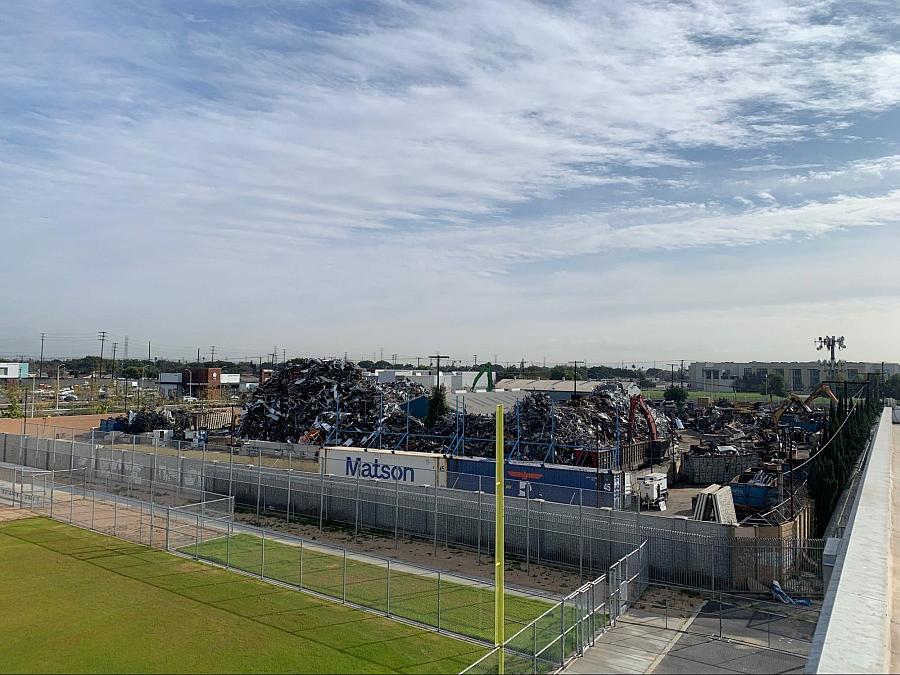
S&W Atlas Iron and Metals separated by a wall from the Jordan High school baseball field. Since this image — taken between 2019 and 2020, according to LAUSD — the scrap piles have been removed.
Photo courtesy of LAUSD.
As the decade of the 2010s drew to a close, a giant mound of scrap metal at Atlas towered visibly above the Jordan High fenceline like the Rocky Mountains of waste.
Previously tucked behind the perimeter wall thanks to a prior land use agreement, the twisted metal became an ugly reminder for the Jordan High community of the perils that existed beyond the classroom windows.
The reason the junk pile — which Atlas finally removed in 2025 — grew so high can be traced to a controversial vote by the LA City Council in 2016.
Against the warnings of then-LA City attorney Mike Feuer, the City Council voted to unwind key operating restrictions at Atlas, including the limit on the height of the junk.
In a 2020 letter to city officials, former LA school board president Richard Vladovic would speculate as to the reasons why.
LA City needed to annex the Atlas property from LA County as part of a $1 billion redevelopment of the neighboring Jordan Downs housing project. The Weisenbergs, however, fought the annexation through litigation, which threatened to derail “critical funding” for the costly redevelopment, Vladovic wrote.
The Weisenbergs pushed for the loosened operating restrictions, Vladovic wrote, as a sweetener to drop the litigation. It worked.
As life worsened for Atlas’s neighbors over the wall, multiple regulatory agencies weighed in. In 2019, for example, the LA County health department identified several health and safety issues and violations at Atlas.
Despite other agencies — including the LA Department of Building and Safety, the local air district and the regional water quality control board — being alerted to these problems, “no meaningful action whatsoever” came from it, wrote Vladovic in his 2020 letter to LA City officials.
For the Jordan High students and teachers, change came glacially, if at all.
More than 100 students signed a letter in 2022 issued to multiple local and state officials describing the routine sounds of cars being crushed, the acrid fumes from “metal being burned,” classrooms shaking from the plant’s operations, and noises “so loud we are unable to hear our teachers speak.”
At one point during student Genesis Cruz’s tenure at Jordan High, Atlas erected a large border wall of metal shipping containers stacked atop one another haphazardly.
The purpose? To obscure the growing pile of metal junk. In a court filing, a school district engineer called the container wall “dangerously non-aligned.”
“If they fell off,” Cruz said, “they could have crushed someone.”
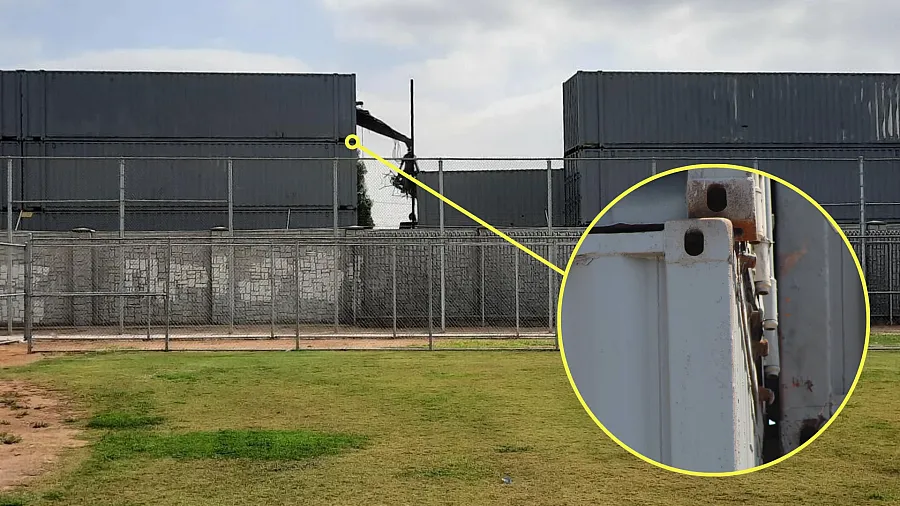
Caption: S&W Atlas Iron and Metals erected a wall of shipping containers that a school district engineer called “dangerously non-aligned.” According to LAUSD, these images were likely taken in 2021.
Photos courtesy of LAUSD. Photo collage by Alyson Yee.
In June 2023, the LA County district attorney’s office, with Wright involved behind the scenes, filed criminal charges against Atlas and the Weisenbergs. But the case, presided over by LA Superior Court Judge Kerry L. White, dragged on.
By 2024, a group of students and community advocates had enough. Dressed in black to reflect the somber nature of the occasion, they descended on the LA Superior Courthouse in Downtown LA for a hearing that January.
At one point, community advocate Tim Watkins vented his frustrations that Atlas was still operating and was promptly ejected from the room by White.
“He just didn’t behave like the community had standing,” said Watkins of White, a judge who garnered more recent public attention for his hostile behavior in the courtroom.
Eight months after Judge White threw Watkins out of his courtroom, Atlas was the scene of yet another explosion that shook the school community, this time on the first day of school.
Timeline of litigation woes:
June 2020: The Los Angeles Unified School District files civil charges in U.S. District Court for the Central District of California against Atlas.
April 2021: The LA City Attorney files civil charges against Atlas in LA County Superior Court. California’s Attorney General joins the case in May.
May 2021: Because of the school district’s ongoing case, LA Superior Court Judge Terry Green stays LA City’s civil case, dismissing in a written filing the legal fight between Atlas and Jordan High as a “dispute” between two neighbors over “Defendants’ use of their own property.”
Cancer-causing gases threatening students
The Weisenbergs’ probation ends October 2027, according to their court order, which means the pressure is on to speed up the remediation.
Regulators, however, aren’t moving with the urgency wanted by the school community considering the toxic threats the children still face.
LAUSD’s testing between 2025 and 2026 found carcinogenic chemicals in the air of the Jordan High gymnasium and basement classroom, which is only about 100 feet from known soil contamination that Atlas’s own testing confirmed.
The school district asked the department of toxic substances control “multiple times” to order Atlas to conduct additional air monitoring, a school district spokesperson wrote, “but [we] have been advised that it would take too long for the agency to make this happen.”
According to LAUSD, Atlas and the Weisenbergs still owe the school district $400,000 of the $1 million judge-ordered restitution.
DTSC spokesperson Lundeen told LA Public Press that none of the chemicals detected in the school gym that were related specifically to Atlas were above residential health thresholds.
A residential cancer risk is typically a stricter standard than commercial or industrial cancer risks, given the amount of time people spend in their homes versus the workplace. According to sources, the cancer risk calculated by the LA County DA’s office comprised all chemicals detected in the school gym, including those unrelated to Atlas.
“If at any time, more immediate action is needed based on new information, DTSC will not hesitate to communicate this to LAUSD and the public,” Lundeen wrote.
In testimony at a February court hearing, Benjamin Stanphill, the DTSC’s Southern California Division Chief, stressed his satisfaction with Atlas’ cooperation during the cleanup.
Yet just two months prior, the DTSC threatened Atlas with a $25,000 fine if the company didn’t quickly deliver a key environmental report it had months to put together. It was already a week overdue.
As of August 21, Atlas had not paid the roughly $220k owed to the DTSC in oversight costs, according to agency spokesperson Elizabeth Leslie-Gassaway.
In an emailed response to questions about the cleanup, attorney William Carter, who represents Atlas and the Weisenbergs, wrote his clients were in “substantial compliance” with the terms of their probation. He specifically quoted the response to Stanphill’s testimony by the LA Superior Court Judge in the case, Terry Bork.
“‘If DTSC had come to this Court saying that the Defendants had impeded the work of regulators or had obstructed that work, then the Defendants would have been remanded into County Jail right then on the spot,’” Carter wrote, quoting Judge Bork.
The whole process, however, according to Dan Wright during the April symposium, is “just taking way too long. All the while, he added, “the kids are sitting there sucking those fumes.”
Wright’s frustrations with the pace of the clean up led him to email the LA County Department of Public Health in December, asking it to declare the Jordan High cleanup an emergency — something the health department hasn’t done.
Health department spokesperson Becky Schlikerman wrote in an email the department joins routine meetings with other agencies about the cleanup, and said it’s the school district that has the authority “to determine if their facilities should be closed.”
Perhaps the reason why the pollution persists at Jordan High can be explained by something LA County District Attorney Hochman said at the same April symposium.
“If this case wasn’t brought in Watts but was brought in Beverly Hills,” Hochman said, “the case would have been solved decades ago.”