

The Health Divide: Who pays the price for America’s AI boom?

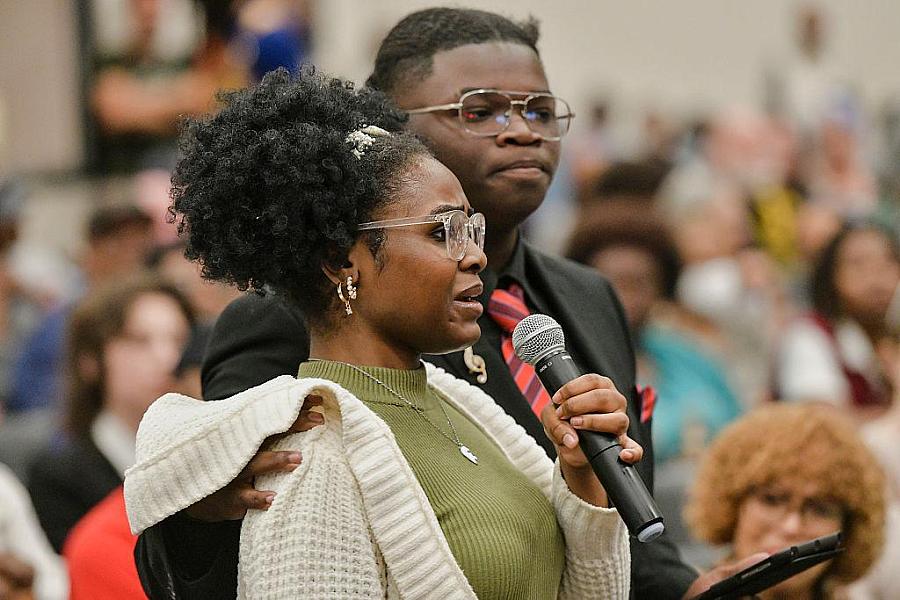
Students speak in opposition to a proposal by Elon Musk's xAI to run gas turbines at a new data center in Memphis, Tennessee, during a public comment meeting hosted by the Shelby County Health Department in April 2025.
(Photo by Brandon Dill for The Washington Post via Getty Images)
Residents near Milwaukee's Midtown Center weren't against doing something with the former Walmart that has been sitting empty since 2016.
When the store closed, nearly 300 people lost their jobs, taking another major employer out of a part of Milwaukee already struggling with unemployment and poverty.
So when developers proposed redeveloping the site with affordable housing, a new library branch, self-storage and other uses, residents weren't necessarily opposed.
The problem was a roughly 19,000-square-foot computing facility proposed for part of the former Walmart.
The developer said it wasn't a traditional data center. It would house high-performance computing and research, use a closed-loop cooling system and require about 10 megawatts of electricity, about 7 megawatts beyond the building's existing electrical capacity.
But residents had questions.
They wanted to know who would operate it, exactly what would happen inside and what it would mean for their utility bills, water, noise and air quality. Some also questioned why a facility they believed would bring environmental impacts was being proposed in a predominantly Black neighborhood.
After three public information sessions and hours of testimony before the City Plan Commission, the developer dropped the computing facility from the proposal.
That ended one neighborhood fight, but it didn't answer a much bigger question facing communities across the country. As companies spend billions of dollars building data centers to meet the growing demand for artificial intelligence, who benefits and who ends up paying the price?
A fresh hit to already burdened communities
For much of my life, I've lived about five blocks from the former A.O. Smith complex, which produced automobile frames on Milwaukee's north side and at one point employed thousands of people. The company is long gone, but cleaning up what was left behind wasn't cheap.
After acquiring much of the property, Milwaukee undertook a roughly $40 million effort that included demolishing buildings, cleaning contaminated soil and groundwater, and preparing the property for what is now Century City Business Park.
Communities of color and low-income communities have long faced disproportionate exposure to highways, factories, power plants and other sources of pollution. That's part of the history that members of Black and brown communities often have in mind when another major development with potential environmental consequences comes along.
And now researchers are examining whether the rapid expansion of data centers could add to environmental and health burdens some communities are already carrying.
The Environmental Data & Governance Initiative examined communities within 1 mile of 550 data centers regulated by state and federal environmental agencies. About 4 million people live within a mile of the facilities the group examined.
It found those communities generally had air-pollution burdens above the national median. More importantly from the perspective of the Health Divide, it found that people of color living near the data centers experienced disproportionately high levels of fine particulate matter, nitrogen dioxide and diesel particulate pollution compared with white residents nearby.
The researchers cautioned that their analysis covered less than 10% of U.S. data centers and doesn't show that the data centers themselves caused all of the pollution measured in surrounding communities.
That's an important distinction, because there isn't enough evidence to say data centers nationwide are deliberately being placed in Black and Hispanic communities or that every data center creates the same health risks. The concern is what happens when facilities requiring enormous amounts of electricity and other resources are added to communities already dealing with pollution, noise and health disparities.
Research in Washington state adds to those concerns.
An analysis by the nonprofit Front and Centered has found more than half of the state’s 81 data centers were in census tracts with some of the highest proportions of people of color. Nearly half were in communities with high cumulative environmental health scores, meaning residents there are already dealing with multiple, overlapping exposures.
In Memphis, residents and environmental groups have raised concerns about air pollution connected to xAI's massive data center and the natural gas turbines being used to help power its operations.
The facility sits near predominantly Black communities in South Memphis that have lived with pollution from industry for decades. The fight over xAI has become another example of why communities already carrying environmental burdens are questioning what happens when the infrastructure needed to power artificial intelligence moves into their neighborhoods.
That doesn't prove data centers are creating the same problems everywhere, but it does suggest that where these facilities are built and how they’re powered can add to the load on communities already stretched thin.
Researchers have tried to put a price on the potential health consequences.
Researchers from UC Riverside and Caltech estimated that by 2030, air pollution from electricity generation and backup generators needed to support the growth of artificial intelligence could contribute to as many as 1,300 premature deaths a year in the United States. The resulting public health costs from premature deaths, cancer, asthma, other illnesses and missed work and school could approach $20 billion a year by 2030.
And researchers found those potential costs wouldn't necessarily be distributed equally.
That’s one reason data centers are becoming a political issue.
Across the country, lawmakers and candidates are debating who should pay for the additional electrical infrastructure data centers require, whether companies should continue receiving tax incentives, how much water the facilities should be allowed to use and how much authority local communities should have over where they are built.
Those debates are taking place in states including Virginia, Georgia, Wisconsin and Pennsylvania, where data center development has accelerated.
And the concerns don’t fall neatly along party lines. Republicans and Democrats have raised questions about utility costs, water consumption, tax incentives and what rapid data center development could mean for the communities where these facilities are being built.
What health reporters should be asking
Most of the conversation about artificial intelligence has focused on what AI can do, how it could change the way we work, whether it will eliminate jobs and whether it can make businesses more productive.
Those are important questions, but health reporters should be asking two more: What does it take to power all of this, and what are the real health consequences for the communities where these facilities are built?
Data centers require land, electricity, cooling systems and, in some cases, additional fossil-fuel generation. Those facilities have to be built somewhere.
People live near them. Their stories are worth telling. Their experiences are part of a larger story about who benefits from America's AI boom, who lives near the infrastructure needed to power it and who could end up paying the environmental and health costs.