

How a Virginia reporter tracked the regional fallout from federal health cuts in real time

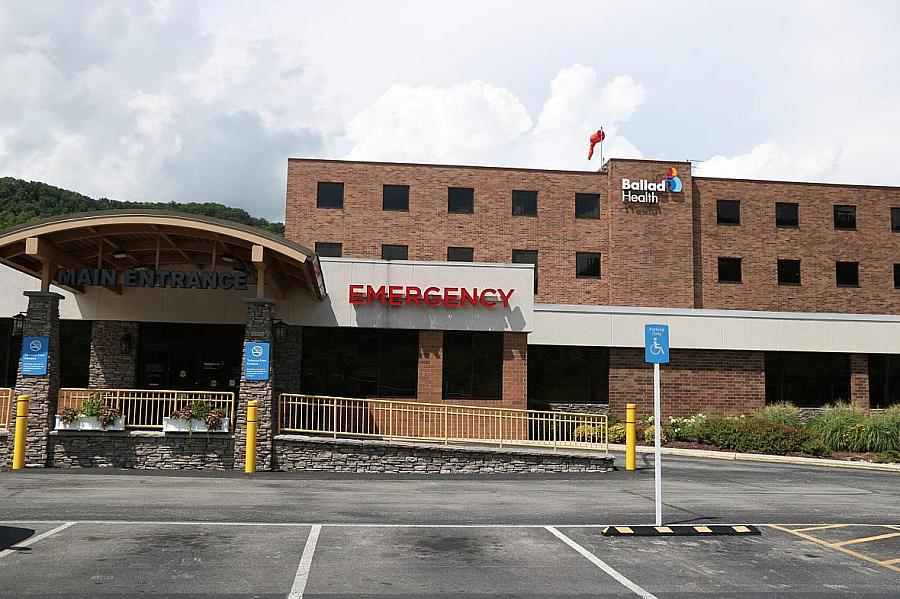
This hospital in Virginia’s Lee County was taken over by Ballad Health and reopened in 2021. It’s now vulnerable to federal funding cuts to Medicaid.
(Photo by Charlotte Rene Woods/Virginia Mercury)
From farm equipment accidents to labor and delivery, the emergency room staff at Lee County Community Hospital are prepared to handle whatever walks through the door, despite not having an obstetrics unit.
“It could be anything,” hospital administrator Cindy Elkins told me during a tour this summer.
The once-shuttered facility was reopened in 2021 and has been incrementally adding services that residents in the region need. The hospital is now owned by Ballad Health, which has a footprint in rural areas of Virginia and Tennessee. The small hospital in the deepest reaches of Southwest Virginia is among six Virginian hospitals and several hundred across the nation that are considered vulnerable to service cuts or closures amid forthcoming cuts to Medicaid funding passed in last summer’s GOP megabill.
The conversations I had with health care providers and patients around the state this summer and fall were grim at times, but there were moments where people flashed a smile. It happened when Norfolk resident Shay Tucker shared her resilience as a Black transgender woman living with HIV who once lacked a roof over her head and had a drug addiction she’s since recovered from. From doing “what I had to do to survive” to being known as the lady handing out informational pamphlets at community events, she recalled how tapping into housing assistance through a federally funded program for HIV/AIDS patients helped her find a new lease on life.
“Thanks for being my cover girl!” I said as she looked over with a smile from LGBT Life Center’s free pantry during a tour of the multi-faceted facility. The center supports the region’s LGBT residents with everything from housing assistance to counseling and support groups, to an in-house pharmacy. Tucker would be prominently featured in a three-part series, supported by the 2025 Impact Fund for Reporting on Health Equity and Health Systems, that explored how Virginians will be impacted by the federal funding cuts to programs such as the one Tucker has benefitted from.
Roughly 630,000 of Virginia’s overall 1.9 million Medicaid recipients stand to be affected by the forthcoming changes in eligibility along with changes to how hospitals are funded by the federal-state program.
These changes may mean uninsured people put off preventative care until they need it and instead end up in hospital emergency rooms — more costly for them and everyone else. As hospitals treat patients regardless of their ability to pay, those costs eventually get passed onto other consumers when negotiations happen with private insurers.
Lee County’s Cindy Elkins expressed concern that only 21% of patients served by the hospital have private insurance. Ballad’s chief operating officer Eric Deaton projects the company could lose $25 million in the first year the changes take effect.
“We’re very concerned and we’re really focused on ‘What can we do to work with our legislators in the future?’” he told me during an interview.
As I traveled around Virginia, I aimed to hear from patients, providers and others who would be real with me about the unfolding impacts of the federal cuts. Virginia’s state health department had already been grappling with its own staffing and financial issues, which I’d reported on the previous year. Solutions had been presented late last year by a state watchdog agency for the health department to implement. So a progress report, in my mind, was due.
While the state has worked to bolster and retain staff and resolve accounting issues — like those that lead to a $33 million deficit and a reimbursement adjustment with an annual Environmental Protection Agency grant — Virginia’s free clinics reported delays in federal grant disbursement this year.
Director Karen Legato of Richmond-based Health Brigade said it has made her rethink reliance on state and federal government for support. She’s since rallied other free clinics for town halls discussing how to ramp up charitable funding sources. Multiple officials in Virginia’s network of free clinics noted that the state’s uninsured patients may further flock to them for care. State lawmakers are looking at how they might be able to boost funding in the year ahead amid various competing needs.
From patients relying on services to providers that are stretched thin to state workers caught in governmental crosshairs, most people I spoke with were in a survival mode.
I knew that incremental reporting would be helpful in real-time, but that a robust contextualizer that could live beyond a 24-hour news cycle and reflect voices from around Virginia would be even more helpful for my part of the country. It’s what I set out to do and the Impact Fund support from the Center for Health Journalism helped make it possible.
This process was also a lesson in continual learning in real time. I had to be nimble. Sometimes sources — particularly in government — need scheduling grace or a FOIA to spur them along, and some sources just need more time to get back to me. I’d been a politics reporter for several years by the time I did this fellowship, but it was refreshing for me to lean into the human connections during the reporting. The work we do from inside chambers and legislative halls is important, but getting outside of them is what the work is really all about.