

A long search for the right subject pays off in story on Washington state’s efforts to keep more families together

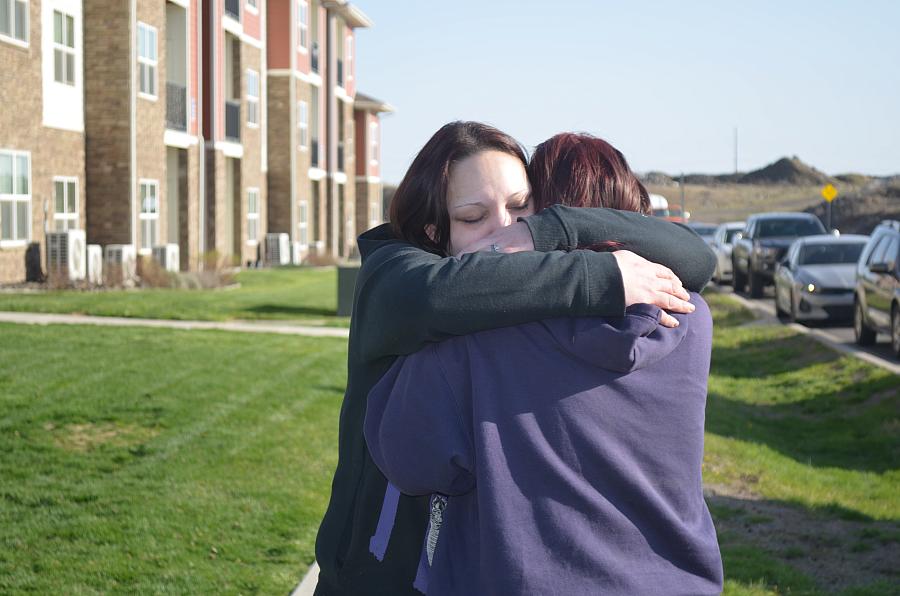
Sarah Nenema and her 14-year-old daughter Shayna hug near where Shayna lives outside Spokane. The family was featured in the author’s story on the disproportionate removal of Native children from their families in Washington state.
KUOW Photo/Eilís O'Neill
As a reporter working on a project for the Center for Health Journalism’s Child Welfare Impact Reporting Fund, my main goal was to understand the effects of two complementary policy changes in Washington state. The changes were implemented to try to keep more families together and to reduce racial disparities in the state’s child welfare system.
Historically, Washington state has been more likely to separate Black and Native American children from their families of origin. I wanted to find out if the policies had achieved those goals. I also wanted to understand whether the changes had caused more babies and children to be left in unsafe homes and situations, and to die, as critics alleged.
One of the policy changes was focused on hospitals; it provided a tool that health care providers, like doctors and social workers, could use to determine whether a call to CPS was necessary or not. Before this change, hospitals tended to always call CPS whenever a newborn tested positive for drugs, or if they tested positive for a medication that helped their birth parent stay off drugs. Now, many hospital-based health care workers use the new tool and often do not call in cases where the parent is taking a medication that reduces withdrawal symptoms and cravings for people with opioid use disorder. That has reduced CPS’s contact with many families who might have been traumatized by the child welfare system, and it has meant more birth parents have kept their infants.
The second policy change, called the Keeping Families Together Act, raised the bar for family separation. Now, for the courts to sign off on a child being taken from their parents, the case worker has to prove that staying at home would involve an imminent risk of physical harm. And the judge has to consider the harm of family separation as well.
Since the passage of that law, Washington lawmakers also passed a new law asking judges to give great consideration to the presence of high-potency synthetic opioids in a home. In mid-2025, the state’s child welfare agency also added a new requirement of “safe child consults” for all families with opioids in the home and a baby or toddler ages 0 to 3 years old.
My project about these policy changes and their effects included two major pieces: a long feature delving into why Native American parents are still the most likely to lose custody of their kids, and a radio documentary about the overall effects of the policy changes. Both radio pieces appeared as articles on the KUOW website as well.
Washington’s child welfare policy changes are important to my audience because they are extremely controversial here. Critics blame them for an increase in child deaths, so there has been a flurry of press coverage over the last couple of years. Most of it has focused on individual tragic cases, without an analysis of whether increasing child removals would increase child safety.
My radio documentary was released at a particularly timely moment — right at the beginning of a legislative session in which lawmakers are considering whether, and how, to change the state’s child welfare policies.
The biggest reporting challenge I faced was finding a parent who had faced CPS involvement but was ultimately able to keep their child due to the state’s policy changes. Many advocates and lawyers were reluctant to even ask their clients and connections if they’d be willing to share their stories, wanting to protect them from the harsh glare of public opinion.
“There isn’t a family that can be the face for 1227 [the Keeping Families Together Act],” one lawyer told me, “because these are confidential cases, and these families have a right to privacy, and the media environment now of a family that struggled with substance abuse — being the face of 1227 isn’t really an option.”
The lawyer also told me that the lack of public voices and stories to humanize the families that are now able to stay together has led to an imbalance in media coverage and public perception of the issue.
“Foster parents have been very vocal and very motivated around this,” the lawyer told me, referring to efforts to connect child deaths in Washington with the policy changes. By putting forward families, especially extended families, who believe the state’s policy changes caused a child’s injury or death, he added, “They’re the more successful side in terms of shaping opinion.”
I did not want my journalism to fall into this trap of providing an emotional narrative on one side of the issue — the critics of the state’s policy changes — without a family or parent who could humanize the other side of the issue — someone whose story illustrated the reasons the state changed its policies in the first place.
I spent months looking for someone, asking all my sources and interviewees to reach out to their contacts to see if anyone might be willing to share their story, and finally a doctor reached out to a patient he thought might be willing, and she texted me and offered to share her story.
KUOW agreed not to publish her last name or an identifiable photo, and we became the first news outlet of the many Seattle publications that have covered this issue to include the perspective of someone who kept their baby thanks to the state’s policy changes.