

In moment of crisis, a reporter pivots quickly for series on hazards faced by California farmworkers

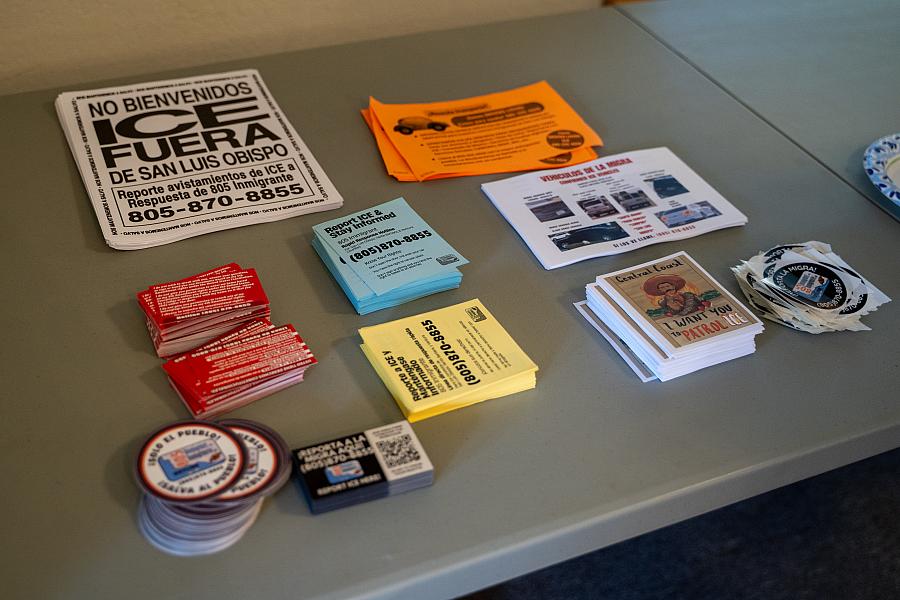
Fliers advertise a rapid response hotline and avenues to mobilize against ICE at a volunteer training in Cambria, California in September 2025.
Photo by Joan Lynch
In January, I pitched a project that would explore the barriers to access to health care for farmworkers and their families on the Central Coast of California. By March, President Donald Trump had drastically escalated U.S. Immigration and Customs Enforcement operations across the nation, including in San Luis Obispo County, where my newspaper is located. ICE descended on Central Coast farms and nearby neighborhoods to take undocumented immigrants into custody. I soon discovered that Central Coast farmworkers and their advocates didn’t have the time or safety to discuss pesticide exposure, dangerous working conditions or access to Medicaid. Sources that I connected with early in my reporting about workplace injuries dropped out of the project by April. They were spending all of their time and energy responding to ICE.
Early during the project, I connected with an immigrant rights activist who patrolled the streets for ICE every day. We spoke on background multiple times about her work and the fear ICE sewed in her neighborhood. She often called me from her car while on patrol, sharing that she hadn’t properly slept or been to the grocery store in weeks because she spent so much time defending her community from immigration agents. ICE was separating families, and people were afraid to leave their homes, even to go to work or the doctor. I realized I needed to adapt the project to fit the needs of a community in crisis.
The first lesson I learned was to change the focus of the project in response to the political climate. I decided to pivot the project to focus on hazards faced by farmworkers and their families rather than access to health care. This allowed me to report on ICE as a health and safety hazard, which was the greatest immediate concern of the farmworkers I interviewed both on and off the record. Shifting the focus of the project allowed me to meet Cesar Vasquez, a then-17-year-old activist on the front lines of the anti-ICE movement. The second article of the series featured his efforts, which included patrolling for ICE, training volunteers and delivering donations to families separated by deportations. The article also discussed the toll increased ICE activity had on his mental health, and the mental health of other activists that frequently encountered ICE. It felt important for the project to provide a platform for his experiences that were shared by so many immigrant families with farmworker parents.
Meanwhile, through this project, I adapted the way I approached my sources. The Central Coast farmworking community already had limited trust in me as a reporter, because my newspaper hadn’t focused its coverage on their concerns before. I started building relationships with farmworker rights and immigrant rights activists through lots of off-the-record phone calls and coffee meetings, and they gradually introduced me to people who work in the fields. In order to preserve a relationship of trust, I made sure to first share with farmworkers that they were not required to talk with me. Then, I shared that if they agreed to an on-the-record interview, I would be able to publish their name and quotes in the article, but I gave them the option to do the interview anonymously or off the record if they preferred. We would spend at least 15 minutes of the interview in a discussion like this, where they could ask me questions about the newspaper, the reporting process and my intentions. I wanted my sources to feel like they had agency over the interview. After on-the-record interviews, I shared quotes with my sources, and reviewed the context of the quotes in the story with them to ensure that their experiences were represented accurately. Considering the danger of ICE, I also offered anonymity to some of the project participants. Two women featured in the first article of the series about the dangers of pesticide exposure to pregnant farmworkers used their grandmothers’ names as aliases in the article to protect their identities.
One of those women, Rosa, worked with pesticides in a vineyard while pregnant with her son. Her son was diagnosed with autism, and she thought pesticide exposure was the cause of his developmental disability. I wanted to make sure to write about autism sensitively. I was nervous to write about a potential link to the development of autism while U.S. Secretary of Health and Human Services Robert F. Kennedy Jr. spread misinformation that vaccines and Tylenol cause autism. But I also wanted to respect Rosa’s experience. I decided to align the framing of Rosa’s story with the neurodiversity movement, which was started by autistic self-advocacy groups. This movement teaches that autism isn’t a flaw; it’s a difference in processing the world. Those activists believe that having autism isn’t inherently a problem. Instead, the problem is a lack of social and institutional support for autistic people and their behavioral differences.
Luckily, Rosa shared this view. She loved her son and the way he saw the world; she was just worried that he would face discrimination his whole life because he was different. I made sure to highlight these details in the article. I also felt it was important to explain the body of research into autism and pesticides. At most, the research suggests a link between exposure to pesticides in the womb and autism. No research has proved an official cause of autism. In fact, some of the studies found no connection between pesticide exposure and autism at all. Meanwhile, I felt it was important to highlight that pesticide exposure is linked to other health problems, like asthma and other neurodevelopmental differences.
Farmworkers and their children are disproportionately exposed to these dangers at a higher rate. With this in mind, my reporting underscored a key point Rosa shared in our interviews: Pesticide exposure doesn’t just impact farmworkers, it also has the ability to impact their entire family, with autism serving as just one example.