

How two journalists in New Orleans revealed their city had dropped the ball on toxic lead exposures

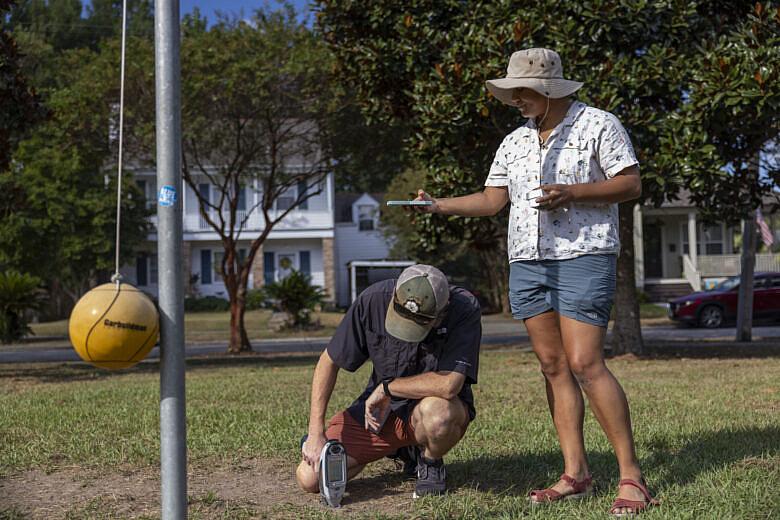
Verite reporter Halle Parker maps GPS coordinates while colleague Tristan Baurick tests lead levels at Mirabeau Playground in New Orleans’ Gentilly neighborhood.
Photo by Christiana Botic/Verite News and CatchLight Local/Report for America
Everyone knows New Orleans is old. Old enough for most of its buildings to still have lead-based paint and for the majority of its corroding service lines to be made of the toxic heavy metal. And no level of lead is safe.
But despite decades of research detailing the danger and pervasiveness of lead, our city officials have had other priorities. So when my colleague at Verite News, Tristan Baurick, approached me about doing our own lead testing in playgrounds across the city, I answered with a resounding “Yes!”
We modeled our work on past reporting by Yvette Cabrera, who did similar testing in people’s backyards in California. No need to reinvent the wheel. We connected with nationally renowned lead expert Howard Mielke to create our protocol for sampling, and we kept it simple: Measure the concentration of lead in topsoil where children are likely to play or kick up dirt. A merry-go-round, the bottom of a slide, under a tree or sand pits, for example. Bare soil poses the highest risk, so we prioritized those spots.
I looked at the city’s database of parks with play equipment, largely managed by the New Orleans Recreation Department, and we added a few others that flew under the radar. In total, we tested 84 parks over about two weeks. We rented an X-ray fluorescence sensor to take the readings. It looks kind of like an oversized price scanner. You hold the sensor against the topsoil (with a guard in between to prevent cross-contamination) and hold the trigger for 30 seconds.
This gadget told us how much lead was in that spot in real time. Before moving on to the next spot, I used my phone to grab the coordinates. The goal was to produce a relatively comprehensive map detailing which playgrounds had unsafe lead levels in the soil and which didn’t. The map could serve as a guide for parents to choose cleaner parks and advocate for others to be remediated. We also hoped it could serve as a starting point for the city to do more testing and cleanup. After we did the testing, we spoke with the city’s recreation department and learned lead testing at playgrounds was pretty rare. We knew more about the past efforts the city had undertaken than the agency’s current leaders.
That’s when we knew that our project marked the largest effort to test the city’s playgrounds for lead in more than 30 years (and possibly ever). And we found about half of the playgrounds we tested had at least one sample that exceeded the threshold for lead in urban soils set under the Biden administration, which was recently rolled back by the Trump administration. About a third had one sample over the current hazard level.
The last push to test the city’s parks occurred 15 years before our story was published. Parents of children with high blood lead levels at the time blamed a playground in New Orleans’ Bywater neighborhood. Mielke’s testing confirmed that the park — recently upgraded with play equipment — was toxic. After advocacy by the parents and media attention, city officials promised sweeping testing and remediation of all playgrounds. But a search of our state Department of Environmental Quality’s database showed the promise wasn’t fulfilled. Just 16 parks were tested, and 13 parks were remediated. (Two parks contained lead beneath the federal hazard level at the time, and one had high levels but wasn’t remediated for reasons that were unclear.)
In my second story, I originally wanted to do a similar testing effort of drinking water at people’s homes. Instead, given funding limitations, I focused on testing one block in which the service line material was mostly unknown but likely contained lead. And I figured out another way to examine the state of lead in the city’s drinking water beyond our utility’s limited triannual testing required by law.
Our utility provides free lead tests to residents upon request. The program had about three years’ worth of data when I sent in a records request last August. I got back data for over 1,100 households that participated, the largest single dataset of lead in drinking water in New Orleans. It showed that the heavy metal was detected in 7 in 10 households. Although the street numbers were redacted, we were able to map the results by block to help give readers a picture of how pervasive lead is in their area. It took some time. I had to manually search for each block ID in the U.S. Census’ Geocoder. But it was worth it to make previously unpublished data available to residents.
The highlight of this project for me though was every parent I spoke with who thanked us for this work. Katherine Prevost, a neighborhood leader, said she rarely speaks to the news media because she feels like it doesn’t contribute to real change. Then she looked me in the eye and pointed at me to say she would only speak with me for our water story because I put in the work to test the water on her block. That moment will stick with me forever. That’s why I’m a journalist. To build trust with people who have been let down time and time again.
Our work hasn’t stopped since our stories published. We’re preparing to print posters to hang at playgrounds where we found high lead levels and send postcards to people living in the ZIP codes with the worst playground contamination. I’ve been asked to test the water of more homes as residents wait for test kits from our utility. I published a third story detailing lessons learned from efforts to reduce lead in other communities, and soon, we’re also publishing a toolkit for limiting your lead exposure, including a list of vetted options for water filters. Parents are starting to organize around pushing the city to remediate, and we’re pressing those same officials for a response. This work is involved. It’s hands-on and relentless. And hopefully in the end, it takes us one step closer to zero lead exposure.