

A reporter learns to pivot when community engagement hits roadblocks in series on maternal mortality in Oregon

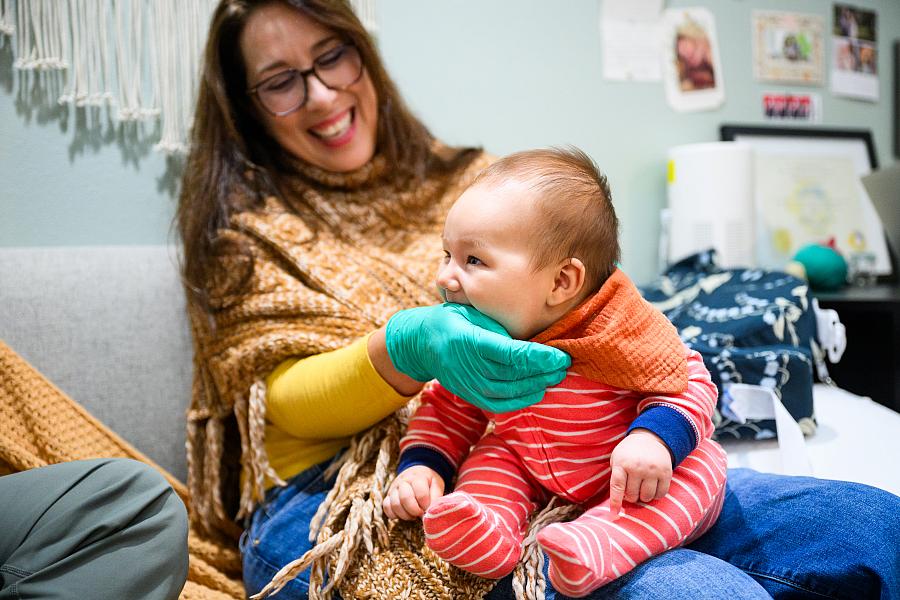
Three-month-old Reuel Wong latches onto lactation consultant Beth Waters’ hand during an appointment at Andaluz Waterbirth Center in Portland, Oregon.
Molly J. Smith/InvestigateWest
When I set out to examine maternal mortality in Oregon, it was clear that the state isn't facing the highest death rates in the country, nor was the problem that no one was paying attention. The problem I was investigating was more nuanced: Despite the state’s efforts to pioneer solutions, disparities are still exposing communities of color and low-income families to far higher rates of death and birth-related trauma.
Across the state, the biggest drivers of those deaths were mental health conditions and substance use disorders, which accounted for 41% of maternal deaths from 2018 through 2021. This finding, published in a report from the state’s Maternal Mortality and Morbidity Review Committee, became the jumping-off point for my stories investigating why our solutions are falling short.
From the beginning, it was important to me to connect with as many people directly impacted by infant or maternal deaths as possible, especially Black and Indigenous families who are disproportionately affected. I started out casting a broad net in search of them, including through my community engagement efforts.
Reaching those families proved more challenging than expected, however. An online form that I created to gather experiences from families and health care providers who had borne witness to or been affected by maternal death didn’t receive a single response, despite repeated efforts to circulate it online and in-person over many weeks. When I spoke with leaders of grief groups and family support networks who were eager to help, they told me they also struggle to reach families who have experienced maternal loss related to pregnancy. I was invited to several community events those groups hosted, including grief circles and an event focused on breastfeeding. But those families were not there.
“It’s harder when it’s a mom,” one organizer who runs a nonprofit focused on supporting families after infant loss told me. She said in her experience, those who had lost a mother during pregnancy or birth tended to withdraw, sometimes because the mother herself was the main person who facilitated community connections.
On one hand, the difficulties I had reaching families through my initial engagement work was discouraging, but it also gave me an opportunity to learn a crucial lesson about engagement: It doesn’t always go the way you imagine, and when something’s not working, you need to pivot.
It became clear over time that birth workers such as doulas, midwives and lactation specialists had important community and personal experiences that could also illuminate the human costs of the problems I was reporting on. They were also emerging in my reporting as key to the state’s efforts to boost maternal mental health. I gradually spent more time reaching out to these professionals, talking to many of them about how they started their work after experiencing pregnancy and birth-related trauma themselves.
I connected with these workers in a few ways. One was by attending events hosted by community groups that focus on supporting and providing resources to Black and multiethnic families in Portland. The first times I met with people, I often put my notebook away, and we spoke off record to build trust. Interviews came later.
I also launched another feedback form, this time a targeted survey of Oregon doulas asking about the barriers they face to sustaining their work. Through a public records request, I received a database of doulas registered with the state health agency, and emailed the survey to around 400 people on that list. The form garnered nearly 30 responses. It was a useful way to get a broad sense of the issues most affecting doulas and their clients, supplemented with additional follow-up with some of the people who filled out the survey.
My first story dug into why mental health is having such a deadly impact in Oregon, and why groundbreaking programs are struggling to have a statewide impact. One of the programs I spotlighted is called Project Nurture, which involves the kind of coordinated care that the state’s maternal mortality review committee recommended as key to prevent vulnerable parents from slipping through the cracks. Project Nurture brings substance use treatment providers together with maternal health care professionals to improve patients’ health when they are navigating pregnancy with a substance use disorder.
The program has shown promising results in its decade of operating in Portland, including reduced child welfare placements and improved engagement with substance use treatment. Lawmakers expanded the model into additional rural counties in 2021, but large swaths of the coast and eastern Oregon still have no such programs. Meanwhile, workers within Project Nurture told me about the constraints blocking the program from growing, including burnout and difficulty getting reimbursed for the care they provide. One of the most powerful voices we shared was that of Sarah Bovee, a doula and peer support specialist who shared her experience receiving care when she was pregnant and navigating addiction. The trauma she suffered propelled her into her work with Project Nurture, and she now walks alongside vulnerable women as an advocate and connection to resources and peer.
My second story focused on the ongoing pay barriers that prevent doulas and lactation workers from being able to sustain their work, leaving Medicaid recipients in particular with fewer options for their services. Oregon was one of the first states to embrace both doulas and lactation specialists in its Medicaid system. But years later, these workers, who serve a crucial role providing mental and physical care for pregnant and postpartum women, are still struggling to get paid. The story went into detail about the bureaucratic barriers that are causing financial strain, burnout and often keeping community-based programs out of the Medicaid system. Their inability to sustainably participate in the program then means fewer options for the families who were supposed to benefit most from increased doulas and lactation consultant access.
After my stories published, I began putting together a roundtable event to continue the conversation. Attendees will include many of the people I spoke to during the course of reporting and new ones who reached out after reading the stories. We plan to discuss what is working in Oregon to boost maternal health outcomes, and what is still needed. To me, this post-publication engagement work is very much in keeping with the spirit of the program and the lessons I learned along the way: to remain open, let the reporting guide you where it will, and remain focused on the communities at the center of the reporting. It also underscores that engagement with a community doesn’t end when you publish. Even more meaningful conversations might still be ahead.