

In this traumatized LA community, school officials and students desperately want a comeback for their schools

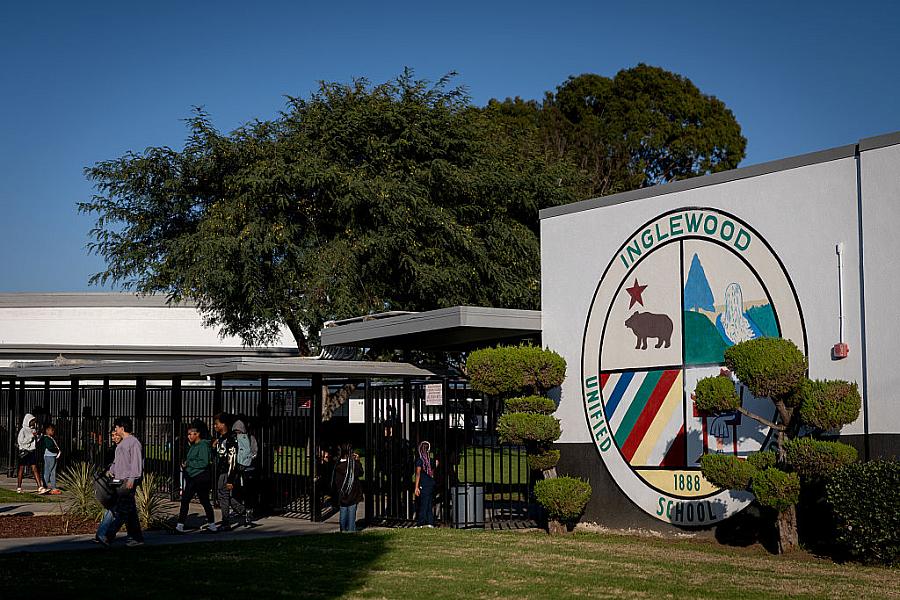
In this traumatized LA community, school officials and students desperately want a comeback for their schools
Eric Thayer / Los Angeles Times via Getty Images
I’ve had the honor of reporting on Inglewood Unified School District (IUSD) and the community activists who have struggled to bring attention to how California and Los Angeles County have mismanaged the district for the past 13 years, in a process called receivership. Across the nation, about 130 of our 10,000 districts have experienced receivership since the 1980s. It’s essentially a full takeover of a school system, usually because of financial or performance woes, in which an appointed official replaces the superintendent and the school board’s legal authority is revoked. Receiverships are often long, costly and traumatizing to communities.
Inglewood was placed in receivership because of financial mismanagement, which some sources assert was an overreaction by the state. During the process, IUSD has hemorrhaged students and closed schools. My primary story for The Guardian US followed Victoria Preciado, a parent who became a community activist starting in 2022 when she rallied a coalition to keep a beloved elementary school open. Inglewood had already had several schools shuttered and her band of parents, educators, residents and students were all in. At one meeting, Preciado’s young daughter, also named Victoria, recited Tupac Shakur’s poem “The Rose That Grew From Concrete,” and pleaded with an advisory committee to keep her school open. The advisory committee, made up of Inglewood residents and businesspeople, sided with little Victoria and the community. Unfortunately, the county-appointed administrator for IUSD is the sole decision-maker. He shuttered the school — and later announced the closure of additional schools, including one of the two remaining comprehensive high schools.
Meanwhile, the city of Inglewood experienced a comeback story. Like its school district, it had a history of financial distress but is now reputed for its big money glitz and glamour. Sports teams and rock stars perform at Inglewood entertainment venues. Many of the events for the 2028 LA Olympics will be based there. Advocates told me it’s galling that while the world is partying in their town, Inglewood students haven’t had a working swimming pool at school for 10 years. Furthermore, under state and LA County control, the district has been in freefall. In the early 2000s, IUSD was recognized as a crowning jewel of urban education for its test scores. In fact, Duke Helfand, then a reporter for the Los Angeles Times, wrote a story with the headline “Inglewood Writes the Book on Success.” Back then the district had some 18,000 students enrolled. Under state control, key metrics across the board including test scores, graduation rates and attendance have nosedived. There are now fewer than 7,000 students enrolled.
Activists warn that we all need to pay heed. Receivership is another tool — along with curriculum censorship, funding cuts and threats to equity and inclusion — to weaken ailing public schools, they told me.
Inglewood is a majority Black and Latino district where more than 80% of the students are considered socioeconomically disadvantaged. New York University’s Domingo Morel, an expert on school takeovers, told me: “When we look at takeovers, the pattern is pretty clear that this is a policy specifically targeted at communities of color.” While whiter and wealthier districts get coaching and monitoring, communities of color get taken over. According to Morel, takeovers rarely fix the problems the districts have that got them into trouble. In fact, counterintuitively, moves like closing schools can worsen the predicament. In Inglewood’s case, that’s been true. Thirteen years and a bloodbath of closed schools later, the district is still years away from getting out of receivership and has only recently shown improvement when it comes to financial management. Victoria Preciado pulled her daughter from the district but continues her activism.
Advocates are particularly incensed that decision-makers have mostly shuttered schools in the poorest part of town — essentially creating school deserts in an area where families often have no car or share one car. In the most recent turn of events, the Inglewood Teachers Association and the American Civil Liberties Union have filed a complaint with California Attorney General Rob Bonta asking for an investigation into the district.
Wrapping my arms around the history of the district, school funding issues, the extremely complicated process of receivership and the socio-emotional impact of school closures on communities, was right up my alley. I often write about families and the intersections of mental health, health equity, social justice and education. Reporting on systems — especially education — is always complicated. But I felt foremost my job was to listen deeply to the activists. They told me they fear they are being erased. The history of the crisis was important to the community. In fact, it was perhaps the most important. Reporting had been done over the years, but nobody had put the story all together, since that’s a labor-intensive reporting project. The key story for this project attempted to look back, look at the present, and look forward. Thankfully, people within IUSD were generous with their time and views. All this meant a lengthy word count compared to the typical Guardian story. Perhaps it would’ve made for a more elegant read to significantly cut the backstory. I made the case to my editors that by not indulging in the history, however, we weren’t helping. I’m glad they mostly agreed.
I also wrote a story about a bright spot in the school district: Inglewood’s storied show-style marching band has been resuscitated under the direction of a dynamo leader. University of Denver’s Angela Narayan, a professor of clinical child psychology, told me band is a great example of what she’s termed “benevolent childhood experiences” — the sort of experiences we want because they can help counterbalance adverse childhood experiences. When I had the chance to hang out with Inglewood teachers who are giving it their all and so many amazing students who undoubtedly have a shining future ahead, I must admit it presented a quandary. A couple of students told me bluntly that they didn’t want people writing “bad things” about their school. In essence, they wished to turn the page. I get it — I’m a mom and a part-time educator too, but I did my job, in the most respectful way possible. I don’t think you can truly turn the page without setting the record straight. Of course, I hope someday to write again about IUSD, and I hope that story is all about its impressive comeback.
For now, though, I’ve just checked with Bonta’s office. There is no word on whether the AG investigation will go forward. Receivership is a discussion we need to have, though. Lawmakers should reevaluate the process. The experts I spoke to say there are less costly, more effective and less punitive ways to assist districts and communities. As challenges mount nationwide to U.S. public school funding, and as California suffers alarming declines in student enrollment, many more communities will likely need to consider how we help districts in trouble without harming the health and well-being of the people who live there.