

Vanishing students: A reporter turns uses engagement to tell story of chronic absenteeism in New Jersey district

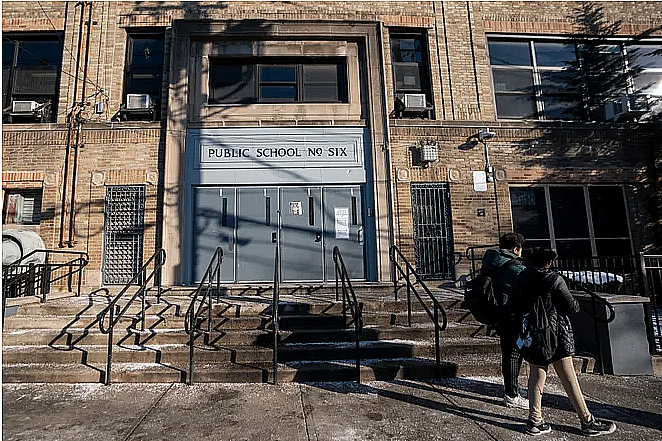
Public School No. Six in Paterson, New Jersey, where chronic absenteeism surged amid the pandemic.
(Photo by Anne-Marie Caruso/NorthJersey.com)
When I began covering education on a full-time beat in June 2021, schools were still complying — or fighting off in raucous board meetings — New Jersey’s vaccine mandates and social distancing and attendance requirements. Children were in school or remote, or a combination of both, in a constantly changing schedule that varied from district to district with every new variant of the COVID-19 virus.
Stark drops in academic performance were the most immediate fallout, but it did not stop there. More children began missing school persistently after the pandemic than they ever did before. That metric is chronic absenteeism, when children miss 10% or more of a year’s school days, including excused and unexcused absences. This is different from truancy, which is always unexcused.
An analysis from education think tank Attendance Works showed that chronic absence nearly doubled in the 2021-22 school year, rising from 16% before the pandemic to nearly 30%, and affecting nearly 14.7 million students. I came across the headlines that this trend was making in The New York Times and other publications, and I wondered what it really meant to have half of an entire school district’s population absent frequently enough that the problem becomes not one of missing a few classes, but irreparable disconnection from school for hundreds of children in a single building.
Nearly half of a school district absent sounds absurd, but in 2022-23, chronic absenteeism in New Jersey hovered around 40% in some districts, including Trenton in central Jersey, Paterson in the north, and Camden in the south.
These cities, tucked away among New Jersey’s best-in-the-country school systems not only suffered disproportionate impacts of the pandemic, but were recovering far more slowly than did their suburban counterparts.
School 6, a K-8 school in the Paterson's poverty- and crime-prone 4th Ward, and the subject of my reporting, saw chronic absenteeism at a staggering 48% in 2020-21 as the school returned to in-person learning during the pandemic. It climbed to 59% in 2021-22, and to nearly 61% in 2022-23. Meanwhile, the average chronic absenteeism in New Jersey in 2022-23 was 17%.
I wanted to see this disparate reality for myself, as a reporter. Schools reopened; mandates lifted. It was time to make the switch from masking and culture wars to covering the on-the-ground reality of the pandemic’s impact on the classroom. I focused on Paterson, New Jersey’s third largest city, serving around 26,000 students. Once the success story of Alexander Hamilton’s vision for a city of silk mills and textile production, Paterson is now a post-industrial city and a Black and Hispanic-majority population with flourishing Arab American and Bengali enclaves, long deserted by its early Irish, Italian, and German immigrants.
I found that the sobering realities of generational poverty and de facto segregation had made for a situation where the post-pandemic spike in chronic absenteeism was just another data point. It was proof that without innovation from the state and building-level commitment from school leaders and parents, the most vulnerable children languish for years.
The story of School 6
School 6, a K-8 school who’s stately 1921 exterior moldings sit among the rows of dusty A/C units sticking out of classroom windows in a dilapidated neighborhood in the city’s Fourth Ward, serves the poorest families in Paterson. The district has tried for years to engage families and involve them in their children’s education, according to my interviews with T J Best, who oversaw attendance in Paterson under a previous superintendent, even starting a new program in which chronic absenteeism specialists visited families. That program launched in 2018 to replace the old program of using truancy officers to round up kids who would be hanging out outside school during school hours.
Best recalled how the district went to great lengths to hire part-timers who were also locals, to build trust with families. Seeing a school employee in a T-shirt with a monogrammed district logo, rather than a uniformed officer, immediately put them at ease, Best said. Despite these efforts, Best said the sheer scale of chronic absence was daunting. And this was in 2018, before the pandemic.
In 2024 when I began my reporting, the district was looking away from the problem entirely with a complacency that verged on cynicism. Newly appointed district superintendent Laurie Newell said she was not aware of any building-level measures at School 6, and the district was not tracking them either.
The district denied me permission to tour School 6 or even talk to long-time district-level attendance staff, many of whom had years of institutional knowledge about the schools and their communities.
I told School 6’s story from outside the building, by visiting the school when it let out, or in the mornings when parents were walking their children to school. The stars of that story were Yazmin Robinson and her kindergartner, School 6 lunch aide Lamal Mattiex — or Mr. Sweetz — former gym teacher Gina Desino, new Ecuadorean immigrants Emily and Ronny and their six-year-old son, Paterson native and school trustee Corey Teague, and B, a ninth-grader and graduate of School 6 who could not go on the record because his mother had concerns about his safety.
Simply following the threads of these individuals revealed the extraordinary challenges of living in the Fourth Ward. Soon after I reported a story featuring Yazmin Robinson, where she discussed her own experience as a single mother who dropped out of high school, I learned that she was about to be evicted from her apartment because a bump in her income from her child’s father’s monthly remittance to her, made her ineligible for the TANF (Temporary Assistance for Needy Families) payments that paid her rent. Currently, she is unable to work because of a discrepancy in her state-issued identification. She is again facing homelessness and a court ruling that will likely be in her landlord’s favor.
Generational poverty and trauma also affect many Fourth Ward families. Jazzmeckah Parsons, a fourth ward resident with children in School 6, told me she was twelve years old when a man who broke into their home killed her own mother in her bedroom as Jazz and her siblings slept downstairs.
Engagement work pays dividends
My biggest challenge while reporting these stories was finding parents and students who would speak to me about their experiences in School 6, as I sought to gather evidence of the disengagement between families and school staff that experts say is a primary driver of attendance and outcomes.
Over a period of three days in February, engagement editor Teena Apeles and I visited laundromats, barbershops, libraries, an after-care center, and school premises to find parents and children who would speak to me. With us was Mike Funes, a Spanish-speaking high school senior I hired to act as a translator. Starting in Passaic City and ending in Paterson, we interviewed and recorded conversations with parents, students, and residents. Many Hispanic parents, likely because they were undocumented and feared deportation under President Trump’s immigration dragnet, did not want to reveal their identities. Others, especially African American parents in Paterson’s Fourth Ward, unanimously expressed disappointment in the public schools compared to when they were children, pointing to changes in classroom culture, poor discipline and shifting demographics.
This kind of deep engagement work, where Teena and I walked into shops and simply asked for permission to talk to clients about the public school, resulted in the third story of my series. We shared the print edition featuring one of my stories with anyone who showed interest. At a pharmacy in Paterson, a woman behind the counter leafed through the pages, grinned, and said to me, “You care about us.”
B, the student whose name I withheld, had one of the most telling stories. He began talking to us after his haircut, and connected me with Mr. Sweetz, a school lunch aide who became a key source. While I could not quote B in my reporting, his experience in School 6 cemented the picture I was gathering from outside the building of its absenteeism and engagement problem: there was a breakdown of climate and order in many classrooms, making serious students avoid or disengage with school.
At School 6, B faced bullying and got into fights, leaving him so unprepared for high school, he begged his mother, a home nurse, to pay for him to attend a low-cost private school that focuses on sports. He knew he had to repeat eighth grade, he told us. He was training for a football scholarship to a high school outside Paterson. He is thriving in the new school’s athletics-centric environment he said, his face shining as he spoke. “Football saved me,” he said, because it gave him an avenue to excel.
Through B, I met Mr. Sweetz, the sole employee willing to go on the record about School 6.
“A lot of the kids that are staying home from School 6 are kids who are actually very smart,” he said. “They don't want to be there. It is too much chaos for them. They don't like it.”
I met two mothers who said their children were happy at school. Yazmin’s little girl loves her class, she told me. But most parents would not speak to me as they gripped their children’s hands and walked by, and the few who were unhappy with the school feared retaliation if they went on the record.
Is public education working in School 6?
The lack of transparency in the district adds fuel to public education’s loudest critics, including those who support the Trump administration’s avowed commitment to dismantle it.
“I believe that we have never come out of that one-box mentality. It is a different child in the inner city, a different mindset, a different culture. It is so many different variables that we must start thinking differently to achieve the same goals,” said Ernest Rucker, a Paterson grandparent and advocate.
Rucker told me he wished educators would find out-of-the-box ways to reach out to the Fourth Ward’s families, to help discipline children and to motivate their young parents, to teach computer science and math in ways that were geared to their world and experiences.
There is little doubt that School 6 is just an affordable alternative for Paterson’s poorest families. Those who know how to advocate for themselves and have supportive parents, like B, make it out while the rest languish.
These children are stuck in a permanent construction zone, where thousands of Title 1 dollars change little for students like B, who knew he had to pivot to sports to succeed, and repeat eighth grade in another school after graduating from School 6.
Or, as Superintendent Newell attested with her statement that was either garden-variety platitude or an accurate assessment, School 6 is “a work in progress.”