

Learning to ‘get closer’: Lessons from documenting homelessness in Sacramento

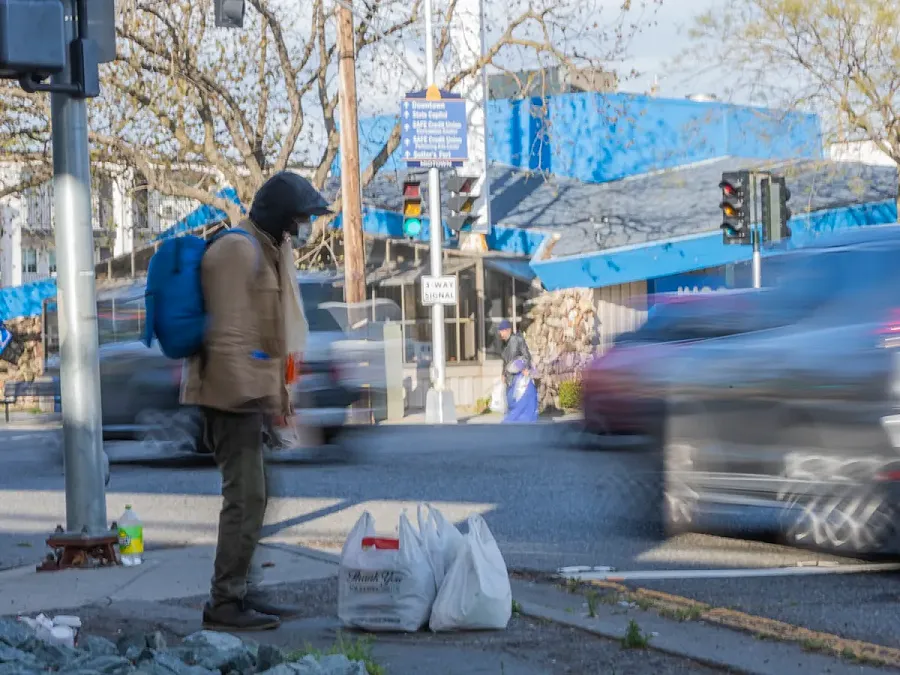
An unhoused man waits for another red light while trying to collect money in Sacramento.
Photo by Russell Stiger/The Observer
When I first started my recent project on homelessness in Sacramento, I struggled with the question of how this issue could be presented in a way that people would relate to. It was a unique chance for me as a Sacramento native to intentionally look at the problems facing my city while using the power of photography as the medium to get people talking about housing.
The enormity of the problem slowly became overwhelming. Self-doubt, creative blocks and other introverted tendencies became my biggest roadblocks. Getting to know someone who is a complete stranger and has no reason to open up to you is complicated. Oftentimes at the Sacramento Observer I am tasked with making someone comfortable enough to be photographed in a time of grief or when they are simply camera shy. For many reasons, Black people, particularly as they age, often feel uncomfortable being photographed.
I practiced introductions before finally deciding to just ask: “Excuse me, my name is Russell, can I have a minute of your time to talk and get to know you?”
I remember the first night of the fellowship, listening to photographer Zaide Sanchez speak about her experience. I reached out to her before starting the project, and she urged me to “Get closer.” When judging the pictures I would take, I would tell myself, “Get closer.” My senior fellow, Will James, mentioned how one photo can do the equivalent work of 30 minutes of podcasting. I carried those sentiments with me and tried to get as close to people as possible, while also making sure the photos spoke louder than anything I write.
While I still got rejected from time to time, the first Black person who allowed me to photograph them was Robert. He did not want me to use his last name and did not have a cell phone. I thought we would meet the next day, but I could not find him at the Target we talked about. I searched for a few days at locations that Robert and I had spoken about him frequenting and found nothing. Throughout this project, the number of different phone numbers I had for certain people became overwhelming, as day to day it could change depending on who had a working number or who had changed their number.
I spent more time than I’d planned just getting to know the subjects and getting them comfortable with what I was doing. At times I questioned if I could push a little harder to get a photo in that moment, especially when reconnecting with people might be difficult. But everything changed when I met Satareah Murphy, Chop, and Sam. They opened up their space to me and allowed me an inside look at the everyday struggles of Black people facing housing issues. Satareah was one of the few who contacted me when she got a new number. Through her, I met another dozen Black people through visiting her camp. She helped me realize that sometimes I was overthinking things and being “too courteous.”
After months of collecting photos and stories, I showed editor Stephen Maganini some images and he immediately lobbied for them to be featured in the paper. After a month and a half of going back and forth on dates and space, never finding the right time, and still collecting photos, it was decided the project would be focused solely online. I did not realize the massive amount of content I was delivering to the editors, who were already consumed by the weekly paper and daily online content. We finally released the first blog post on Sept. 26.
With a new digital team, we learned many lessons about video edits, photo layouts, content storage and edit-release schedules. Working with multiple people across different areas of expertise was a different experience for me, as I am used to having more control. Allowing others’ input while maintaining the essence of what the project should be was stressful and something I had to clearly articulate.
This project hopefully sparks conversation internally amongst Black people about housing, while also preparing us as a community to take advantage of opportunities. But the most important thing is starting the conversation about the need for more housing to help prevent our own family or friends from facing housing insecurity in the first place. Lending a couch or an open room can help stem the tide, but it is also important to remember that everyone’s situation is different and some people want to do it themselves. It’s only putting a band aid on a wound when you house someone for a year in a place they may not be able to afford, only for them to end up back on the streets.