

What farmworker survivors of domestic violence taught me about access and trust

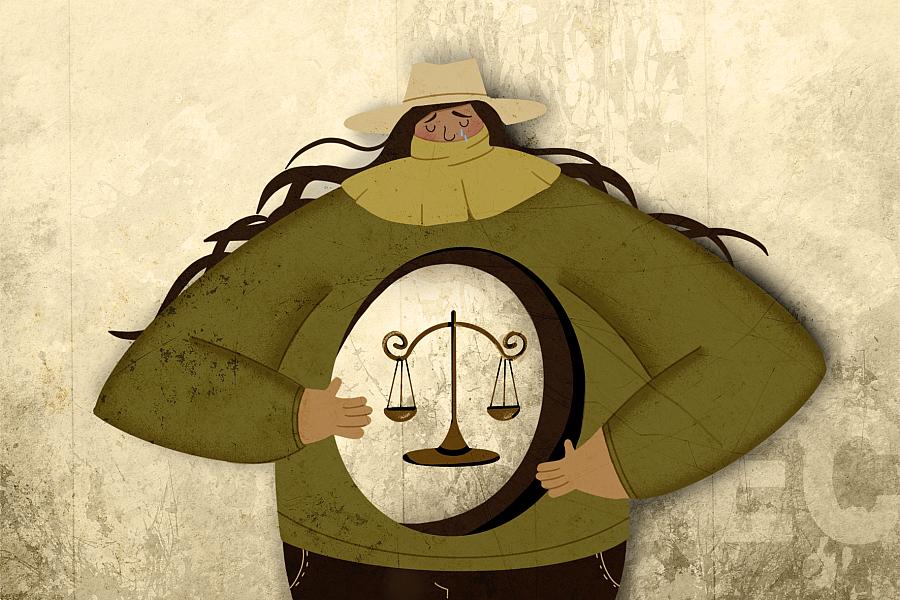
(Illustration courtesy Roxsy Lin)
During a meeting with the nonprofit Líderes Campesinas group in Thermal, California, I sat listening as women talked about their experiences of domestic violence. They shared how those meetings had helped them understand what they had experienced and begin their healing process.
I started wondering what was happening in other farmworker communities across California. Were survivors elsewhere finding support? Did they know what resources were available? Could they navigate the legal system? And were government agencies and domestic violence organizations reaching people whose work schedules, languages, immigration status and cultural backgrounds could make traditional services difficult to access?
The USC Center for Health Journalism’s Domestic Violence Impact Reporting Fund gave me the opportunity to explore these questions across three distinct agricultural regions of California: the north (Santa Rosa), the Central Coast (Santa Maria), and the south (Coachella Valley).
I chose Santa Rosa because it lies at the heart of Sonoma County’s wine industry, which relies heavily on farmworker labor. I selected Santa Maria, in Santa Barbara County, because of its large Indigenous farmworker population, particularly members of the Mixtec community. Together, these two regions offered an opportunity to examine how domestic violence intersects with the distinct realities of agricultural communities.
I also chose the Coachella Valley because I wanted to understand why Líderes Campesinas had been able to make such a meaningful difference in the lives of farmworker women. I wanted to learn how the organization had created a space where women could find the support, community, and resources they needed to begin healing.
The resulting three-part series for American Community Media (AcoM) showed me very different versions of what can happen when a farmworker experiencing domestic violence looks for help. It also changed the way I think about interviewing survivors.
Three communities, three different experiences seeking help
The first story, “In the Heart of California’s Wine Country, Little Help for Farmworkers Facing Domestic Violence,” followed Anita Noriega, a Santa Rosa farmworker whose 17-year-old daughter, Lesly, was killed by her boyfriend four months after a judge denied Lesly’s request to extend a protective order.
Her family’s experience exposed a larger problem in Sonoma County: Farmworkers can be surrounded by domestic violence services and legal protections without knowing how to access them.
Many farmworkers I interviewed did not know restraining orders existed or that free legal help was available. Local agencies acknowledged that outreach specifically targeting farmworkers was limited, while long workdays, distance from service providers, and an English-language court filing process created additional barriers.
Lesly’s case showed how the existence of a legal remedy does not guarantee meaningful access to it.
My second story, “Mixtec Domestic Violence Survivors in California Struggle to Access Needed Support, Resources,” centered on Matilde, a Mixtec farmworker in Santa Maria who endured years of coercive control and tried repeatedly to seek help. A social worker gave her phone numbers to call, but Matilde said no one returned her messages. When she later showed threatening messages from her husband to police, she said officers told her they did not see evidence of an immediate threat.
After other attempts to find help also failed, she felt she had run out of options and returned to her husband. Her experience exposed barriers that are particularly acute for Indigenous farmworkers: Many Mixtec speakers have limited fluency in Spanish, government forms are rarely available in Mixtec, and outreach often fails to accommodate farmworkers’ schedules or cultural realities. The reporting showed that labeling a service “bilingual” or culturally accessible does not necessarily make it accessible to Indigenous survivors.
The final story, “In Coachella Valley, Líderes Campesinas Offers Domestic Violence Survivors a Path Forward,” examined what can happen when outreach is designed around farmworkers instead of expecting farmworkers to navigate institutions on their own.
Adriana, an immigrant farmworker who survived years of abuse, encountered the nonprofit Líderes Campesinas at an information table in a grocery store. Through the organization, she learned to recognize forms of domestic violence beyond physical abuse and was connected with resources, including psychological support.
Ana, another survivor, said the organization’s meetings helped her understand for the first time that what she had experienced was domestic violence; she later became a Líderes Campesinas advocate herself. The organization does not wait for survivors to enter an office. It conducts outreach at parks, bakeries, check-cashing businesses, and other places farmworkers already frequent, sometimes as early as 5 a.m., and holds recurring meetings where women learn about their rights and hear from other survivors.
The contrast with Santa Rosa and Santa Maria was striking: the reporting showed that access improves when information is delivered through trusted relationships, at the times and places where workers can actually receive it.
Spending time reporting in these three communities changed my understanding of what “access” really means. Having a hotline, an office, or a service available on paper does not necessarily mean a survivor can use it. Access also depends on language, work schedules, transportation, cultural understanding and, perhaps most importantly, trust.
I came to understand that the same principle applies to journalism. Trust cannot be rushed. Some of the women I interviewed shared experiences they had not discussed even with members of their own families. Their willingness to open their lives to me was something I did not take lightly, and I remain deeply grateful for it.
That trust also changed the way I conducted interviews. I learned to let survivors tell their stories before worrying about precise timelines or every detail I might eventually need for my reporting. Those questions could come later. At the beginning, what mattered most was giving women the space to speak without pressure and allowing them to decide where their stories would begin and how quickly they would unfold.
Because the survivors I interviewed were unfamiliar with the reporting process, and because they were recounting traumatic experiences, I felt it was especially important to protect their sense of agency throughout the interview. I told them directly that they could stop the conversation at any time, decline to answer any question, or tell me when they did not want to discuss something.
That kind of transparency mattered because a source may not realize that they can decline a question or fully understand how much of an interview could eventually become public. I made every effort to explain what participation in the reporting process could mean and to make sure the survivors understood and were comfortable with the potential consequences of publication.
That commitment also led me to do something that can be unconventional by traditional journalistic standards: I read survivors portions of my drafts that described their experiences.
I did not see this as giving up editorial control. I saw it as another way of asserting survivors’ agency. By the time I was writing, some time had passed since our interviews. I had reviewed my notes, reconstructed events, and made decisions about which details were important to the story. A detail a survivor had mentioned only briefly, for example, might take on greater significance during the reporting and writing process. Before publication, I wanted to make sure she understood that this part of her life would become public and that she remained comfortable sharing it.
Above all, I wanted to make sure there were no surprises for the survivors who had trusted me with their stories.
That same principle guided decisions about identity and privacy. In some stories, I used pseudonyms at the interviewees’ request to protect their privacy and safety. This gave survivors more freedom to share their experiences without having to reveal their identities publicly. I also omitted the names of perpetrators when identifying them could create additional risks for survivors.
Language is part of the reporting
Trust, however, was shaped not only by the choices I made during the reporting process, but also by how I was able to communicate with the women and communities I covered. Speaking Spanish was essential to my work because it was the first language of most of the survivors I interviewed. It allowed me to hear women describe their experiences directly, in their own words, without an interpreter between us. It also helped create the sense of closeness and understanding that these deeply personal conversations required.
My cultural background as a Latina woman also helped me connect with the communities I covered. Language and cultural familiarity allowed me to understand references, expressions, and experiences that might otherwise have been difficult to recognize fully. Without those two elements, I do not think I would have been able to build the same level of trust or connect as deeply with survivors and other community members. They were not simply advantages I brought to the reporting; they shaped what I was able to hear, understand, and ultimately convey in the stories.
Give difficult interviews room to breathe
I learned that interviews involving trauma require more than additional time. They also require attention to stress, emotional fatigue, and the need to decompress, both for the person being interviewed and for me.
There were days when I interviewed one woman after another, listening as they recalled some of the hardest moments of their lives. One of the most difficult conversations was with Anita Noriega, whose daughter had died in a murder-suicide. Sitting across from her as she walked me through the darkest moments, I found it difficult to hold back my tears.
The lesson for me was not that I needed to become less emotional. It was that I needed to recognize those emotions and give myself space to process them.
Sometimes that meant slowing down. We took breaks. We shared meals. I learned that giving both the person you are interviewing and yourself an opportunity to decompress after a difficult conversation is not separate from the reporting process; it is part of doing this kind of reporting responsibly.
After spending an entire Saturday interviewing women in Santa Rosa, I remember feeling an urgent need for a quiet Sunday morning simply to process everything I had heard.
Journalists are often expected to contain their emotions, as though emotional distance is a requirement for rigor. This project made me question that assumption. Feeling deeply about what someone tells us does not have to conflict with careful, accurate journalism.
The women I interviewed are part of communities I care deeply about. Their labor helps put food on our tables every day. Listening to what they had endured touched me. I do not think acknowledging that weakens the journalism. If anything, it made me more conscious of the responsibility that came with telling their stories.
Revealing opportunities for change
That sense of responsibility extended beyond how I conducted interviews.
In Sonoma County, my conversations with Legal Aid about the lack of domestic violence outreach specifically directed toward farmworkers prompted the organization to consider strengthening that work. Legal Aid of Sonoma County told me that it had contacted the Graton Day Labor Center to explore offering outreach services through the center.
That response mattered to me because one of the clearest findings across the series was that survivors cannot use resources they do not know exist. A service may be available, but if information about it never reaches farmworkers in a language, setting, or way they trust, its existence alone does not create meaningful access.
The difference I saw in the Coachella Valley was not that domestic violence had disappeared. It was that Líderes Campesinas actively sought out the women who might need support. The organization met farmworkers where they already were, spoke with them repeatedly, and created spaces where relationships could grow over time.
I began this project wanting to understand domestic violence among farmworkers in three California regions. I finished it thinking much more deeply about access, agency, and trust — not only in the systems survivors must navigate, but also in journalism itself.
Making sure survivors understood what I planned to publish did not weaken the journalism. Instead, these practices made me more thoughtful about the responsibility that comes with asking someone to entrust you with some of the most painful parts of their life.