

What I learned reporting on California's free pre-K launch for 4-year-olds in the Central Valley

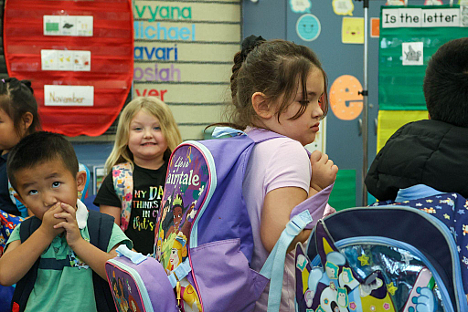
Transitional kindergarten students wait to be picked up at Tarpey Elementary School in Clovis, California.
Photo by KVPR/Rachel Livinal
In the San Joaquin Valley, education isn’t always top of mind. The Valley, as locals call it, stretches across miles of farmland, rural towns and communities, many of them beset by economic hardship. Here, fewer than a quarter of residents have a bachelor’s degree and about a quarter are under the age of 18.
My mom spent much of her career teaching kindergarten in the northern part of the region in Merced County. She prided herself on her academic focus and spent much of her time teaching students how to read at or above their grade level, learn sight words and tackle math. There was always time for art and imagination in her classroom, but I remember the homework packets she would print out every week — they were hefty for a 5-year-old. She wanted to level the playing field for children who didn’t come from private preschool backgrounds or have two-parent households. In 2020, she moved to the Bay Area to start teaching transitional kindergarten.
Transitional kindergarten has existed in California for years but wasn’t widely known until recently. Gov. Gavin Newsom signed a bill in 2021 that launched a multi-year rollout requiring all public school districts to offer TK to all 4-year-olds. Newsom said providing this early childhood education is vital because critical stages of brain development occur before age 5.
But TK is supposed to be nothing like a typical classroom. There are no worksheets, not much writing, and only some teacher-led activities. My mom went back to school to earn college credits required for early childhood education. Her school district then provided equipment for interactive play centers and stations. Sometimes she reflects on the first two decades of her teaching, and wonders what would have changed if she knew what she knows now.
After a couple of years of higher education reporting and listening to my mom, I wanted to understand how a 4-year-old’s education could impact their adult life. Could these children be more likely to enter college or develop healthier social skills? Would they feel more joy at school? Most importantly, would the Valley buy in?
Experts I spoke to said the health benefits were clear. Children in play-based transitional kindergarten classrooms show growth in social-emotional learning, language development, and critical thinking skills. All of these benefits are especially notable for students with special needs and multilingual learners.
But my reporting found the buy-in wasn’t as clear-cut. Fewer than half of 4-year-olds were enrolled during the 2024-25 school year, even though 75% were eligible. From talking to researchers and parents, I found there was a lot of misinformation surrounding the grade. Many parents assumed TK was like an academic kindergarten classroom, and others thought there were no options for their child’s care past noon. Often, those assumptions were unfounded.
Beyond that, I also found an increase in students with special needs entering TK. Although this showed positive results for them, talking to school leaders and parents revealed that school districts, especially in rural areas, didn’t have the staff to keep up with the influx.
Multilingual learners are also facing a hurdle right now. The state discontinued the assessment that tested TK students on English proficiency and provided them resources, saying it was developmentally inappropriate. The California Department of Education recently unveiled a plan to launch a new one within a couple of years. But in the meantime, the primary avenue for language development is through bilingual classes, otherwise known as dual language immersion classrooms. My data analysis found only about 13% of Valley school districts offered these, despite having a higher K-12 English learner population than the rest of the state.
These stories gave the lay of the land for Valley parents, children and educational leaders, but they did not come without challenges.
Going into this series, I thought it would be relatively easy to find data on TK students throughout the years. I knew the state department of education collected it, and I just needed to analyze it. But I found that the data collection for TK was inconsistent up until a couple of years ago, and it didn’t include key data points, such as information on students with disabilities. I was forced to rely on only a couple of years of data for most of my analysis, and I also didn’t have the most recent school year’s data because it had not yet been released.
I worked through this by talking to someone who was already doing this research. She gave me tips on what to request, and from that guidance, I obtained additional data by analyzing self-reported surveys from school districts in the rollout of the program. To tell the stories, I relied on the most current data and on interviews with school staff to gauge how the launch was going.
I also struggled with finding a main character for one of my stories about students with special needs. After two parents who had agreed to be interviewed backed out, I relied heavily on Facebook parent groups and on the same educational leaders I had already spoken with to find new sources. I made sure I had a second or even third option if another parent were to opt out, and eventually talked with a family and student who illustrated the personal aspect of TK perfectly. I think it was important for me to understand my intended character in this situation — not only are parents busy, but parents with a child with special needs are especially busy, and their child’s disability may be a sensitive topic they’re not ready to share.
This reporting worked to dispel misinformation. I often found myself educating parents about TK even while reporting, and I believe the published stories continued to do so. A pillar of public radio and journalism is to inform and inspire the public with free access to information, and I think this reporting educated parents and the overall community on what to expect when it comes to their child’s care, education and future.