

Reporter finds new strategies to power series on impacts of cannabis on teens in eastern Washington

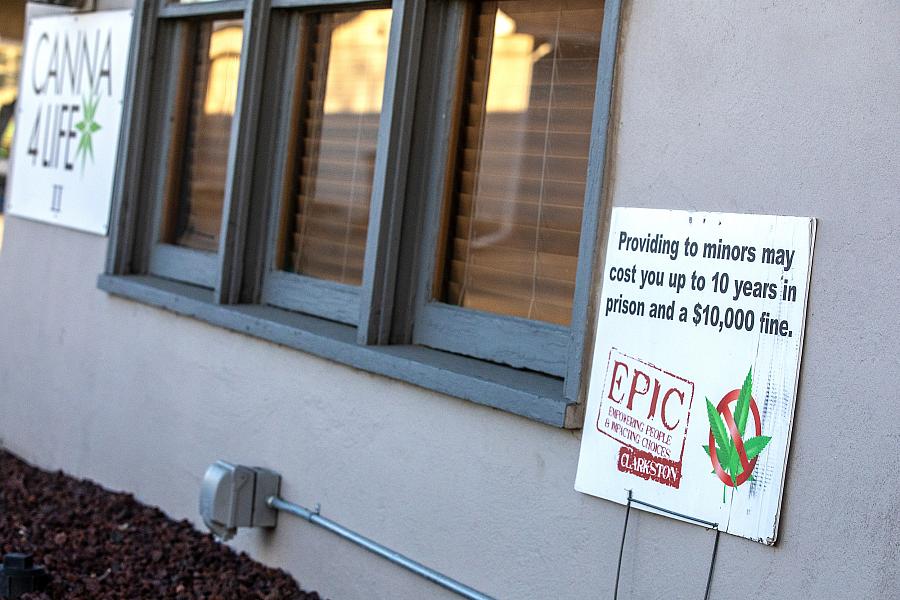
(Photo by Jakub Porzycki/NurPhoto via Getty Images)
The day the first state-licensed cannabis store opened in Clarkston, Washington in 2015, there was an air of celebration. Customers shared a feeling of camaraderie as they entered the building, decorated with balloons.
The store gave away cannabis to the first person to arrive, an amputee confined to a wheelchair. The woman hoped cannabis would ease her chronic pain, with fewer side effects than prescription drugs.
One shopper hinted about the social side of cannabis, mentioning a number of his friends were having birthdays soon.
Valid as all of that was, as a journalist, I knew what I witnessed was just part of the story. I was particularly curious about how much access teenagers would have to the cannabis sold legally.
That interest grew from the proximity of cannabis sales to Clarkston High School. It’s the largest of two high schools in Asotin County along the Idaho-Washington border in the Lewiston-Clarkston Valley, which has a combined population of about 50,000 people.
All three cannabis stores opened within a 10-minute walk from the high school, and those three outlets remain in the same locations today, in compliance with regulations that restrict how close such businesses can be to schools, arcades, parks, libraries and day cares.
My instinct that I needed to dig deeper stayed with me for more than a decade. It was a story my news organization, the Lewiston Tribune, wanted to pursue, but we didn’t have the bandwidth.
Our staff kept shrinking, leaving us with fewer people to cover news like the COVID-19 pandemic and wildfires, including one so devastating that it destroyed an entire town.
The story remained solidly on the back burner until I applied for and received a USC Annenberg Center for Health Journalism’s 2025 Data Fellowship with the full support of my managing editor, Matt Baney.
The reporting I did over five months, supported by the fellowship, established a solid foundation for community discussions about cannabis and the risks it poses to teenagers and adolescents, a topic that prior to our stories had received little attention.
We had four key takeaways.
For starters, legal cannabis sales have skyrocketed at Clarkston’s three state-licensed stores since legalization. Total annual sales were four times higher in 2024 compared to the first full year of sales more than a decade ago, after adjusting for inflation.
Legal cannabis gets into the hands of teenagers through back channels even though the three stores abide by a ban on sales to anyone who isn’t at least 21 years old, according to teenagers, educators and law enforcement.
Teenagers steal it from adults or pay adults to buy it for them. It’s a felony to buy cannabis for minors, but prosecutions are rare, partly because it’s difficult to obtain evidence.
The health risks associated with cannabis use among adolescents and teenagers are troubling. They include a decrease in reasoning and an increase in anxiety after one or two uses, as well as impaired learning for as long as 28 days for teenagers who are weekly users.
The state is monitoring use of cannabis among teens through its Healthy Youth Survey, but it isn’t tracking medical issues tied to the drug.
One expert at Washington State University pinpointed the problem: Washington does not have a dedicated surveillance system that tracks the health impacts of youth cannabis in a systematic way.
The lack of coordinated monitoring is widely acknowledged and is a reason researchers at WSU and across the state emphasize the need for stronger public health tracking, particularly as the potency and variety of products have risen, the expert added.
The fellowship provided me with tools to unearth that information, track what I found and distill it into multimedia content to reach a wide audience — two stories, a graphic, video, podcast and pictures.
One of the most important resources the fellowship offered was time.
Following the advice of the senior fellows, I established my reporting schedule for my project with my managing editor. I set aside four hours every Thursday and Friday for the stories, moving the blocks to other parts of my schedule to accommodate breaking news and time off during the holidays.
Even so, the project absorbed almost all of my time in the last two weeks prior to publication. Had I not been working on the story consistently in the prior months, I would have never met the deadline.
The reasons the demands of the stories ballooned in the final phases involve challenges that other fellows might encounter.
We approached the three cannabis retailers in Clarkston with our findings and offered them opportunities to comment three weeks prior to publication.
We couldn’t have done that sooner because our findings would have been incomplete. That put one key interview on my schedule a week after a half before publication.
Fact-checking was time consuming and made the story significantly stronger. A number of sources, including a Lewiston police officer, provided new information.
Another strategy from the fellowship that proved invaluable was documenting my reporting.
I kept a Google Docs sheet that listed names, email addresses, telephone numbers, interview dates, website addresses, dates of emails and titles of reports I had read, among other things.
I consulted that document frequently in writing and fact-checking. It shaved days off the time I would have otherwise needed to complete that work.
At every step, my senior fellow and the fellows in my cohort listened and provided advice.
My senior fellow recommended I spend a day at Clarkston High School. When I talked about that in the monthly check-in with my cohort, one of the fellows suggested I take video.
That advice combined for some of the strongest reporting of the piece.
I gained insight into how students conceal cannabis from the school’s staff — in their backpacks, in bathrooms and in their vehicles. And I learned how challenging it can be to combat the problem. The school’s principal went to a bathroom just minutes after someone smelled cannabis, but whoever was using it had already left unspotted.
I filmed a video of a police officer holding a baggie of cannabis edibles that had been confiscated at one of the district’s schools. The THC-infused gummies looked similar to a common type of candy sold at grocery stores. It would have taken paragraphs to describe what the few seconds of video showed dramatically.
Additionally, the senior fellows consistently emphasized that even in data stories, people are the backbone of reporting. I found that to be true.
It was people who told me how teenagers obtain cannabis. It was also people who explained the appeal of cannabis in spite of its risks. The drug, teens and a former cannabis user told us, provides what feels like a temporary escape from problems they’d rather avoid than find solutions to.
As a package, our coverage confirmed we do indeed need to pay more attention to the hazards of cannabis. The fellowship has equipped me with the tools to keep the issue in the spotlight and explore other topics using data.