

Arizona workers suffer in extreme heat, but many fear speaking out
The article was originally published in the KJZZ Phoenix with support from our 2025 Health and Climate Change Reporting Fellowship.

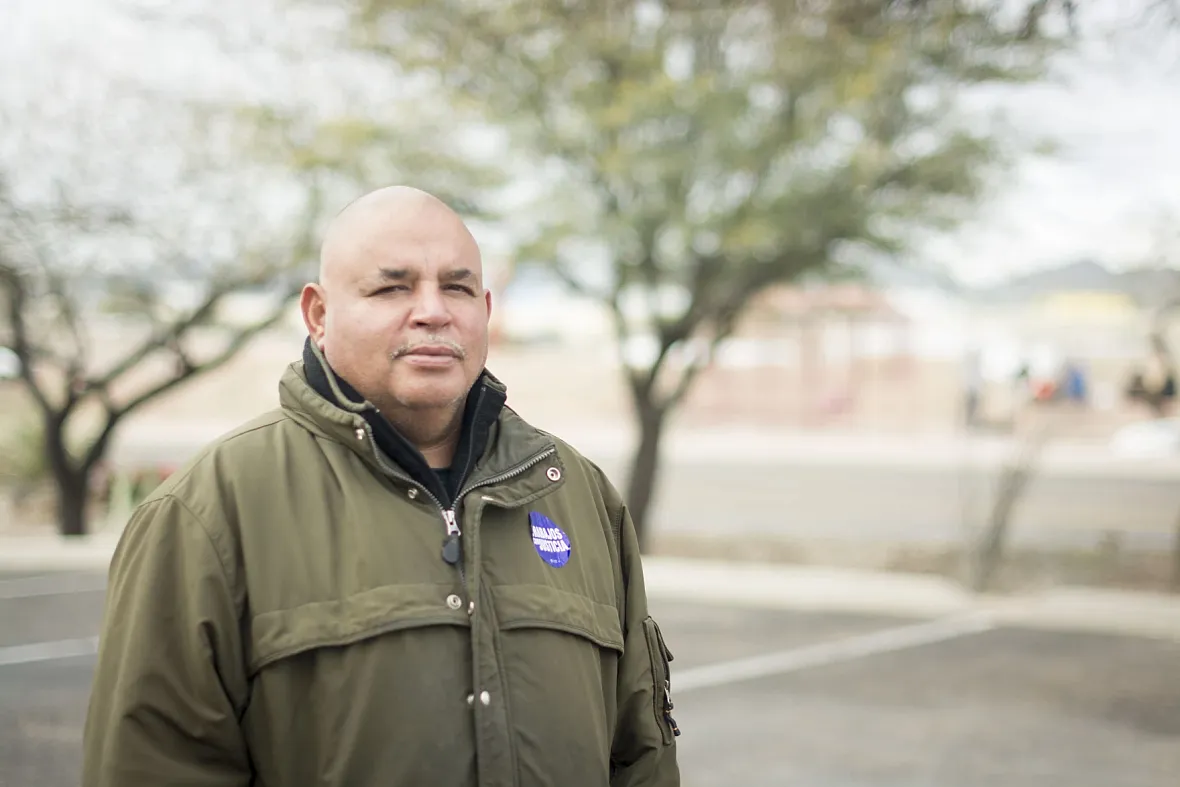
Jesus Reyes suffered a life-threatening heatstroke while working on a landscaping job in triple-digit temperatures.
Katherine Davis-Young/KJZZ
Jesus Reyes has been a day laborer in Tucson for about 30 years. The 53-year-old mostly does landscaping work, so he has spent a lot of time under the scorching Arizona sun. But one afternoon in June 2021, the heat really caught up with him.
“It started with a severe headache, a lot of vomiting, and a lot of dizziness,” Reyes said in Spanish, during a recent interview in Tucson.
Reyes said he had been working all day in triple-digit temperatures without much access to water or shade. By the time he got home, he knew he was having a medical emergency. His wife drove him to the hospital and by the time they got there, Reyes had lost consciousness.
“The doctor told me that I had arrived just in time,” Reyes said.
It was heatstroke — a life-threatening illness that affects the heart, brain and other vital organs. Reyes needed two surgeries to save his life. He was hospitalized for two days and it was almost a month before he could go back to work.
“It wasn’t an easy thing,” Reyes said.
Five years later, he still doesn’t feel like he’s fully recovered. He continues to work, but feels weaker and tires quickly. And he worries when temperatures start to climb.
“I don't want to push my body too hard because I'm afraid — afraid that the same thing might happen to me again — because it was a truly terrible experience,” Reyes said.
Working in extreme heat can be deadly
Arizona’s outdoor workers face some of the hottest conditions in the country. Statewide, more than 1 million people work in farming, landscaping, construction, delivery services or other industries that expose them to extreme heat on the job, according to an estimate from the Natural Resources Defense Council.
And these workers are heading into another summer without any specific state regulations requiring their employers to provide them with water, shade or breaks from the heat.
The U.S. Occupational Safety and Health Administration estimates tens of thousands of workers, like Reyes, suffer illnesses or injuries related to heat exposure on the job nationwide each year and estimates about 559 workers die annually from heat-related causes.
OSHA says these cases are vastly underreported. And it’s unclear exactly how many workers in Arizona die from working in the heat each year. But KJZZ found dozens of examples of heat-related workplace fatalities going back decades in the state.
Just last summer, a Phoenix-area postal worker who’d been in the role just three weeks died on the sidewalk while delivering mail on a 106-degree day; a construction worker who was only 23 years old died after collapsing from heat on a jobsite in Glendale; and a longtime air conditioning technician died after working in a sweltering attic near Prescott.
Worker heat illnesses and deaths appear to be increasing
These cases appear to be on the rise.
“We see more people reporting those issues,” said Emma Torres, executive director of Campesinos Sin Fronteras, a Yuma-based organization that advocates for farmworkers.
Torres has worked with farmworkers for decades, but said in just the last few years, she has started hearing more concerns about the heat, as temperatures have shattered records, and the heat season has stretched longer into the spring and fall.
“For years, people have been exposed to heat and they’ve found ways to protect themselves — wearing a big hat or drinking water all the time, but what they’re reporting is that more and more, it’s worse,” Torres said.
A recent study in the journal Health Affairs confirms Torres’s suspicions — as climate change drives more intense heat waves, outdoor worker deaths in Arizona are increasing. But the study noted the rise in Arizona in recent years has been steeper than in neighboring California.
The difference? Arizona has never had state regulations around workplace heat safety. California has had requirements for water, shade and other precautions in place since 2005.
Prior to 2005, California had a similar rate of deaths among outdoor workers to the rates in neighboring states.
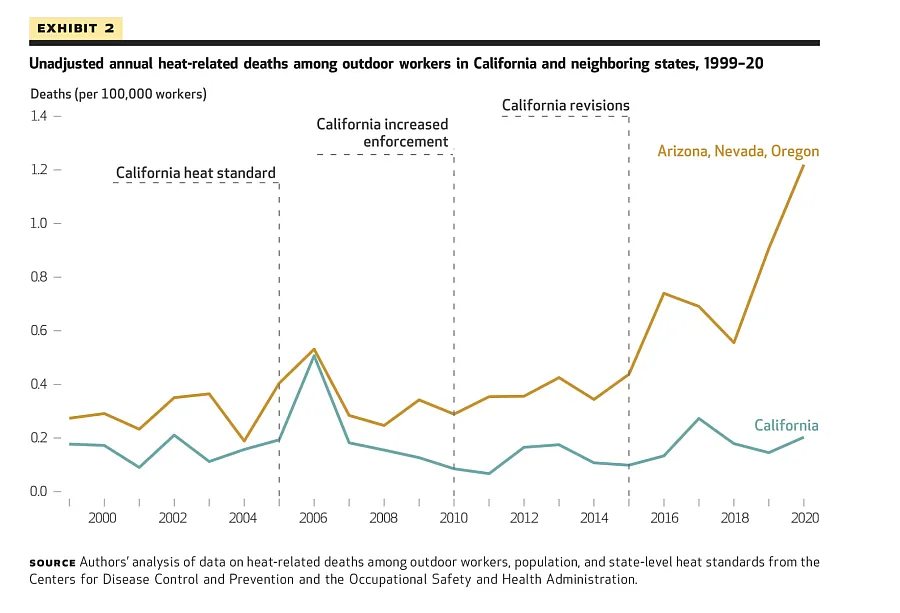
Outdoor worker deaths in Arizona are increasing at a faster rate than in neighboring California, where state regulations for workplace heat safety have been in place since 2005, according to a recent study in the journal Health Affairs.
Adam Dean and Jamie McCallum/Health Affairs
“That gives us confidence that, if not for this policy, the deaths in California would have continued to follow the same trajectory as the other states,” said George Washington University associate professor of political science Adam Dean, one of the study’s authors. “Heat standards can significantly reduce worker deaths if they’re well-crafted and well-enforced.”
That enforcement, Dean said, is key.
“Governments looking to protect these workers need to pass these laws but also make sure they’re enforced and that worksites are inspected to protect the most vulnerable workers among us,” Dean said.
Workers in high-risk industries don’t feel comfortable speaking out
Since 2023, Arizona’s Division of Occupational Safety and Health has had a State Emphasis Program in place to encourage heat safety on job sites. Under the program, ADOSH inspectors are directed to look out for heat risks in workplaces and conduct more outreach to educate employers about heat safety.
According to ADOSH, more than 600 Arizona employers were trained on heat safety in the first two years of the Emphasis Program. And ADOSH credits the program with a dramatic decrease in workers’ compensation claims related to heat. The division reports 441 heat-related claims were filed in 2023; the following year, there were 192 claims.
ADOSH also investigates numerous workplaces each year prompted by complaints from workers concerned about heat-related hazards. But the vast majority of those complaints do not come from outdoor workers, records obtained by KJZZ show.
Workers in some of the hottest roles — day laborers, farmworkers — have very little job security and even if conditions are unsafe, they are highly motivated not to complain.
These jobs are often filled by immigrants who may lack proper documentation for work in the U.S., they may not be aware of how to file a formal complaint, or they simply may not want to jeopardize a paycheck.
“The most important thing is that they come here to work,” Torres said. “They don’t want to cause any problems, any issues, so more likely, they would just not say anything.”
Day laborers like Reyes might work for a different boss every day. And Reyes said those bosses have all the power — what would be the point of speaking out?
“We are day laborers; we work eight hours, and most of our bosses drive us like they’re cracking the whip over us,” Reyes said.
Many Arizona labor rights organizations say if workers in high-risk outdoor jobs feel too intimidated to speak out about workplace heat hazards, it should be up to the state to protect them. Labor groups want water, shade or other specific precautions to be mandatory in hot workplaces, and they want the state to impose citations or fines on employers who do not comply.
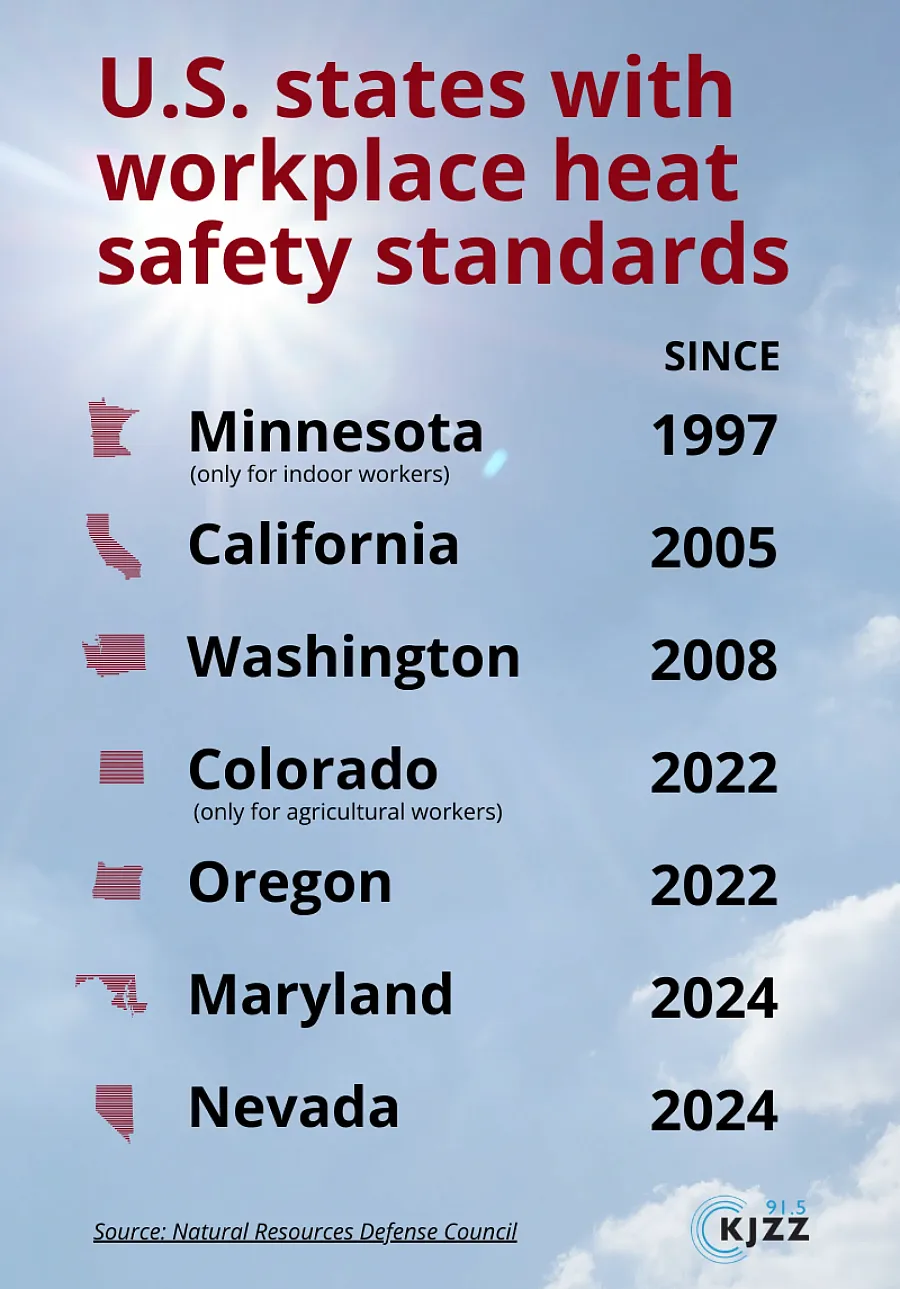
California and six other states have adopted workplace heat safety regulations.
Labor groups say Arizona, known for its extreme climate, should be next.
Sky Schaudt
Labor groups want the state to hold employers accountable
Gov. Katie Hobbs last year convened a task force to make recommendations to the Industrial Commission of Arizona, which includes ADOSH, around workplace heat safety. The Industrial Commission has the power to establish workplace standards through a rulemaking process.
Some labor rights groups hoped the task force recommendations might lead to a new state-level standard which would include strong enforcement mechanisms.
In February, Reyes and a few other workers affiliated with Tucson’s Southside Worker Center, a day laborers advocacy organization, testified before an ADOSH advisory committee to say they want enforceable state regulations.
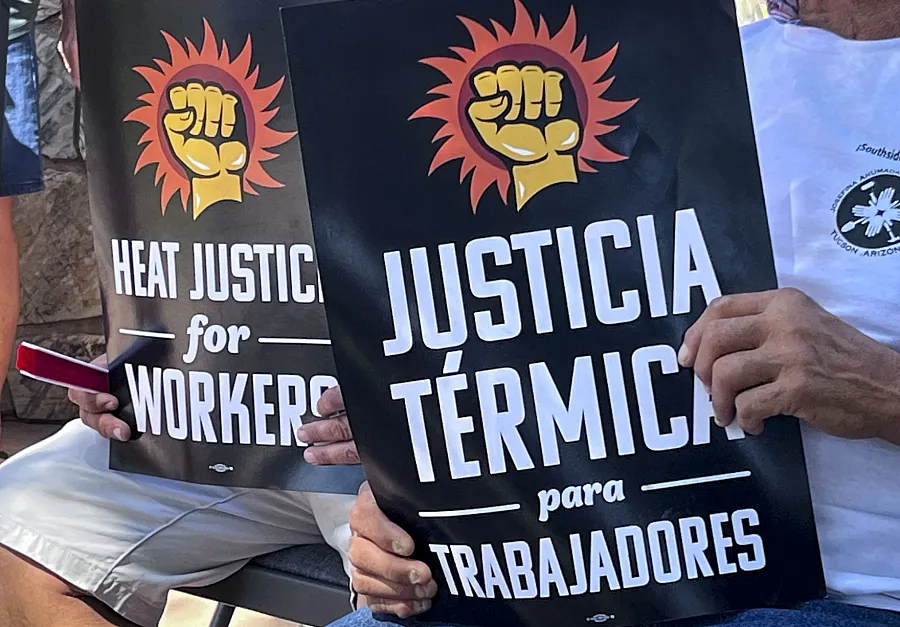
Demonstrators hold signs calling for workplace protections from extreme heat at the Arizona Capitol on June 17, 2025.
Katherine Davis-Young/KJZZ
“We need a law that requires employers to provide water and shade for day laborers,” Reyes told the ADOSH committee.
“We need mandatory heat protections. Not suggestions, not recommendations, but real rules that protect us all before it’s too late,” another day laborer, Tony Pineda, testified.
But so far, actions from the task force and the ADOSH committee have fallen short of what labor rights groups hoped for.
Hobbs’s heat safety task force in December recommended the state should require employers to create workplace heat illness prevention plans, provide potable water at no cost to workers, provide shade and encourage workers to take rest breaks. The task force also recommended employers should provide acclimatization periods and training to help workers stay safe in the heat.
But the task force recommendations did not specify if, or how, the rules should be enforced.
And the ADOSH committee, which heard Reyes’ and other workers’ public comments, voted to advance the task force recommendations as written, without adding a recommendation that the Industrial Commission also begin a rulemaking process to establish an enforceable heat standard for Arizona.
The Industrial Commission is likely to consider the recommendations later this week. But it appears unlikely the commission will enact any new workplace heat safety rules before summer heat sets in.
For Jesus Reyes, the fast-approaching heat season brings a disheartening dilemma.
“We have to work to survive,” Reyes said.
But without stronger protections from Arizona’s heat, he worries about whether he can survive his work.