

Asthma's toll in Louisville is uneven. 'We've just accepted that'
This article was originally published in Courier Journal with support from our 2026 National Fellowship, the Fund for Reporting on Child Well-Being and the Dennis A. Hunt Fund for Health Journalism.

The inhaler is priced beyond reach. The home is blackened with mold. The car to the doctor's office is towed. The air conditioner sputters out. The smog settles in.
In Louisville, asthma weighs heaviest on people who are already struggling. Where someone lives, and how much money they have, often determines whether a manageable case of asthma becomes a scramble to the hospital.
Neighborhoods with lower incomes, less access to health care, less access to quality housing and worse air quality see higher rates of asthma.
In a corner of Algonquin estimated to have the highest asthma rate in the city, incomes are among the lowest in Jefferson County. Head five miles northeast into the wealthy, tree-canopied enclaves of Mockingbird Valley and Indian Hills, and asthma rates drop by nearly half.
Rates of asthma-related hospitalizations are three times higher for Black residents than White residents, according to data from Louisville hospitals, and five times higher in the West End than in the east. In some of Louisville's majority-Black neighborhoods, asthma rates are estimated to be in the top 1% of the U.S.
The chasm in Louisville's asthma burden is a familiar story, one that appears again and again in the city's public health data: Wherever people lack resources, disease is more common and lives are shorter.
In dozens of interviews with residents, lawyers, advocates, doctors and officials, The Courier Journal found the disparities in asthma are partly driven by systemic issues that families have little, if any ability to control. The trends are shaped by decades of public spending and policy that concentrated wealth in some neighborhoods while compounding health risks, like industrial plants and highways, in others.
So-called "social determinants of health" are believed to have more influence over a person's health outcomes than any other factor, including clinical care itself.
"There are so many systems underlying this," said Natasha DeJarnett, an environmental health researcher at the University of Louisville who has asthma. "... There are so many systems that govern people's interaction with public health and medicine."
Two overlapping issues can compound a family's struggle with asthma: access to quality housing and access to a healthy environment. In other words, clean air inside and clean air outside.
Triggers for asthma attacks are found often in Louisville's aging housing stock, including units that are owned or subsidized by the government, according to complaints, violation notices, work orders and emails reviewed by The Courier Journal. Tenants and lawyers said current laws and enforcement on habitability have not been effective in protecting families from unhealthy conditions, even when a child with asthma is at risk.
When Louisvillians step outside of a stuffy home, they may be met with noxious outdoor air. The city is averaging more days of unhealthy ozone levels, which often bring an uptick in asthma-related emergency room visits. Advocates fear warming summers and rollbacks of federal clean air standards could hinder Louisville's progress in reducing air pollution.
Families living in poor housing conditions or near major pollution sources may not have the option to move out of unhealthy circumstances, and the disparities can layer together in cruel and costly ways. For patients disproportionately exposed to asthma triggers in their environment, and without access to preventative care, symptoms may spiral into a lengthy hospital stay.
The situation is not a matter of misfortune or coincidence.
Louisville Metro Government itself has attributed asthma disparities, in part, to policy decisions that have disproportionately harmed majority-Black neighborhoods. In its health equity assessments, the Department of Public Health and Wellness points to decades of discriminatory development and housing policies, including redlining, zoning of heavy industry near homes and the construction of highways through majority-Black communities, as root causes that contribute to current gaps in chronic disease, including asthma.
As the department studied hospitalization data for asthma patients, Angela Graham, executive administrator for research and academic partnerships, found few surprises in who was most impacted.
"Most of our maps look kind of the same," she said, "and most of our data look kind of the same."
'This is the air you're breathing in, and you can't avoid it'
After school, 12-year-old Antwan is itching to get outside. He spends time with friends, plays football and basketball and throws shot put. Neither his asthma nor the September heat keeps him in.
Antwan uses an inhaler, and has learned to monitor his breathing, especially when he's playing sports, he said. Asthma can be "scary," he added, especially when no one else is around to help.

Jen Anderson with her 12-year old son, Antwan, who has missed school this year because of his asthma.
Sept. 18, 2026 Michael Clevenger/Courier Journal
His mom, Jen Anderson, lights up as she talks about her son. She's happy he's active, even if she sometimes worries about his breathing. Antwan was first diagnosed with asthma when he was little, and has usually been able to keep the condition in check, Anderson said.
But in August, as JCPS students returned to school, Antwan's asthma was keeping him home. His symptoms had been flaring up more over the past year, and Anderson worried the problem stemmed from mold in their last apartment, at the Falcon Crest complex in Okolona. Mold can trigger asthma symptoms when the spores are inhaled.
Anderson shared videos and photos of the apartment: The carpet was completely soaked from leaking appliances, and water bubbled up around her feet as she walked. As moisture and apparent mold in the home worsened, the family moved their beds out to the living room. Anderson said she struggled to get a response from the leasing office, even as her neighbors reported similar maintenance issues. Solidago, a Texas-based firm that manages the property, did not respond to The Courier Journal's request for comment.
Anderson receives housing assistance, and first complained about issues in the unit to the Louisville Metro Housing Authority in September 2025, she said. But the family wasn't able to move into a new home until August 2026, following months of inspection, reinspection and moving procedures.
Mold, pests, ventilation issues and other potential asthma triggers in the home are habitability problems, and when they're found in an inspection, LMHA typically gives a property owner 30 days to correct them, agency spokesperson Jailen Leavell said in a statement. "If the owner fails to correct the deficiencies, LMHA must take the required enforcement action," which may include cutting off payments to the property owner and moving a tenant elsewhere.
At the Pointe at Stoneybrook, a housing complex off Taylorsville Road, Cindy Simmons struggled with similar problems this year. Her apartment was without air conditioning for much of the summer, and leaks appeared to be contributing to mold growth.
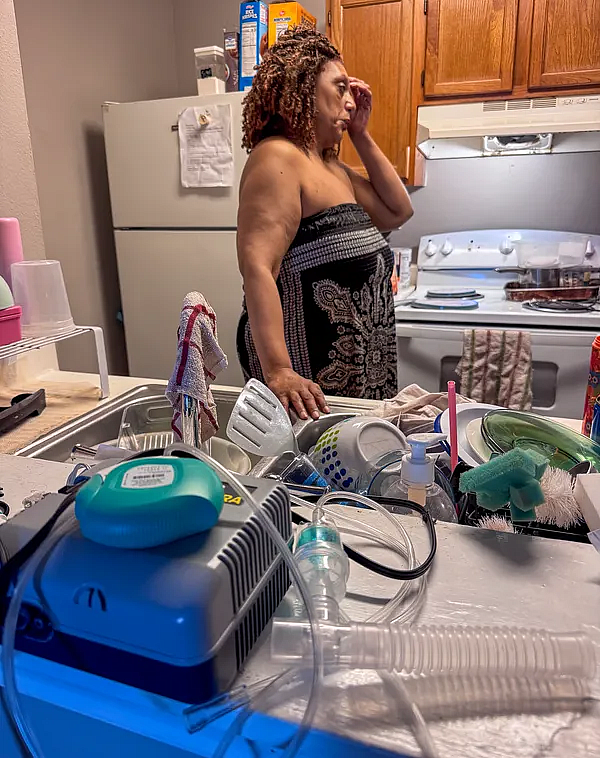
Cindy Simmons believes mold and other maintenance issues in her apartment contributed to her asthma.
Aug. 11, 2026 Michael Clevenger/Courier Journal
Simmons has asthma, and believes the air quality in the apartment worsened her symptoms. Her doctor encouraged her to move out "as soon as possible," she said.
The property manager for the complex was often unresponsive, and failed to remedy maintenance issues in her apartment and other units, Simmons said. Michaels, which owns the complex and bills itself as "the nation's largest private sector owner of affordable housing," did not respond to a Courier Journal request for comment.
"The whole complex needs to be torn down and remodeled," Simmons said in October, shortly after she moved out. Her breathing problems have lingered.
The Louisville Legal Aid Society, which serves low-income clients, regularly fields referrals from tenants who say mold and a range of other housing issues are affecting their health. Some specifically reference asthma and other respiratory diseases.
Grace Chambers, a Legal Aid attorney who has previously worked with tenants in unhealthy housing conditions, said she often heard the same story: "Codes comes out, cites for mold, landlord paints over it, sprays with bleach. I heard that about a billion times a day," Chambers said. "But then, within days or a couple weeks, it's back. The same thing happens over and over."
The Department of Codes and Regulations has issued hundreds of citations for mold and similar indoor air quality issues in recent years, city records show – sometimes repeatedly to the same address. Emily Martin, a spokesperson for the Department of Codes and Regulations, said the agency may require air-quality tests for units with persistent mold.
"When officers identify a likely source, such as a leak or condensation, the property owner must correct it," Martin said in a statement. "Covering the substance does not resolve an underlying maintenance issue."
Chambers works with clients who don't want to go through the hassle of moving over maintenance issues; they simply want the problem fixed. She tells them not to get their hopes up.
"I have to have that conversation with them," she said. "In my experience, this mold is never going to get fixed while you're there. And your landlord's never going to do it. And Code Enforcement is never going to force them to do it."
Families living in unhealthy homes may have few alternatives amid a dire shortage of quality, affordable housing. Even after LMHA finds deficiencies and clears a family to move out of poor conditions, finding a new unit can take months.
Some residents may not even realize conditions in their home are contributing to asthma.
"That's why it's so insidious," Chambers said. "Because this is the air you're breathing in, and you can't avoid it."
Hazards in government housing
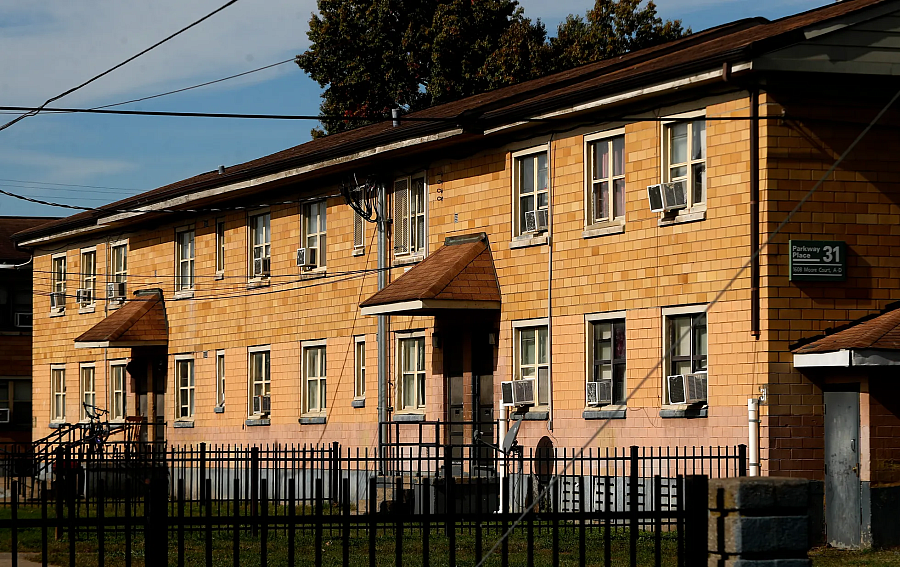
Residents of Parkway Place, a public housing complex in Algonquin, have complained about their children needing to go to the hospital for their asthma as a result of mold in their apartments.
Scott Utterback/Courier Journal
Last year, days before Christmas, residents were in the management office of Parkway Place, a public housing complex in Algonquin, asking to be moved.
"They have been coming here almost every day for the past few months," a staff member wrote in an LMHA email. "They are saying their children have been in and out of the hospital for issues with their asthma because of the mold."
In Parkway Place, a barracks-style public housing community built more than 80 years ago, mold has been a long-standing problem. The complex also sits in the Louisville census tract with the highest estimated asthma rate in the city. About 1 in 6 adults are estimated to have the disease, nearly double the national average.
LMHA houses thousands of residents, and its properties are old. Executive director Elizabeth Strojan said the agency has been working to curb mold and other known maintenance issues that can contribute to asthma symptoms. But it largely lacks the resources to fix those problems at the source, which often requires deep remediation or complete redevelopment of a property.
"The solution that LMHA is racing toward, as soon as we can, is fixing the source of leaks, fixing the source of problems," Strojan said in an interview. "That takes a lot of money, and it takes time, but we're working on it."
LMHA worked with community members on a plan to completely redevelop Parkway Place, but a timeline and funding for the project are uncertain. Last summer, agency staff scheduled a meeting to discuss "known pervasive mold hazards" at Parkway Place, emails show. One agenda item said: "Is preventative maintenance possible?"
Federal funding for public housing, which underpins LMHA's work and similar programs across the country, has been drying up for decades, Strojan said. Congress has favored Section 8 voucher assistance, which steer public dollars to landlords and investors rather than public housing agencies. "Without new revenue streams, LMHA properties will continue to deteriorate, and rental assistance vouchers could ultimately be at risk," the agency said in a report this year.
"We need more healthy housing that's well maintained, and that's not free," Strojan said. "Whether it's your private landlord or a public entity like us, costs are skyrocketing for everybody. Insurance, the cost to get a contractor out, the cost of that paint bucket ... everything's going up."
While Louisville struggles with a shortage of quality, affordable housing, shoddy conditions continue to threaten the health of residents, many of whom lack the resources to move elsewhere. At the same time, the air quality out in the neighborhood might also be contributing to sickness.
Air pollution adds to asthma risk in Louisville
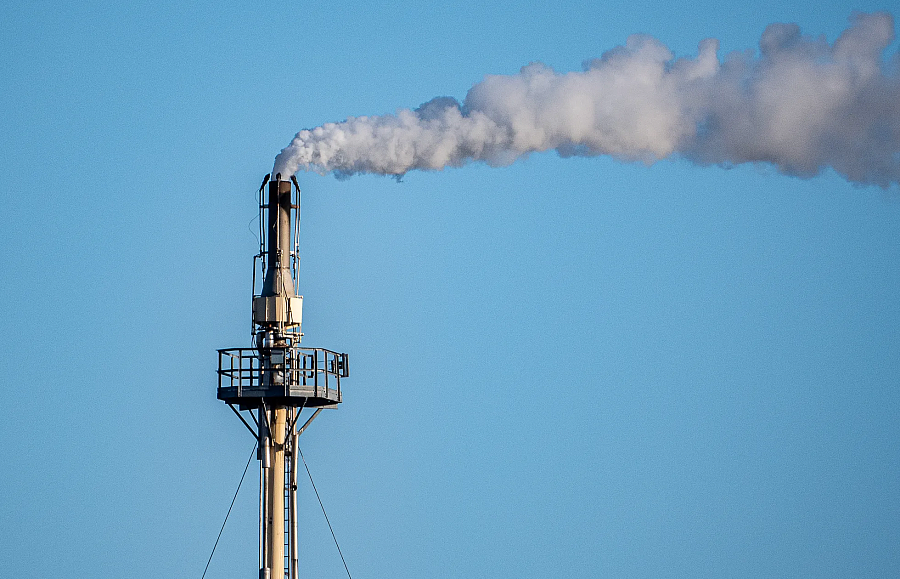
Emissions are released from a stack in Rubbertown, an industrial area in west Louisville along the Ohio River.
Jan. 27, 2025. Jeff Faughender/Courier Journal
Tra'Nise Lloyd lives in Shively, just across Interstate 264 from Rubbertown, the largest cluster of chemical plants in the city. Born and raised in Louisville, Lloyd has had asthma most of her life, and worries about how fumes from nearby industry could be affecting her breathing and that of her neighbors.
"All these pollutants here ... they need to take into account that it does affect people," Lloyd said. "Not just people with asthma. It affects everyone."
While Louisville has made significant progress in reducing air pollution over the last few decades, neighborhoods bordering the fenceline of Rubbertown and other areas of heavy industry are still exposed to disproportionate levels of asthma-flaring emissions, from particulate matter to toxic chemicals.
The construction of Louisville's highways through majority-Black neighborhoods adds an additional layer of local pollution that puts residents "at an increased likelihood of developing asthma and experiencing more frequent asthma attacks," Louisville's health equity report found.
Dr. Wes Sublett, a Louisville physician at Family Allergy and Asthma, said traffic and industrial emissions play a part in asthma, alongside other airborne triggers like pollen. National and local studies have repeatedly found links between local air pollution and asthma, including in young children, who are especially vulnerable.
"It's multiple factors that lead to worsening or more difficult-to-control disease," Sublett said. "But pollution, and where people live – in proximity to industry that produces pollution, or busy intersections that lead to more diesel particulates, or the expressways – that definitely influences asthma."
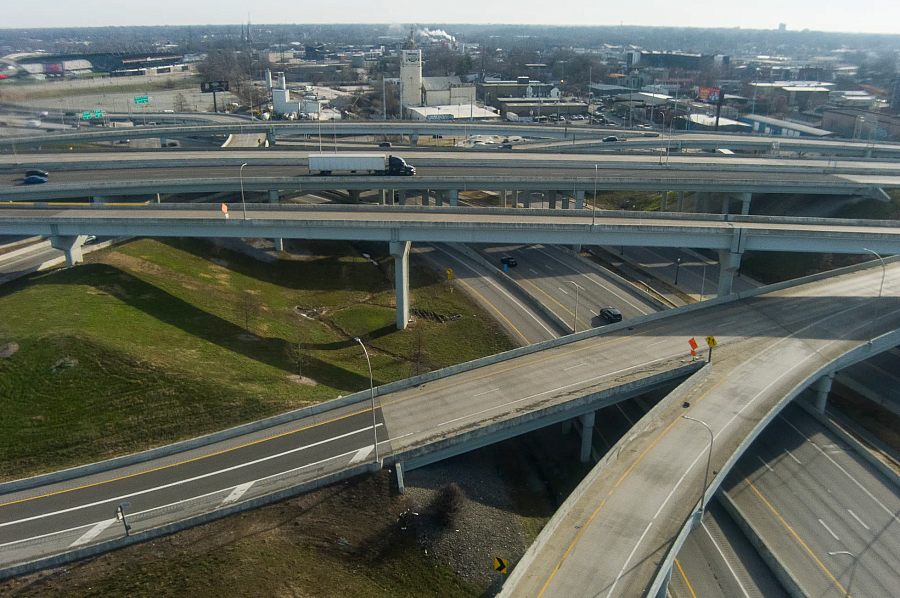
Spaghetti Junction in downtown Louisville. Proximity to highways can contribute to asthma rates.
Matt Stone/Courier Journal
Many families in Louisville struggling with asthma can see an industrial smokestack from their porch. Large swaths of Louisville feature zoning that allows heavy industry directly adjacent to residential areas. Community advocates have pressed regulators for decades to require those facilities to reduce emissions.
Matt King, acting assistant director of the city's Air Pollution Control District, agreed some parts of Louisville still breathe worse air than others. "All the advancements we've made in air quality," he said, "still haven't spread those impacts out."
Threats to air quality progress
For years, Louisville has failed to meet federal standards for ozone pollution, a potent asthma trigger that can contribute to emergency room visits. The city is narrowly in line with standards for particulate matter: tiny particles – emitted from the combustion of fuel in a car's engine, the combustion of coal in a power plant and even the combustion of distant forests in wildfires – that can embed deep in the lungs and make asthma worse.
Kentucky Attorney General Russell Coleman is leading a multi-state challenge against stricter federal standards for particulate matter. This summer, he asked the U.S. Supreme Court to take up the matter following a denial in federal court.
The new Biden-era standards are "disastrous," and "would drive up costs and send jobs and investment out of the Commonwealth," Coleman said in a statement. "Our Office will continue to support the full and proper scientific review that federal law requires, not the last Administration's political grandstanding."
Louisville's decades of air quality improvements are the result of a gradual tightening of Clean Air Act standards and local regulations on the city's biggest emitters. Companies complied by cleaning up their operations, often enabled by new technology, in a decades-long push-and-pull between economic interests and public health. When air pollution contributes to a child's asthma-related emergency room visit, the externality is difficult to trace back to the smokestack.
But the Trump administration has taken sweeping action to roll back federal regulation on Kentucky's biggest sources of air pollution: everything from coal-fired power plants and chemical manufacturers to gas-powered vehicles.
While environmental regulations ease, advocates say new sources of pollution are poised to impact the same vulnerable neighborhoods. Developers had little trouble planning Louisville's first hyperscale data center on an industrial lot along Camp Ground Road in the Rubbertown corridor, where homes sit nearby.
Lloyd lives nearby, and is among many Louisville residents concerned about how the data center project could further impact air quality. In addition to drawing large amounts of electricity from a coal- and gas-dominated grid, the project will include diesel back-up generators, which would release harmful emissions when operated. The developer says the generators will be used only on rare occasions, such as testing and power outages.
The continued risk placed on fenceline neighborhoods is "cruel," said Monica Unseld, a Louisville public health and environmental justice advocate who has asthma. She called for officials to focus "on cleaner air for Louisville residents, instead of trying to make sure that industry is not burdened with regulations."
'Our communities are so full of promise'
DeJarnett, the University of Louisville researcher, was set on her career path by a combination of her asthma and an understanding of environmental injustice in her grandparents' neighborhood in North Birmingham, Alabama, where steel mills and other heavy industry operate in close proximity to homes.
On visits to her family, she felt her breathing suffer. As part of a community health assessment in graduate school, DeJarnett said, "I was able to conclude that the poor air quality likely contributes to how I breathe when I'm there."
She sees some of the same patterns in parts of Louisville, where pollution sources are situated next to neighborhoods. "The communities mirror each other," DeJarnett said. "They're largely low-income, largely communities of color. And unfortunately, I could tell a tale of two cities in Alabama and Louisville, Kentucky, and their similarities. We find this situation all over the U.S."
Disparities in chronic disease, including asthma, pose a tangible setback for Louisville communities. Without a healthy environment and steady access to care, asthma can inflict a discouraging, if not debilitating, effect.
"Our communities are so full of promise. Our communities are full of people that may have the answer to unlocking the next generation of technology, or the next generation of disease treatment," DeJarnett said. "But it's really hard to do that if your health is so hindered that you're missing X number of days of school because of asthma, or you're missing X number of days of work because of other preventable ailments."
Before Shameka Parrish-Wright was a member of Louisville Metro Council, she was raising children with asthma. Their attacks came on suddenly, and kept her on edge.
"As a mother with young kids that couldn't explain everything that was happening to them, it was scary," she said. Their asthma sometimes resulted in trips to the emergency room.
Now in government, Parrish-Wright has thought more about how asthma and other chronic health conditions affect Louisville as a whole. The city's resources are stretched thin, she said, but more could be done on asthma and public health.
"Where we put our money shows what our priorities are," said Parrish-Wright, who is running for mayor. "I don't think we put enough resources and funding toward how we deal with asthma, how our communities are impacted by it, and building awareness and education around it."
In an interview at her office in City Hall, Parrish-Wright wondered aloud how Louisville could better confront the root causes of asthma and its disparities.
"The reality is that for too many Louisvillians that are impacted by asthma, it literally is decreasing their life expectancy," she said.
"We can't continue to be silent about it or just accept it and say, 'He has asthma, he doesn't. He has asthma, she doesn't.' I think that for too long, we've just accepted that."
In Part 4: Solutions to asthma's burden are in reach. Will Kentucky act?
Read the entire series: Courier Journal investigates asthma's burden on Kentuckians in 'Breathless'
Connor Giffin is an environmental reporter at The Courier Journal. Reach him directly at cgiffin@courier-journal.com.