For Centuries, Native Women Have Been Told to ‘Trust the Doctor.’ The Results Have Been Disastrous.
The article was originally published in The Imprint with support from our 2024 National Fellowship.

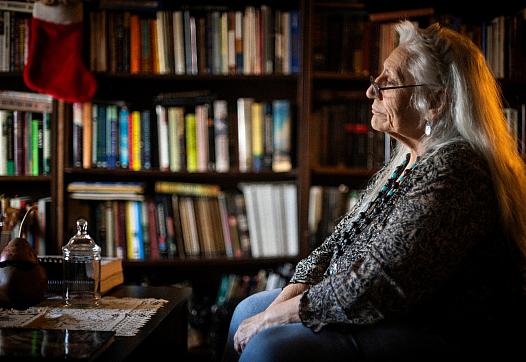
Patti Jo King in her home in Tahlequah, Oklahoma.
Photo by Shane Bevel for The Imprint.
Patti Jo King’s life was just coming into focus in the spring of 1972. She was a young mother working her way through college in Riverside, California, and had joined the Red Power Movement — a nationwide uprising of Indigenous resistance that demanded self-determination, enforcement of treaty rights and an end to systemic oppression of Native Americans.
Thoughtful, precociously well-read and ambitious, the 20-year-old Cherokee Nation tribal member had dreams of becoming a writer, a teacher or maybe a doctor.
But in April of that year, an ER visit for abdominal pain and a suspected ovarian cyst changed the course of her life.
Weeks later, she was seen by a gynecologist at what was then known as the Parkview Community Hospital in Riverside. He immediately insisted on “exploratory surgery,” which was scheduled for the following morning, according to his notes in King’s medical records.
King, now 73, was asked to sign a vaguely worded waiver that made her uneasy.
She recalls it mentioning the word “sterilization.”
King says her doctor dismissed her concerns. “There’s nothing to worry about, because this isn’t gonna happen,” she recalled him telling her. “It’s just in case.”
In multiple interviews over the past year, King explained why she went ahead and signed, despite her misgivings.
“My mother was with me and she was this tiny Cherokee lady who believed in doctors, because that’s how she was raised,” she said. “I was young and healthy, and I didn’t think I necessarily needed ‘exploratory surgery’ for a cyst that could lead to being sterilized.
“But she told me: ‘Trust the doctor.’ So I signed it.”
The next day, May 10, 1972, King woke up in a recovery room confronted by her smiling surgeon.
She recalls the physician telling her: “Well honey, sell your stock in Kotex forever, because you’re never going to have to use another one for the rest of your life.” His words burned into her memory. “We took everything.”
Still groggy from the anesthesia, King struggled to understand what had just happened, noting that his glib — even cheerful — demeanor belied the enormous gravity of a full hysterectomy. Her life would never be the same.
“That’s how I found out I was sterile,” she said.
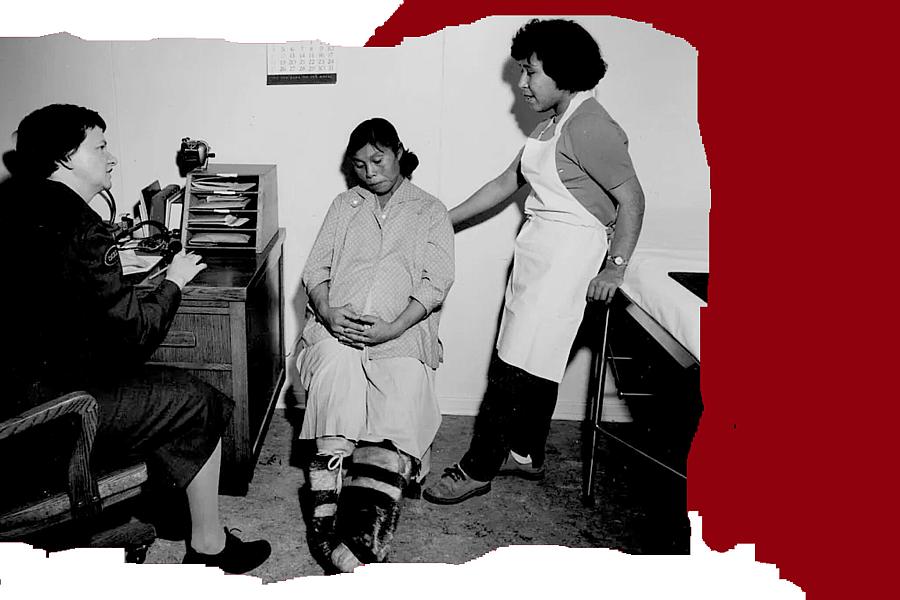
Thousands of First Nations, Inuit and Métis women in Canada were also sterilized through forced and coerced surgeries from 1928 through 1973, under the same eugenics policies as the United States.
Archival photo from the Canadian National Archives.
King’s story is just one among tens of thousands of Indigenous women, men, and children sterilized in the 20th century — often without their consent, or through misinformation and intimidation, including threats by social services to remove their children into foster care.
The account described in this article is based on a review of King’s medical records by a reporter and an independent medical expert, with her permission.
Representatives of Parkview Community Hospital did not respond to repeated requests for comment on King’s account of her experience.
She recalls the physician telling her: “Well honey, sell your stock in Kotex forever, because you’re never going to have to use another one for the rest of your life. We took it all.”
A legacy of control: sterilization, surveillance, erasure
Beginning as early as the 1800s, the U.S. government began implementing policies based on an emerging “science of race improvement” as a means of enforcing a hierarchy of social control. British scientist Francis Galton, a cousin of Charles Darwin, developed the theory of “eugenics” in 1883 to promote selective breeding of humans that he claimed would improve hereditary traits in the name of genetic purity.
Rooted in white supremacist and colonial ideologies, Galton’s ideas became state-sanctioned policies in the early 20th century. In 1907, Indiana enacted the world’s first statute authorizing the compulsory sterilization of people labeled “unfit,” which other states and nations soon replicated. Targeted populations included Black and Latino people, immigrants, the incarcerated, people with disabilities, the poor, homosexuals and anyone defined in vague terms as “socially inadequate.”
American Indians and Alaska Natives, in particular, were subjected to systemic reproductive surveillance and control due to their limited legal protections, language barriers, and dependence on Indian Health Service facilities in remote, impoverished tribal communities. These conditions made them targets for coercion, misinformation, and medical abuse, in a system that was mandated by treaty to provide healthcare to Native Americans in exchange for the loss of their lands. Consequently, they were sterilized at far higher per capita rates than any other group.
More than just policy failures or negligence, however, these acts were part of a broader effort to eliminate Indigenous people using reproductive oppression as a form of ethnic cleansing.
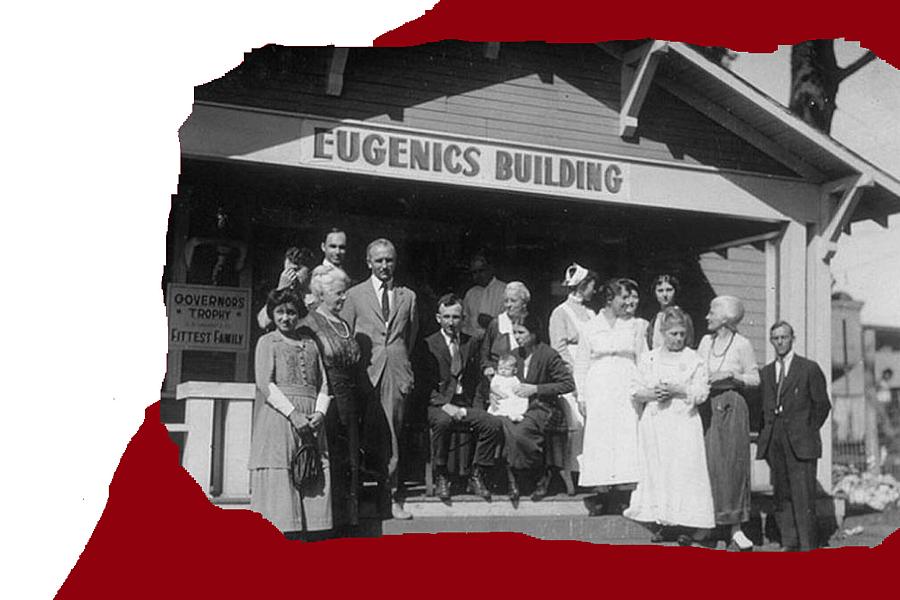
The “Eugenics Building” at an early 20th-century state fair, where exhibits promoted the idea that society could be improved by controlling who was allowed to reproduce. The eugenics movement’s pseudoscience shaped sterilization laws targeting those deemed “unfit.”
Photo from the American Philosophical Society, Wikimedia Commons
In her groundbreaking book, “Reproduction on the Reservation,” Brianna Theobald describes the effects of these policies on women and reproduction on the Crow Reservation in Montana. Central to the government’s agenda was the “Save the Babies” campaign — a public relations effort launched in 1916 with deeply racist and paternalistic motives that portrayed Native mothers as irresponsible or unfit, thus justifying the aggressive removal of their children and the imposition of fertility restrictions.

Brianna Theobald
“It was a government policy that was implemented and carried out by the medical establishment, which had enormous discretionary authority and control over the bodies of Native people,” said Theobald, an associate professor of history and affiliate faculty in the Susan B. Anthony Institute for Gender, Sexuality, and Women’s Studies at the University of Rochester.
Indian Health Service (IHS) hospitals became “training grounds for new and inexperienced physicians who were practicing on Native women and girls in order to be accepted into the College of Obstetrics and Gynecology,” Theobald added. “It was a systematic way of reducing birth rates — and by extension, Native populations — that was funded by the federal government.”
Moreover, the American Board of Surgery promoted this policy by establishing required quotas for operations that surgeons had to perform to complete their residencies, which only incentivized the abuse. “Let’s face it, we’ve all talked women into hysterectomies who didn’t need them, during residency training,” one surgeon admitted.
On the front line of this grim campaign were “field matrons,” white women whose sole job, as agents of federal policy, was to monitor, regulate and enforce Euro-American standards for mothering and childrearing in Native American homes. Theobald’s research estimates that up to 45% of Crow women were sterilized during this period, reflecting trends of 25% to 50% among Native American women nationwide.
Stealing reproductive freedom in Indian Country
Whether at IHS hospitals or public hospitals, many Native women were subjected to the pretext of “exploratory surgeries” with vaguely written waivers that removed any trace of legal liability, leaving them vulnerable to sterilization whenever they sought medical care for any reason.

Abigail Echo-Hawk
Government coercion also played a role, as women were forced to choose between sterilization or losing welfare benefits in impoverished communities where unemployment rates were as high as 70%.
“Our people were desperately poor — they were starving. And they were confronted with awful choices about whether to sterilize or lose their benefits, which could mean absolute destitution,” said Abigail Echo-Hawk, a member of the Pawnee Nation of Oklahoma who is director of the Urban Indian Health Institute and chief research officer of the Seattle Indian Health Board. “These policies have had and continue to have long-term impacts on the crises in our communities that build on one another, including depression, suicides, alcohol, substance abuse, domestic violence and ongoing, generational trauma.”
The passage of Title X of the Family Planning Services and Population Research Act in 1970 dramatically expanded federal funding for contraception and sterilization services. Initially funded at $6 million, the program’s budget ballooned to more than $100 million within two years. Some of these funds were directed to IHS facilities, fueling a sharp increase in sterilizations among Native people.
It was a government policy that was implemented and carried out by the medical establishment, which had enormous discretionary authority and control over the bodies of Native people.
Brianna Theobald
What had been promoted as “family planning” was, in reality, a government-funded assault on Indigenous reproductive rights carried out by the medical establishment with brutal efficiency.
Thousands of Native adults and children were trapped in medical systems where their reproductive rights were stripped away, often during treatment for minor conditions. Scholar Jane Lawrence has written that some patients, for example, received tubal ligations or vasectomies during routine procedures to remove their tonsils or appendix —only to discover years later they had been sterilized.
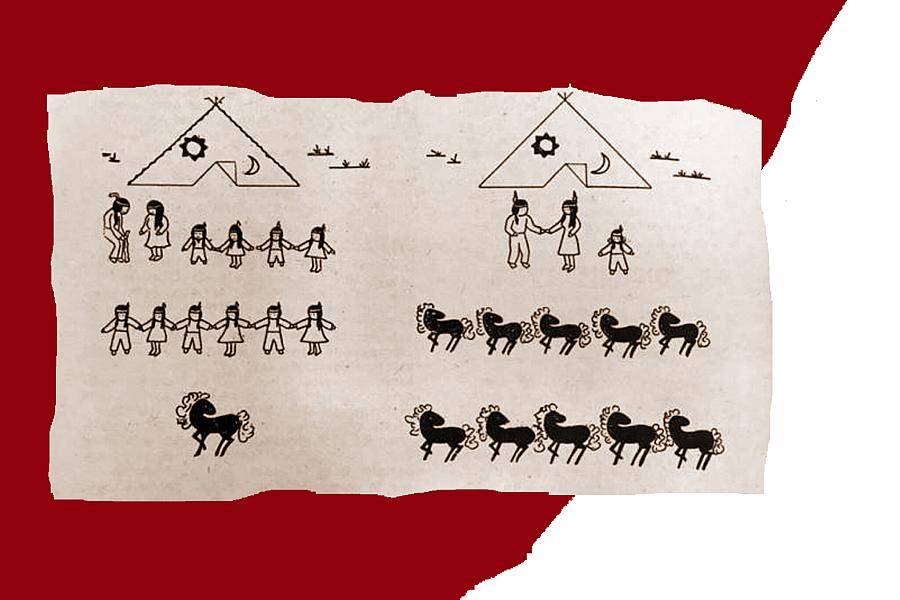
Cartoon illustrations from a government pamphlet promoted sterilization by suggesting that Native families would become prosperous by having fewer children. Critics denounced the imagery that reduced Indigenous families to crude stereotypes and portrayed Native birth rates as a problem to be managed.
Archival image from the U.S. Government.
Under Title X, “the government began subsidizing 90 percent of the cost of sterilizations performed through the IHS,” according to a 2021 legal journal article titled “The Enemy is the Knife: Native Americans, Medical Genocide, and the Prohibition of Nonconsensual Sterilizations.”
The article further notes that these financial incentives drove a sharp surge in procedures: “Doctors and hospitals received only small subsidies for most forms of birth control, [but] a sterilization could earn as much as $720.60.” Over the following decade, the number of federally funded sterilizations of Native Americans increased by more than five times.
Students were being raped and impregnated by school personnel. But they decided if you sterilize them, they can’t get pregnant.
ABIGAIL ECHO-HAWK
Some victims included students in federal Indian boarding schools, who were subjected to forced sterilizations at IHS facilities without their knowledge and without their parents being notified.
“Students were being raped and impregnated by school personnel,” Echo-Hawk said. “But they decided if you sterilize them, they can’t get pregnant.”
At its core, Echo-Hawk says, the intended goal was the deliberate reduction of Indigenous birth rates. But sterilization was not merely a method of population control. It was a strategic assault on tribal continuity, sovereignty, and territorial rights, aimed at weakening Indigenous claims to their lands, resources, and treaty protections — by erasing future generations. Hence, by the end of the 1970s, birth rates fell by up to 75% in some tribal communities.
“This is what structural racism looks like when the government and the medical establishment become complicit in the mass sterilization of Native people,” Echo-Hawk said, “which was incentivized and paid for with federal funding.”
These Indian women breed like rabbits
Devastated, depressed and in full-blown menopause at the age of 20, Patti Jo King was resigned to the fact that she would never have more children. She remained in Riverside with her mother and went on with her life, continuing to raise her young daughter, Portia, who was 2 years old at the time. She later finished her bachelor’s and master’s degrees at Northern Arizona University.

Patti Jo King holds a photo of herself as a young mother with her daughter.
Photo by Shane Bevel for The Imprint.
But a subsequent conversation with a friend who had been the scrub nurse for her 1972 surgery haunted her for years. The nurse told King that as she lay unconscious, the surgeon dryly commented to those in the operating room that “These Indian women breed like rabbits.”
The remark shocked King to her core, and convinced her that the doctor set out to sterilize her because she was Native American.
“It was a despicable, prejudicial thing to say about his own patient,” she said. “It always made me think that he knew exactly what he was doing.”
In the early 1980s, King moved to Berkeley with her daughter and husband for new jobs. When she enrolled in a Bay Area health plan, she retrieved her patient records from the facility now known as Parkview Community Hospital Medical Center. They included the reports she had never been given after her surgery.
The doctor’s surgical notes and the lab’s pathology report revealed she had been given a full hysterectomy for “moderate inflammation” that had blocked one of her fallopian tubes from a ruptured cyst. King’s records showed no evidence of cancer, tumors, sepsis or any other emergent or life-threatening condition that would have necessitated the complete removal of all of her reproductive organs, according to Dr. Amelia Huntsberger’s independent evaluation for this article.

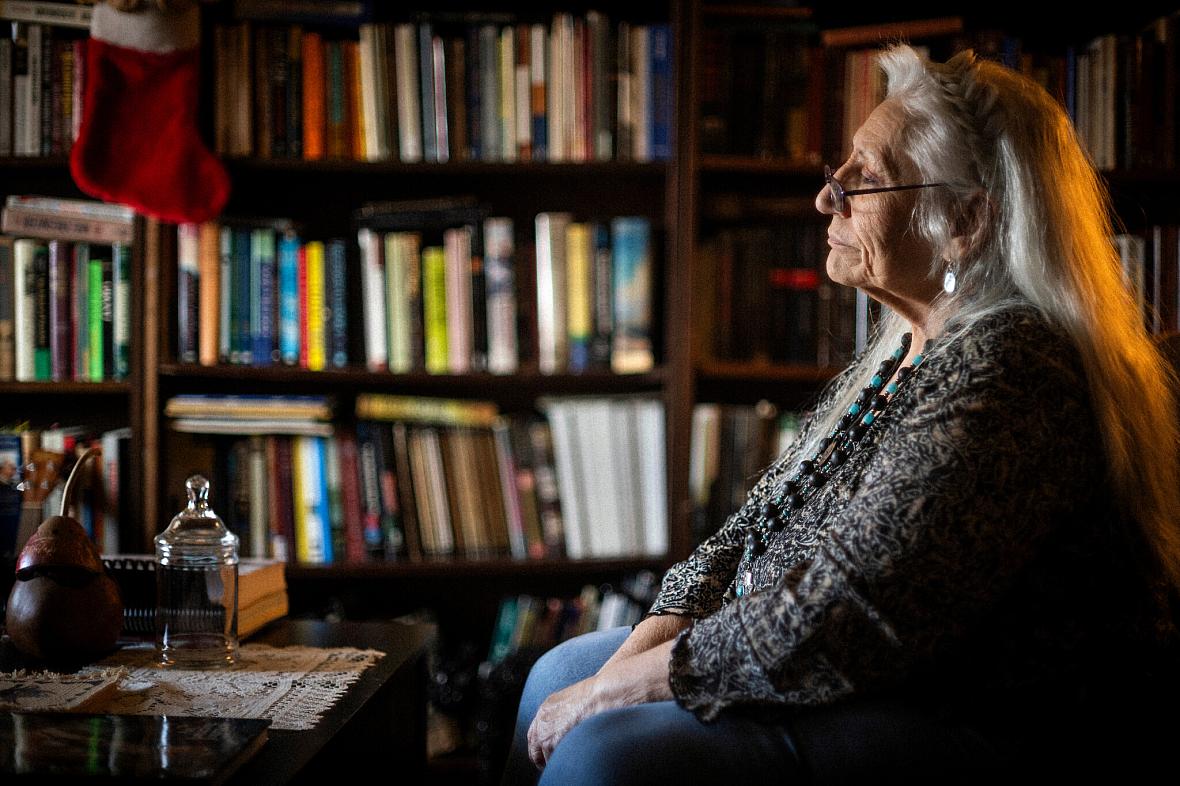
Corn husk dolls and some of the 4,000 books in Patti Jo King’s home in Tahlequah, Oklahoma.
Photo by Shane Bevel for The Imprint.
With King’s permission, the Oregon-based obstetrician/gynecologist reviewed the pre- and post-surgical records, pathology reports and clinical condition at the time. Huntsberger concluded that, in her opinion, a full hysterectomy was medically unnecessary.
“Taking out the reproductive organs of a 19- to 20-year-old is a big deal, and the clinical circumstances in her case did not seem to warrant that kind of drastic action,” Huntsberger said. “She was not in danger and this was not a surgical emergency. But her fertility was taken away by what could have been treated with antibiotics — even at that time.”
I began to realize that genocide was still alive and well in America, and I wept for all the unborn children used as collateral in the quest for dominance and political hegemony.
Patti Jo King
Moreover, King’s surgery took place less than 24 hours after her office visit, leaving her no time to reconsider or seek a second opinion — as she alleges that no one explained her rights or options.
What King read in the medical records confirmed her long-held suspicions.
“That pathologist’s report slapped me into reality. I couldn’t believe the vile deception — and the way the doctor had placated my trusting mother made me furious,” she said. “I began to realize that genocide was still alive and well in America, and I wept for all the unborn children used as collateral in the quest for dominance and political hegemony.”
But the weight of what had happened to her also hit hard internally.
“I was plunged into a deep depression because I wanted more children and I wanted my daughter to have siblings,” King said. “But that was never going to happen and I spent years agonizing over it.”

Patti Jo King visits the grave of George Lowrey, an uncle of hers, at the Tahlequah Cemetery near her home in Tahlequah, Oklahoma.
Photo by Shane Bevel for The Imprint.
Confronting the past, reshaping the future
In the early 1970s, Dr. Constance Redbird Pinkerman-Uri, a Cherokee and Choctaw physician and lawyer, opened her own investigation into suspicious and involuntary sterilizations at Claremore Indian Hospital in Oklahoma. The impetus came from one of her patients who had undergone a hysterectomy in 1966 at the age of 20 but was told by her surgeon she could receive a uterine transplant — which was a lie, as no such procedure was developed or available until many decades later. In fact, the first uterine transplant in this country was not successfully performed until 2017, and even today remains an exceedingly rare and experimental operation.
Pinkerman-Uri, along with several other Indigenous medical professionals at Indian Health Service facilities across the country, began demanding action from Sen. James Abourezk of South Dakota, then chair of the Senate Subcommittee on Indian Affairs. Subsequently, Abourezk asked the General Accounting Office to conduct an investigation into sterilization abuses.
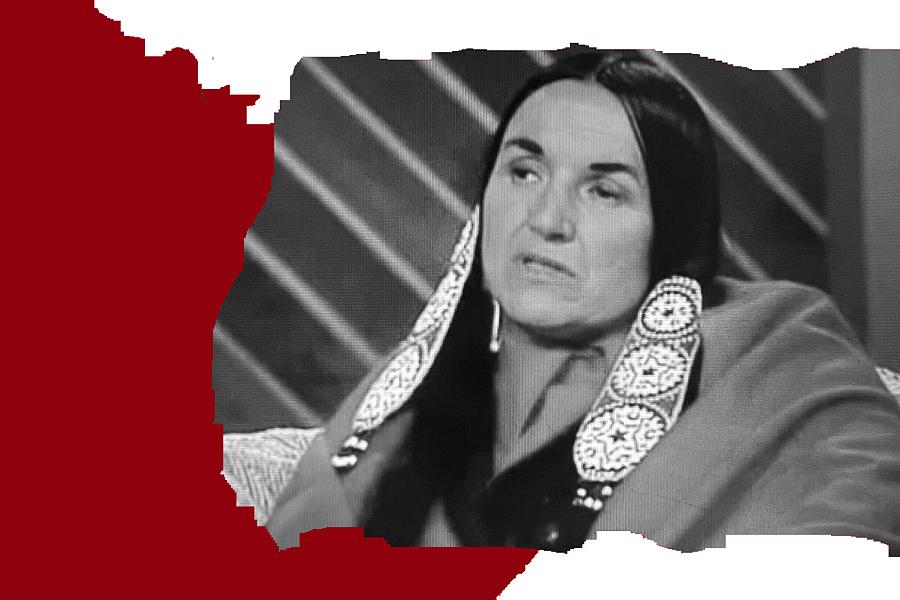
Dr. Constance Redbird Pinkerman Uri, a Cherokee physician, was among the first to publicly expose the widespread sterilization of Native women in the 1970s, sparking national investigations into federal health programs serving Indigenous communities.
Screenshot image from a 1970s PBS documentary.
In 1976, the GAO investigation — which included four IHS facilities in Albuquerque, Phoenix, Oklahoma City and Aberdeen — found that 3,406 Indigenous women had been sterilized in a 46-month period, including 36 under the age of 21.
Since then, however, critics have faulted the investigation as fundamentally flawed, since it only covered four of the 12 IHS regions, excluded patient testimonies, relied narrowly on signed waivers, and ignored coercive tactics and doctor misconduct. Numerous sources now estimate that up to 70,000 Native women were sterilized from 1970 to 1976.
Pinkerton-Uri had concluded that only 100,000 Native women of childbearing age remained nationwide — creating an urgency in addressing the scale of harm to Indigenous communities and the long-term demographic, cultural, legal and political consequences for Native nations.
“Their intentions about why they were doing this was not a secret in Native communities,” said Echo-Hawk. “We have to talk more and tell the truth about what happened — because from truth comes healing.”
To date no one has ever been held liable or criminally accountable, and the federal government has never offered an apology for the abuses that occurred at its medical facilities serving Native Americans.
In the late 1970s, Native women from around the country began forming advocacy groups, including Women of All Red Nations (WARN), to fight back against a system that had methodically deprived them of their reproductive sovereignty and their basic human rights. They demanded justice, accountability, and an end to coerced sterilizations and medical abuse.
Subsequent policy changes at the Indian Health Service included stricter informed consent guidelines; a 72-hour waiting period; bans on sterilizations for women under 21; consent forms translated into Indigenous languages; and increased oversight of IHS and federal health programs for Native people.

Women of All Red Nations (WARN) activists in the 1970s. The Indigenous women’s organization exposed the forced sterilization of Native women and in 1977 brought the issue to the United Nations in Geneva.
In the early 1980s, when King became fully aware that she had been sterilized for a treatable condition, she sought legal advice from a medical malpractice attorney in Riverside regarding how to hold the doctor and hospital accountable. But by that time, she learned, the statute of limitations for filing suit in California had long passed.
To date no one has ever been held liable or criminally accountable, and the federal government has never offered an apology for the abuses that occurred at its medical facilities serving Native Americans.
But the wall of silence has begun to crack. On Feb. 19 the New Mexico Legislature voted to open an investigation into the forced sterilization of Native American women — a long-overdue step toward truth and accountability.
Bearing witness to a hidden history
Today, Patti Jo King is a retired professor of American Indian History and Indigenous Studies now residing on the Cherokee Nation reservation in Oklahoma. Her daughter Portia, now 55, has four children and four grandchildren of her own and lives near her mother.
King, who eventually received her Ph.D in American Indian Studies from the University of Oklahoma, has spent decades writing, teaching and advocating for Indigenous causes, in the hope that her work will help expose historical injustices, empower Native communities, and support the fight for sovereignty and healing.

Photo by Shane Bevel for The Imprint.
Her message reflects a powerful shift from historical silencing and control to empowerment and reproductive sovereignty for Indigenous women. She speaks to a broad movement for birth justice — reclaiming bodily autonomy, honoring traditional knowledge, and confronting generations of systemic oppression with resilience, agency, and a vision for future generations.
“We are a matrilineal community of strong women who have always had a powerful role in our leadership,” said King, who is currently working on, “Charlatans, Hucksters and Spiritual Orphans: American Indian Ethnic Fraud in Academia,” her second book.
“Your relationship to your child and childbearing is the most powerful statement you can make in the continuance of our communities — so guard it, advocate for yourself and pass it on to the next seven generations.”