

Drinking water from Stanislaus County’s domestic wells can be dangerous. Here’s why
The article was originally published in Modesto Bee with support from our 2025 Data Fellowship.

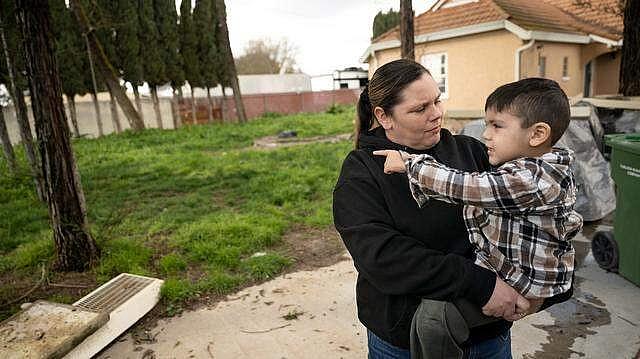
Emily Petersen with her son Matthew, 4, at their home in unincorporated Stanislaus County, Thursday, Feb. 19, 2026.
Andy Alfaro aalfaro@modbee.com
On a half-acre lot just feet from a walnut orchard, Emily Petersen lives with her husband, her three young children and her German shepherds.
When she and her husband, Jose, bought the house seven years ago between the unincorporated town of Empire and the city of Waterford, she was excited. It meant having more space and privacy away from the city.
When she learned it came with a well, she thought, “Great, free water.” What she eventually discovered was more complicated.
“You think, ‘Oh, wow, one less bill,’ you’re not going to have to worry about water,” Petersen said. “Well, I didn’t realize, actually, no, you still have to worry about your water.”
State records show that Stanislaus County has about 20,000 water wells, with nearly half used domestically. Those wells are more likely than not to contain unsafe drinking water, according to test results reviewed by The Bee. They tend to be shallow and therefore more prone to surface contaminants like pesticide residue, heavy metals and nitrate contamination from fertilizer, dairies or septic tanks.
Domestic wells are a blind spot for water quality data since the state does not regulate private wells. It’s only through voluntary programs like the Valley Water Collaborative that data on these wells are gathered.
The Bee obtained test results from September 2022 to mid-December 2025 by submitting a California Public Records Act request to the State Water Resources Control Board.
Residents of unincorporated areas in Stanislaus County are more likely to be impacted by polluted groundwater and less likely to have the money to purchase bottled water or install a full home filtration system on their own.
Petersen’s risk for drinking water contaminants is close to the highest in the region. On top of that, she lives in an area heavily burdened by pollution, environmental hazards and socioeconomic vulnerabilities.
“Unless you can afford a new water filtration system, you’re just stuck,” Petersen said.
The most prolific contaminant is nitrate
South of Ceres lies the Cowan Tract, a 102-acre neighborhood with a mix of mobile homes and single-family houses on 1-acre plots.
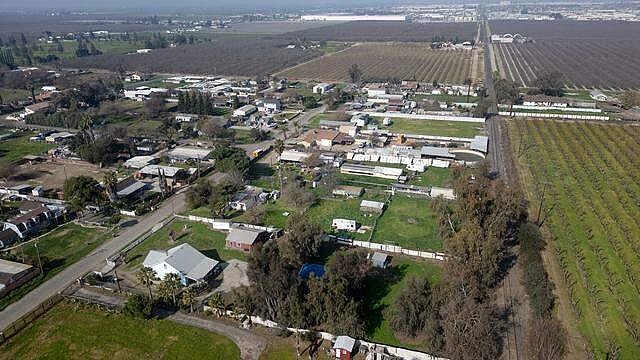
Cowan Tract in unincorporated Stanislaus County, Tuesday, Feb. 3, 2026.
Andy Alfaro aalfaro@modbee.com
The neighborhood of 94 households was created in the 1940s on agricultural land zoned for uses like parking, composting and storage sheds. It abuts railroad tracks, orchards and a golf course, and it has no sewer systems, sidewalks or fire hydrants.
The small community relies entirely on domestic wells. Of those tested, all were found over the safe drinking limit for nitrate, and most tested above twice the safe amount.
Travis Davis has lived in the tract with his wife and two children for five years.
“We’re able to get an allotment of drinking water because the water from the well is so terrible,” Davis said. “There is a worry in the back of my mind: Am I creating an issue I might have healthwise later on in my life?”
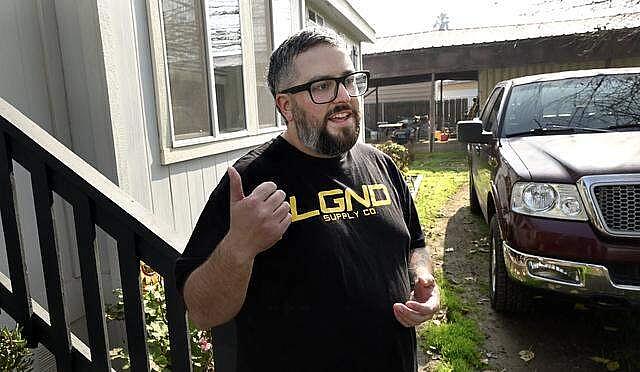
Travis Davis at his Cowan Tract home in unincorporated Stanislaus County, Tuesday, Feb. 3, 2026. Davis’ family drinks bottled water instead of drinking from their well.
Nitrate can cause serious health concerns for pregnant women and children under the age of 6 months when ingested. Infants who consume nitrate through their drinking water may develop “blue baby syndrome,” a rare but fatal condition that prevents oxygen from moving through the bloodstream.
In May, the California Department of Justice sent a letter to the Stanislaus County Department of Planning and Community Development pointing to the Cowan Tract as a disadvantaged community particularly vulnerable to poor water quality and in need of a more robust plan to address its future development.
Nitrate testing, facilitated by the Valley Water Collaborative, is part of a 35-year deal brokered between the Valley Water Control Board and industries that contribute to nitrate contamination in the region.
The county estimates that there are around 2,000 domestic wells, but state drill records show almost 10,000 such wells in Stanislaus County, and only a small fraction of those have been tested for groundwater contamination, according to records obtained by The Bee.
Since the program began, 540 tests have been conducted throughout the county for nitrate in domestic wells. The Bee found 65% of the tests were over the safe drinking water levels and over 25% were double the safe drinking limit or more.
The county cited “extensive agricultural activities” as the reason nitrate levels reached unsafe standards and emphasized the higher risk in the shallow aquifers.
What’s being done about it?
There have been steps to mitigate the continuing seep of nitrate into groundwater. Most of it has focused on educating farmers on better fertilizing practices so they’re using fertilizer only at times it’s most likely to be absorbed by crops.
But even if nitrate stopped percolating into the shallow aquifers in the county today, it may take 50 years to get back to normal.
Aysha Massell, program director for Water for the Future at Sustainable Conservation, said one idea to decrease nitrate pollution in groundwater is to increase groundwater recharge and essentially flush it out.
Because the groundwater quality is already poor, recharge might work better to move the nitrate out of the aquifer, Massell said, citing a white paper created by Sustainable Conservation.
“In combination with just reducing or eliminating continuing leaching or discharges, it could be very powerful in terms of cleaning it up sooner than later,” she said.
As it stands, nitrate is pervasive throughout the county at high levels, especially for people who live near dairies.
What else is in the water?
Tests of domestic wells show the groundwater contamination is more than just above safe drinking levels for nitrate.
Near half of the tested wells were over the safe drinking water levels for uranium, which over time can cause kidney issues. Though uranium is naturally occurring, the county suspects it penetrated the shallow aquifer through high PH groundwater recharge and noted a strong correlation between nitrate and uranium in the groundwater in the regions near Modesto and Ceres.
Around 12% of the wells tested in Stanislaus County were over the safe drinking limit for 1,2,3, TCP, a man-made chemical recognized by the state of California to cause cancer and, over the long term, liver or kidney damage. It also has short-term symptoms like eye, skin, nose, throat and lung irritation, headaches, memory and concentration problems, and muscle coordination issues.
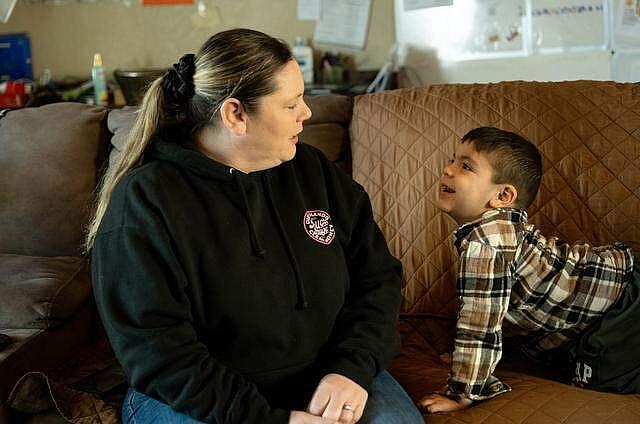
Emily Petersen with her son Matthew, 4, at their home in unincorporated Stanislaus County, Thursday, Feb. 19, 2026. The Petersen well water has tested almost nine times over the safe drinking limit for 1,2,3 TCP so they have been drinking bottled water provided by the Valley Water Collaborative.
Andy Alfaro aalfaro@modbee.com
Petersen said when her youngest son, 4-year old Matthew, began to have dry skin and developed spots on his legs, she decided to get her water tested. She found online that Valley Water Collaborative provided free testing that is easy to sign up for.Her test results came back almost nine times over the safe drinking limit for 1,2,3 TCP which persisted in the aquifer her well draws from long after the ingredient was banned in the 1990s.
One in 20 of the wells tested above safe limits for arsenic, another carcinogen most common in the regions near Hughson and Salida.
The most common contaminants found in domestic wells in the county give no hint there is a problem. They are invisible to the naked eye, odorless and often tasteless.
Though Stanislaus County as a whole has a slightly higher cancer rate for both men and women across all age groups compared to the rest of California, determining a direct link between a particular carcinogen and cancer rates in the real world can be difficult due to multiple environmental factors within a small population size.
Testing beyond nitrate is covered by the state’s Safe and Affordable Funding for Equity and Resilience, a program designed to identify where there are unsafe drinking water conditions and help fund short and long-term solutions to persistent groundwater issues.
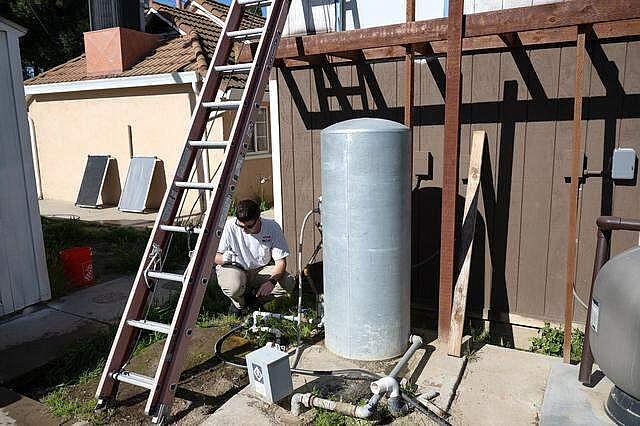
Geoanalytical Laboratories technician Logan Davis draws a water sample from the domestic well on the property of the Petersen family in 2025.
Andy Alfaro aalfaro@modbee.com
Since the test, Petersen’s family has received 1-gallon water bottles through the Valley Water Collaborative. Petersen’s youngest child, Matthew, has more sensitive skin and likes taking baths. Though the main form of exposure is through drinking contaminated water, the type of contamination she has in her well can cause skin irritation even if her family isn’t drinking it by absorbing through the skin or evaporating during showers or bathing.
Though testing is completely voluntary and the state cannot shut down a well if it tests over, hesitance from residents remains. Some residents fear retaliation from nearby farmers, others worry about property value, still others worry that the information may be used to identify them if they are undocumented.
The next steps to address the contamination of drinking water are to consolidate wells into small or public water systems and implement concrete long-term solutions to groundwater pollution by agriculture in the county. All of these are years to decades off.
For Petersen, the Valley Water Collaborative is interested in moving her family to a filtered community system that she and her neighbors could access, but she doesn’t think it will happen.
“None of the neighbors want to sign up because either they own a part of the land, they’re a part of the problem, or they just don’t want to make the homeowner upset at them,” Petersen said.
For now, Petersen distributes her extra water bottles among her neighbors.
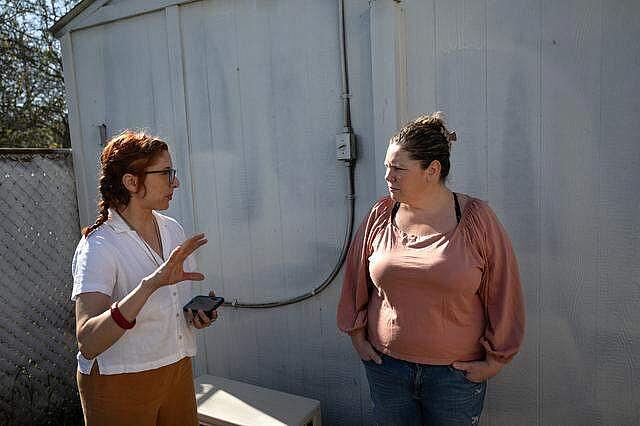
Emily Petersen, right, talks with Sara Bernal from the Valley Water Collaborative during water testing at the Petersen home in Stanislaus County, Thursday, April 10, 2025.
Andy Alfaro aalfaro@modbee.com