

Florida is taking fewer kids into foster care. What changed?
This article was originally published in the Tampa Bay Times with support from our 2025 Data Fellowship.

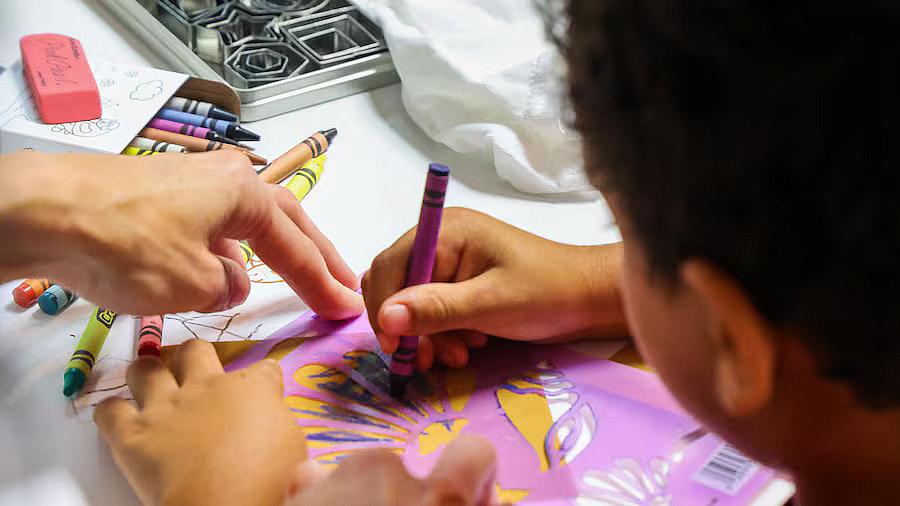
Lisa Wilkes, left, helps her foster child create art at Florida Craft Art in June 2026 in St. Petersburg. Fewer and fewer Florida kids are entering foster care, data shows.
DIRK SHADD | Times
Fewer Florida kids are in foster care than at any point in two decades, historical records show, after a steep drop that has drawn a mix of celebration and concern. And nowhere has seen a bigger change than Tampa Bay.
The population is around 40% less than it was at this time five years ago.
Agency leaders tout the rapid drop as a victory for a system that for years struggled to manage it. And advocates widely agree that reducing the number of kids in state custody is, overall, a good thing. The state is in line with national trends.
But some lawmakers and child welfare experts in the state expressed concern about the speed of the drop across all parts of Florida. And they say it’s unclear what’s happening to kids instead.
“It doesn’t mean that fewer kids are in families that are having problems,” said Robin Rosenberg, deputy director of the nonprofit Florida’s Children First, which advocates for kids in the child welfare system. “So where are those kids going, and is it better off for them?”
Several factors could be driving the decrease, Rosenberg and other experts told the Tampa Bay Times. To name a few: organizational turnover, evolving policy guidelines and an overall push for diversion programs intended to help families address problems without removing children.
A growing body of research also points to a trend known as “hidden foster care,” in which children are informally placed with relatives. A Times investigation in Hillsborough County cast a spotlight on such arrangements this summer. Though not tracked as foster care placements, the Times found the county’s lead child welfare agency often separates families off the books, compelling parents to sign away custody of their children, under circumstances that experts described as “coercive” and “highly disturbing.”
State Sen. Don Gaetz, R-Pensacola, told the Times in September there is no set of numbers that would alone indicate “success,” because every child is different. But it’s troubling, he said, that state officials haven’t explained them.
Gaetz and other Florida lawmakers have called for a complete overhaul of the Department of Children and Families after a grand jury report in August found “systemic patterns of neglect and abuse” and operational failures within the agency.
“Why can’t the Department of Children and Families answer the question: Why are these numbers what they are?” he said. “And is it good or bad?”
The department did not grant a requested interview or respond to detailed questions from the Times. But in a news release from December, the department said the decrease was a measurable improvement, “reflecting strong family stabilization efforts and proactive supports.”
“The results we are seeing for children and families across Florida are not by happenstance,” then-department Secretary Taylor Hatch said in the release, which also noted declines in opioid deaths, homelessness and enrollment in government assistance programs like food stamps. “They reflect years of intentional leadership by Governor (Ron) DeSantis and First Lady (Casey) DeSantis, strong partnerships in the Florida Legislature and local organizations, and a commitment to serving families as if they were our own.”
An overburdened system began taking in fewer kids
Florida’s foster care population started rising in the 2010s, peaking around 24,500 children in 2017.
Reports from the time abounded of an overburdened system, especially in Tampa Bay. In Hillsborough County, kids bounced around “night-to-night” placements amid a bed shortage. In Pinellas, children slept in “deplorable conditions” at an unlicensed Largo office.
But for the last decade, the number of children in care has steadily dropped.
The Times analyzed data, both published and provided in response to a records request, tracking hundreds of thousands of children’s movements through the foster care system — showing when they entered state custody and why.
Fewer children are entering foster care than any time in the last 20 years, the Times analysis shows.
In 2022, around 11,000 children entered foster care in Florida, data shows. Three years later, less than 8,000 did.
“It is historically significant,” said Robert Latham, a law professor at the University of Miami and associate director of the school’s Children and Youth Law Clinic.
The last time the state’s foster care population dropped at such a rapid pace was in the late 2000s, he said. Amid a national push then, Florida streamlined the process for kids to exit through guardianship, in which the court appoints a new caregiver.
This time around, Latham said, there’s been no obvious policy change.
Fewer kids are being removed for drug reasons
Some of the trend can be explained by how investigators handle parental drug use.
Across the United States, synthetic opioid use skyrocketed in the mid-2010s. Nearly half the children entering state custody that decade were removed due to parental drug use, the Times analysis of department data shows — almost 8,000 kids some years. Often they were babies, taken into care after mothers tested positive for drugs during pregnancy, experts say.
In 2017, when the foster population was the highest it had been in nearly a decade, more than 5,600 Floridians died of a drug overdose — a toll that had nearly doubled in two years. Overdose deaths continued to climb before returning to similar levels.
Meanwhile, parents’ drug use remains the most common cause for foster care placements. But it’s decreased significantly: in 2022, nearly 5,000 children were removed for reasons related to substance abuse that entire year. In 2024, a state dashboard shows, only 3,200 were.
“The use of drugs during pregnancy can have significant health impacts on kids,” he said. But removing children did little to encourage parents to get help with addiction or maintain health during pregnancy.
“I think overall it’s positive, because it’ll help us work better with families.”
Black children are still overrepresented
Though the foster care population is down across the state, the drop hasn’t been equal across demographic groups.
Removals of babies and toddlers decreased the most, leading to the overall population now skewing older.
And the decrease in white children has outpaced other racial groups — tracking the waning opioid epidemic, which affected white families more.
Black children have always been overrepresented in foster care, data shows. Now, that disparity is even sharper: they make up 24% of Florida kids but 37% of those in foster care. (The data does not break out Hispanic origin.)
Despite the overall drop, Florida’s foster care system has just as many Black teens as it did five years ago.
That comes as little surprise to community activists like Risasi Milima, a mental health counselor based in Temple Terrace. Milima pointed to what he sees as biases in the system and authorities more heavily scrutinizing Black parents. Officials should continue to study the disparity, he said.
“Until we really look and see the groups that are being affected in the long term, we will continue to miss the mark,” Milima said.
Tampa Bay is leading the charge
Hillsborough’s foster care population has decreased by more than 1,000 children in just under five years, the largest drop in the state. Other counties in Tampa Bay are close behind.
The region has experienced drastic turnover in leadership. Before 2022, Clearwater-based Eckerd Connects led foster care in Hillsborough, Pinellas and Pasco counties. But after reports of mismanagement and a criminal investigation, Florida cut ties with the group.
The Children’s Network of Hillsborough County, an offshoot of a group serving Southwest Florida, took over services in Hillsborough. Across the bay, Family Support Services of SunCoast handles Pinellas and Pasco.
Leaders at both agencies said they streamlined a backlog of adoptions and implemented diversion programs aimed at reducing the number of kids entering care, offering resources to some families while kids remained at home.
Carlos Cruz, the chief of staff for Family Support Services, said they’re still helping the same kids who might have gone into foster care, “just in a less traumatic, more planned and strategic manner that is less intrusive, less costly, better for the family.”
Meanwhile in Hillsborough, the Children’s Network touts a program called the Intensive Family Services Team, which similarly connects families to services with the goal of keeping families intact, said Terri Balliet, the Children’s Network CEO.
It connects parents to services to help with issues like substance abuse and mental health, she said. Balliet credited the team with reducing the number of children entering care by at least half.
“All of that has really impacted the decrease overall,” Balliet said last year. “And just making sure … if they’re removed from the home, that we’re finding relatives or even non-relatives for those kids versus bringing them actually into foster care.”
In some cases, the Times investigation had found, the team advises parents to sign away custody of their children, outside of the formal court process and without their own legal representation. Child welfare advocates have been critical of these tactics. But the informal arrangements are not tracked as official foster care placements.
“These child welfare interventions are undertaken in the name of child protection,” said Heather Tager, managing attorney at the L. David Shear Children’s Law Center, part of Bay Area Legal Services. “We should be able to demonstrate through transparency and measurable outcomes that children are better off as a result. Without that accountability, it’s difficult to know whether we are strengthening families, saving money or simply moving problems out of public view.”
Latham said he is concerned that hidden foster care arrangements may mean families in the child welfare world are undercounted across the state.
“I’m worried that these numbers are an illusion,” said Latham. “That they’re not actually going down.”
There’s a national trend
Child welfare experts say there’s no ideal level for the foster care population. Agencies must constantly weigh the need to intervene if a child is in danger with the potential harms of separating families.
The U.S. Administration for Children and Families reported the country’s foster population had decreased four years in a row from 2020 to 2024 (there was a 1.4% increase in 2025).
Richard Wexler, executive director of the National Coalition for Child Protection Reform, called the change “a good thing, because we know how harmful foster care is.”
He cited national studies that warn of widespread physical and sexual abuse in foster care, as well as evidence of an “inherent trauma of removal.” Providers say fewer kids in the system means closer relationships and more stability.
There’s been a greater push, nationwide, to separate fewer children from families, sparking various diversion programs across the U.S., he said. Congress made more money available for such programs beginning in 2018.
“The whole system has also shifted,” said Rosenberg, with Florida’s Children First. “The state is placing a greater emphasis on keeping kids at home and helping the families.”