

How Madison, Kalamazoo groups fill void in saving Black babies, moms
This article was originally published in The Cap Times with support from our 2026 National Fellowship and a participant in the Center’s engagement initiative.

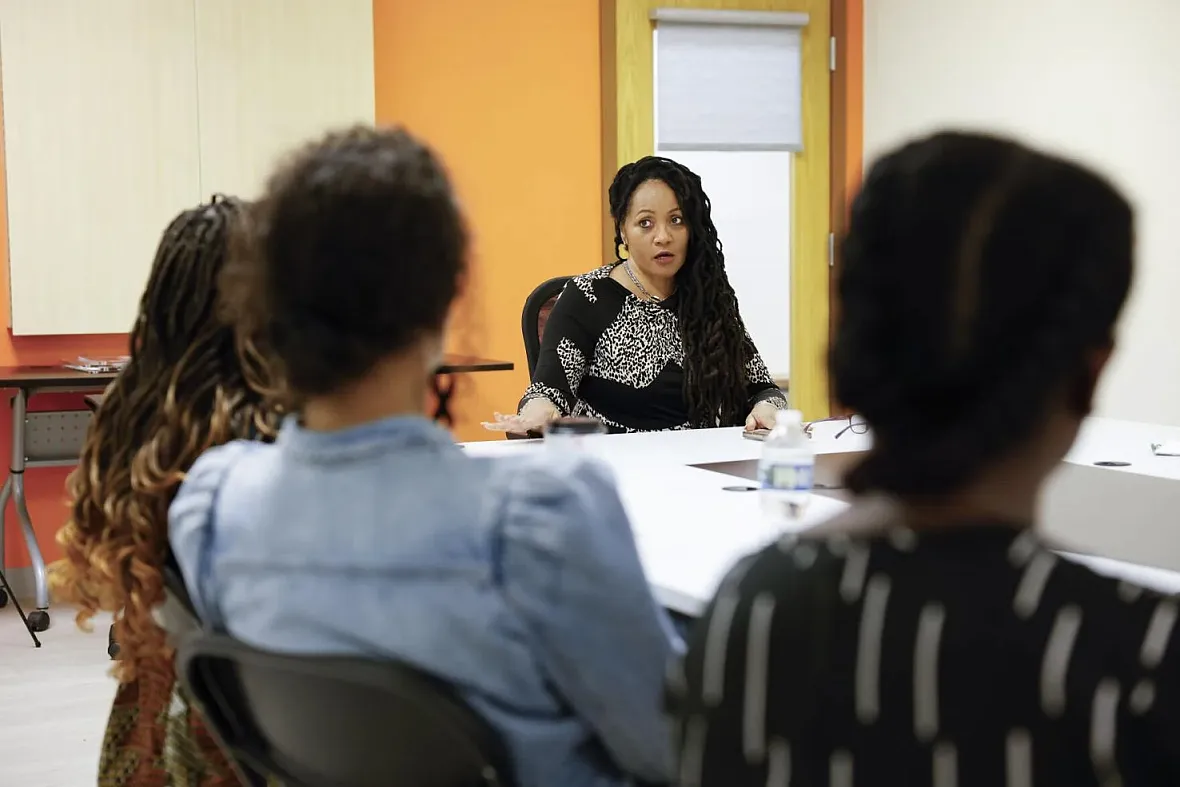
Lisa Peyton, founder and CEO of the Foundation for Black Women’s Wellness, leads a conversation on the group's Saving Our Babies initiative.
RUTHIE HAUE
For Jameca Patrick-Singleton, as with so many others, her drive to save Black babies from extraordinarily high death rates has always been personal.
She was 16 years old when she gave birth to her first child and 17 when her second baby arrived three months early. Doctors told her he might not survive the night. The next day, no one had told her he was still alive. When a nurse finally led her to the neonatal intensive care unit, Patrick-Singleton thought she was being taken to the morgue.
Instead, she found her son surrounded by tubes, wires and machines, but surviving.
“I was crying because he was alive,” she recalled.
Over the next year, Patrick-Singleton fought to make sure her son received the care he needed. When his temperature dropped dangerously low, a hospital nurse dismissed the reading as a faulty thermometer and prepared to send him home.
Patrick-Singleton’s mother intervened, demanding that the medical team keep the newborn boy overnight. Doctors would spend two more weeks in the NICU trying to regulate his temperature.
“Had I taken him home that night, he would have died,” Patrick-Singleton said.
Months later, when her son began vomiting after every feeding, a nurse accused Patrick-Singleton of neglect and threatened to call social services. Tests eventually revealed a reflux disorder. The nurse never apologized, Patrick-Singleton said.
These incidents during the first few months of her son’s life left a lasting mark on Patrick-Singleton, who would go on to build a career helping other mothers and babies navigate a system she knew could fail them.
As state leaders fail to act on policies to address or acknowledge Wisconsin’s extraordinarily high rate of Black infant deaths and Congress appears far from compromise that would help Black families across the country, meaningful change to reduce infant mortality has fallen on the shoulders of the communities themselves. Neighbors are stepping in to help neighbors, mothers are helping mothers, and local organizations are determined not to let their own fall through the cracks.
The stark racial disparities putting Black infants at far higher risk than their white neighbors persists as the systems meant to protect them are slow to change. Two communities on opposite sides of Lake Michigan are refusing to wait.
Through community connection, mutual aid, local health work, doula programming and resource linking, the Foundation for Black Women’s Wellness in Madison and Cradle Kalamazoo in Michigan are taking on the crisis of Black infant and maternal mortality one case at a time.
Early signs show these efforts can save lives and begin to close the gap between the survival of Black and white babies. The key is centering those most affected.
“You cannot shape solutions that aren’t holistic, particularly with Black women, because so much of the experience is rooted in bias and systemic racism,” said Lisa Peyton, founder and CEO of the Foundation for Black Women’s Wellness. “How you are addressed when you walk through the door, that first interaction sets the tone. Black women often don’t feel safe.”
Just over 200 miles east of Madison as the crow flies, Patrick-Singleton leads Cradle Kalamazoo, an organization launched in 2015 to address Kalamazoo County’s high rates of Black infant deaths.
“All of those experiences taught me that I had to be the voice and the change,” she said.
‘Saving our babies’
In Madison, Peyton and her team at the Foundation for Black Women’s Wellness have worked to shape the change they want to see.
Their work began with a question: What would it take to make sure Black mothers and babies have a better chance of surviving and thriving? The answer, the organization found, could not come from the healthcare system alone.
In 2018, the Foundation partnered with the Dane County Health Council and other community organizations to launch Saving Our Babies, an effort to understand and address the persistent disparities in birth outcomes for Black families in Dane County.
The initiative began by listening. The organizations met with and learned from Black mothers, families and community members to understand their experiences with pregnancy, childbirth and the healthcare system. What emerged was a picture of the challenges facing Black families that extended far beyond the delivery room.
Mothers described the stress of navigating a healthcare system that did not always listen to their concerns. They spoke about the effects of racism and discrimination, the pressures of economic insecurity, and the difficulties of finding stable housing, transportation and other basic necessities. They described trying to manage pregnancy while carrying the weight of circumstances that could affect both their health and their babies’ well-being.
“We want to get that picture of the whole person and what the environment looks like and what their community looks like, what their home life looks like,” said Micaela Berry-Smith, director of maternal and child health initiatives at the Foundation. “Having a doula is great, but if they’re still dealing with homelessness and starving, then the doula's just putting a Band-Aid on it instead of really getting to the root of the problem.”
The partnership between the Foundation and the Dane County Health Council brought together community knowledge and public health infrastructure. Together, they began building an approach that recognized a mother’s health as inseparable from the conditions in which she lives.
That meant considering not only whether a pregnant woman had access to prenatal care, but whether she had reliable transportation to get there. Not only whether she had been given a referral, but whether she had someone to help her navigate the process. Not only whether she had delivered a healthy baby, but whether she had the support she needed to care for herself and her child afterward.
The Saving Our Babies initiative laid the groundwork for ConnectRx Wisconsin, a program launched in 2022 to connect pregnant Black women and birthing people with the support they need throughout pregnancy and beyond.
The program brings together doulas, community health workers and other partners to help families navigate healthcare and the everyday challenges that can shape a pregnancy.
Doulas provide emotional, physical and informational support during pregnancy, childbirth and the postpartum period. Community health workers help families access resources and stay connected to care.
The idea is that a referral alone is not enough. Families need someone who can help them follow through, someone who understands their circumstances, Peyton said.
For the Foundation, the work is also about changing who gets to define the problem and shape the response. Black mothers have long been expected to navigate systems that may not recognize their needs or take their concerns seriously. The initiative seeks to shift that dynamic by centering their experiences.
“Black women are experiencing the positives and the negatives of clinical care, and this work has to support them outside of those walls, and at times advocate for them within those walls,” Peyton said. “We were adamant that no model is going to go forward that is centralized in clinical settings, and that doulas needed to be community-based, and that infrastructure needed to be shared in community settings.”
The work is not a substitute for systemic change. The inequities that put Black mothers and babies at risk remain, and no nonprofit can independently undo the effects of racism, unequal access to care or economic insecurity, Peyton said. But the partnership offers a different way to respond while broader change remains out of reach.
Through the partnership, doulas are now allowed into delivery rooms during labor and birth and operating rooms if Cesarean sections are necessary at UnityPoint Health-Meriter, Madison’s primary birthing hospital.
Quartz, the largest insurance provider for the county, now offers a doula reimbursement option to make accessing doula care easier for families facing financial difficulties.
These changes aren’t a simple fix to a problem that has existed for centuries. But each step is one in the right direction, a shift that eases barriers to the type of care and support that Black women have told the Foundation they want.
‘All about systemic change’
In Michigan, another community nonprofit is fighting the same disparities in its community, and approaching the problem with similar programming.
For years, Black babies in Kalamazoo County died at rates far higher than white infants. The disparity reflected a broader crisis, one rooted not simply in access to medical care, but in the conditions surrounding pregnancy and parenthood.
“Cradle’s work is all about systemic change,” said Patrick-Singleton, who leads Cradle Kalamazoo. “Our sole mission is to decrease the infant mortality rate for Black babies in Kalamazoo County.”
Since its founding in 2014, the nonprofit has brought together healthcare providers, other community organizations, doulas and families around the shared goal of reducing infant mortality and ensuring more Black babies survive their first year of life.
Years after almost losing her son, Patrick-Singleton graduated high school, earned an associate degree, then a bachelor’s and a master’s. Her kids grew up alongside her, she said, as she worked to turn the fear and uncertainty of her own early motherhood into something that could help other families.
“We experience life together,” Patrick-Singleton said. “And I’m so thankful we got to the other side of it.”
At the heart of Cradle Kalamazoo’s approach is a belief that families need more than medical appointments and instructions. They need people who can walk alongside them, understand their circumstances and help them navigate the challenges that come with pregnancy and a new baby.
That is where the organization’s doula program comes in. They help families prepare for birth, advocate for themselves in medical settings and navigate the transition into parenthood. Just as important, they offer a consistent presence during a time when many families can feel isolated or overwhelmed.
Bree Warren leads Cradle Kalamazoo’s doula program.
“I consider a doula to be your birth advocate, your person,” Warren said. “We have a relationship with these people, birthing people, that I think a doctor could never.”
Warren said she has seen firsthand how that support can change the experience of pregnancy and birth.
“I think that the presence of a doula can change the way you're treated,” Warren said. “Unfortunately, you see things like doctors not explaining things all the way when the doula’s not in the room, and then when a doula’s in the room, it's completely different.”
The organization bases its programming off of a combination of data and lived experience, said Nia Evans, who joined the team in 2021 as a research coordinator and member of the data team.
In 2018, the nonprofit launched a survey of local moms during which Cradle Kalamazoo gathered women from across the county to interview them about their experiences with pregnancy, birth and the postpartum period.
“To better learn about what their experiences were around the clinical setting, their experiences interacting with different physicians, and then also their experiences trying to raise an infant,” Evans said.
Each data point on Black infant mortality that Evans uses along with her team to help shape the nonprofit's programming direction is supported by personal stories from community members.
Their stories help bring the numbers into focus, Evans said. Behind every decline in infant mortality is a family that did not have to endure the loss of a child. Behind every healthy birth is a mother whose needs were recognized and whose community showed up.
Cradle Kalamazoo’s progress has not erased the racial disparity, Patrick-Singleton said. But, both in Kalamazoo and back in Dane County, drops in infant mortality show their efforts are working.
Data shows programs make a difference
Data from both organizations in Dane County and in Michigan tell a story that some policymakers have yet to fully reckon with: When communities invest in Black mothers and babies, they save lives.
A preliminary evaluation of the Foundation's programming in Dane County was conducted by the University of Wisconsin-Madison Reproductive Equity Action Lab in May. It found that Black residents enrolled in ConnectRx Wisconsin during their first trimester of pregnancy had significantly better birth outcomes. Among those participants, the rate of preterm births — the No. 1 cause of Black infant deaths — was cut by more than half compared with the rate for Black women not enrolled in the program. The initiative has supported 515 births, with 94% reaching optimal gestational age of 38.4 weeks or more and 93% of babies born at a healthy birth weight of more than 5 pounds 7 ounces, according to the report.
The program’s approach is simple, Berry-Smith said, aimed at connecting with families early, building trust and sticking with them.
In Kalamazoo, similar results show fewer babies are dying before their first birthday. Since Cradle Kalamazoo launched in 2014, the county’s Black infant mortality rate has fallen from 15.3 deaths per 1,000 live births to seven in the most recent three-year data from 2022 to 2024. That is a decline of more than half, and the lowest rate recorded for Black infants in the county in decades.
The racial gap has narrowed, too. Black babies in Kalamazoo still die at 2.5 times the rate of white babies, but that’s compared with 4.8 times in the previous three-year period. The distance between those numbers is evidence of progress, Patrick-Singleton said, but she also cautioned against becoming comfortable with the current situation.
“I’m very happy, and I’m petrified, and I’ll tell you why. Finally, people are listening. The right people are in place. Things are working,” Patrick-Singleton said. “When people see things changing, they think, ‘Oh, we don’t have to keep the pressure up.’”
Neither organization claims to have solved the crisis. In Wisconsin, the ConnectRx evaluation found that demand is outpacing capacity, and researchers caution that some findings remain preliminary. In Kalamazoo, Black infant mortality remains far higher than the rate for white babies. The systems that produce those disparities, including systemic racism and unequal access to care, remain firmly in place.
But beyond a measure of progress, the data from both programs disprove the idea that these disparities are too catastrophic to change, and the programming illustrates approaches that appear to be working.
‘We do what we must’
The drive to do this work day after day, despite financial complications and despite the exhausting nature of the crisis at hand, is rooted in personal understanding, Peyton said.
“You can wrap it up as the racialized experiences of Black women, families and communities: this generational struggle to secure equality, to experience equity, to be able to live and thrive and access what you need like everyone else around you,” Peyton said. “That’s a very personal story.”
Peyton, like others on her team and in Kalamazoo, have seen these inequities, disparities and racist systems play out across the country. Something about fighting for your own community makes this fight different, though.
“Don’t matter the city or state you’re talking about, the patterns are the same. The level of severity is different. Wisconsin is the crucible,” Peyton said.
These women have themselves felt the fear and pain of discrimination in healthcare settings — ranging from infant and maternal health to the overarching dismissal of Black women across the medical field. They have buried babies, mothers, aunties and sisters too young. They have wrapped around community members reeling from preventable loss, and they’ve made it their mission to let no other neighbors fall through the cracks.
“We do what we must,” Peyton said. “And it’s working.”