How working in the heat can turn deadly
The article was originally published in the KJZZ Phoenix with support from our 2025 Health and Climate Change Reporting Fellowship.

Heat kills more people annually than any other type of weather-related event and outdoor workers face higher risks for heat illness.
Workers die from heat exposure on the job every year in Arizona, though the total number of these deaths in the state is unclear. The Occupational Safety and Health Administration estimates nationwide, about 559 workers die from heat exposure every year, and more than 24,000 workers experience heat-related illnesses or injuries.
What makes working in the heat so dangerous?
Heatstroke quickly impacts multiple bodily functions
The human body can function only within a relatively small temperature range, said Dr. Amelia Gallitano, professor of basic medical sciences at the University of Arizona College of Medicine-Phoenix, and co-leader of the university’s Heat and Health Resilience Innovation Consortium.
So in hot conditions, the body tries to regulate its temperature. A person who is overheating will sweat as the body tries to create evaporative cooling. They may appear flushed as the body sends more blood to the skin to try to release heat.
National Weather Service
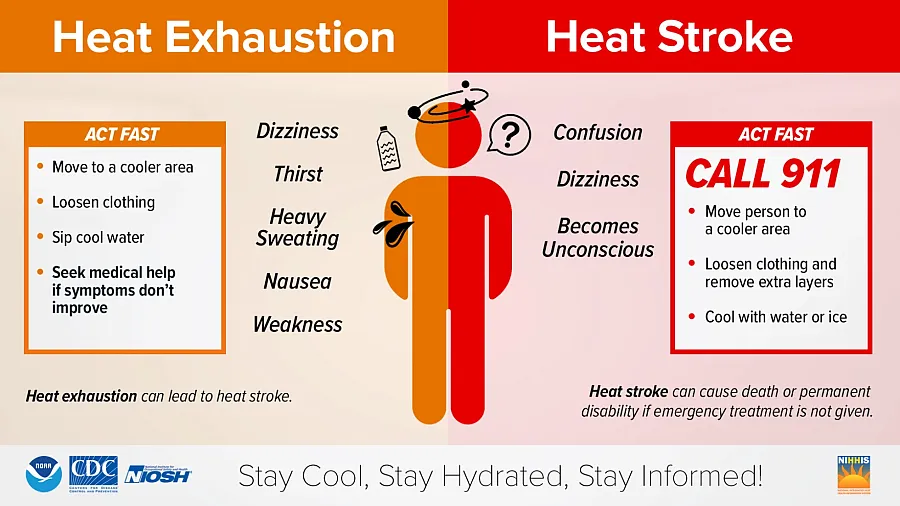
But when someone is developing more serious heat exhaustion or heatstroke, some of those cooling mechanisms begin to shut down, Gallitano said.
“Everything goes haywire,” Gallitano said. “If you are dehydrated, you no longer have that extra fluid to be able to sweat. So you will stop sweating and then you stop cooling.”
As the body temperature rises, the heart strains to pump blood through the body. Organs don’t get enough oxygen because blood flow is disrupted. The kidneys, stressed by dehydration, struggle to filter out toxins.
“Ultimately then, what happens is when you start to reach these really high temperatures then basic cellular function breaks down,” Gallitano said.
As cells break down, Gallitano said they release toxins into the body which can cause inflammation and swelling, known as edema.
“And edema in the brain can very rapidly lead to brain dysfunction and death,” Gallitano said.
Heatstroke can happen to anyone, but outdoor workers are at higher risk because they’re exposed to high temperatures for longer periods of time. And physical labor accelerates these bodily processes, Gallitano said.
“Construction workers and agriculture workers, people that have to do physical work, that is exercise and that is increasing their body temperature,” Gallitano said.
Other types of workplace injuries, deaths also increase with temperature
Heatstroke is not the only risk that workers face in hot conditions. Fatal workplace accidents and non-fatal injuries increase with temperature, too.
“Every type of work-related injury, from a slip or a strain to an amputation — they all occur more often on hot days,” said David Michaels, professor at the George Washington University Milken Institute School of Public Health and a former OSHA administrator.
Michaels co-authored a 2025 study in the journal Environmental Health which found the odds of workplace injuries occurring on a 105 degree day were about 15% higher compared to an 80 degree day.
Workers become fatigued more quickly in higher temperatures and heat can impair judgment, slow reaction times, and reduce hand-eye coordination, the study said. Those impacts can easily lead to injuries and accidents.
“Heat strains not just the body but the mind,” Michaels said.
Working in the heat can have long-term health impacts
Heat exposure can also have long-term consequences for workers’ health.
For example, a recent University of Arizona study found extreme heat can exacerbate the impacts of some toxins, leading to kidney damage.
Farmworkers in the study were exposed to several types of metals and chemicals on the job — some naturally occurring in the soil and others from agricultural products such as pesticides. Postdoctoral fellow Rietta Wagoner, lead author on the paper, said hot weather made those exposures more dangerous.
“For arsenic, cadmium, chromium and uranium, when those were combined with heat — so when the workers’ bodies were heated up — we saw worse effects on the kidneys,” Wagoner said.
Wagoner said there are several ways the heat changes the body’s response to chemicals.
“You can absorb more things because you’re breathing more heavily, your skin becomes more permeable, and your heart starts beating quite a bit, and so the way chemicals and different elements are broken down in the body even changes and how they’re excreted can change as well,” Wagoner said.
Wagoner said more research on the subject is needed, but she said rising temperatures, driven by climate change, are likely playing a role as rates of chronic kidney disease increase worldwide, especially among outdoor workers.
Regulations appear to make a difference
Medical experts consider most heat-related deaths to be preventable. Hydration, rest and early responses to symptoms of heat exhaustion can help people avoid the worst health outcomes in extreme temperatures.
Arizona has never had statewide regulations specifically to protect workers from heat exposure. But seven other states have adopted heat safety standards, and studies suggest those state regulations do prevent injuries and deaths.
“The necessary protections are simple — water, shade and rest breaks — these aren’t complicated or expensive,” said Adam Dean, George Washington University associate professor of political science.
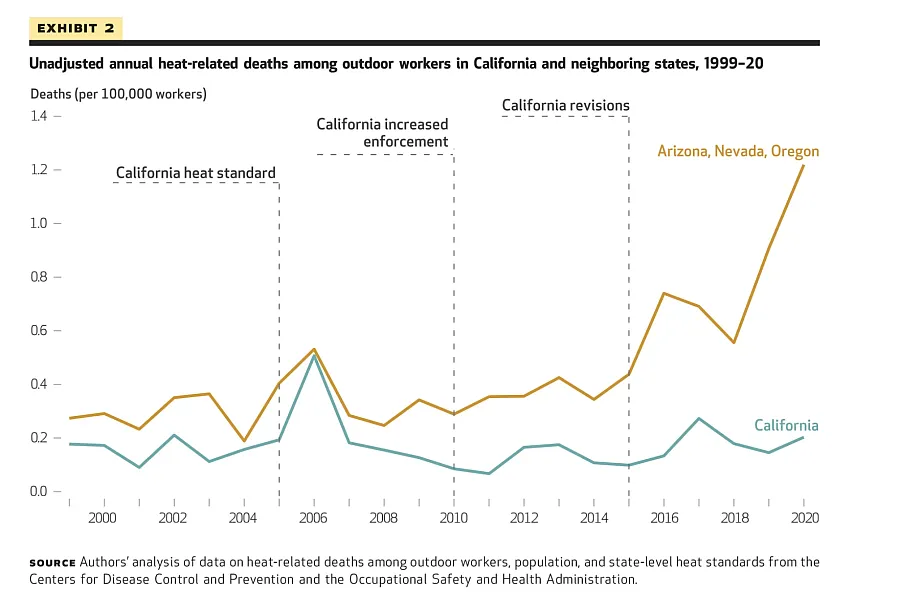
Dean co-authored a 2025 study in the journal Health Affairs which showed California’s workplace heat policy, first implemented in 2005, has resulted in a 33% decrease in deaths among outdoor workers compared to the number of deaths the state would have expected to see without the policy. Meanwhile, as climate change drives more intense heat waves, heat-related worker deaths in states without heat regulations, like Arizona, appear to be increasing at a faster rate than in California.
“That gives us confidence that, if not for this policy, the deaths in California would have continued to follow the same trajectory as the other states,” Dean said.