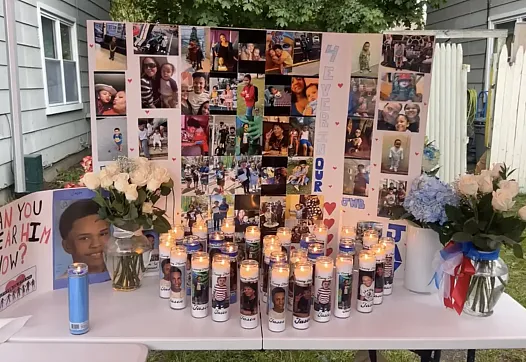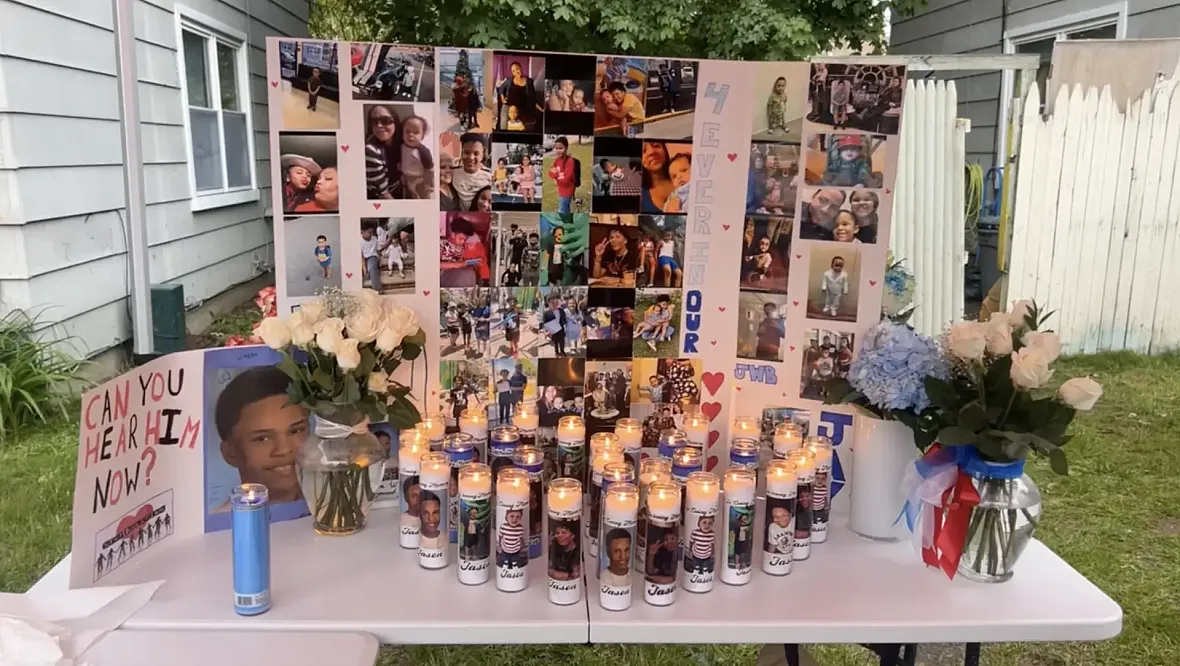
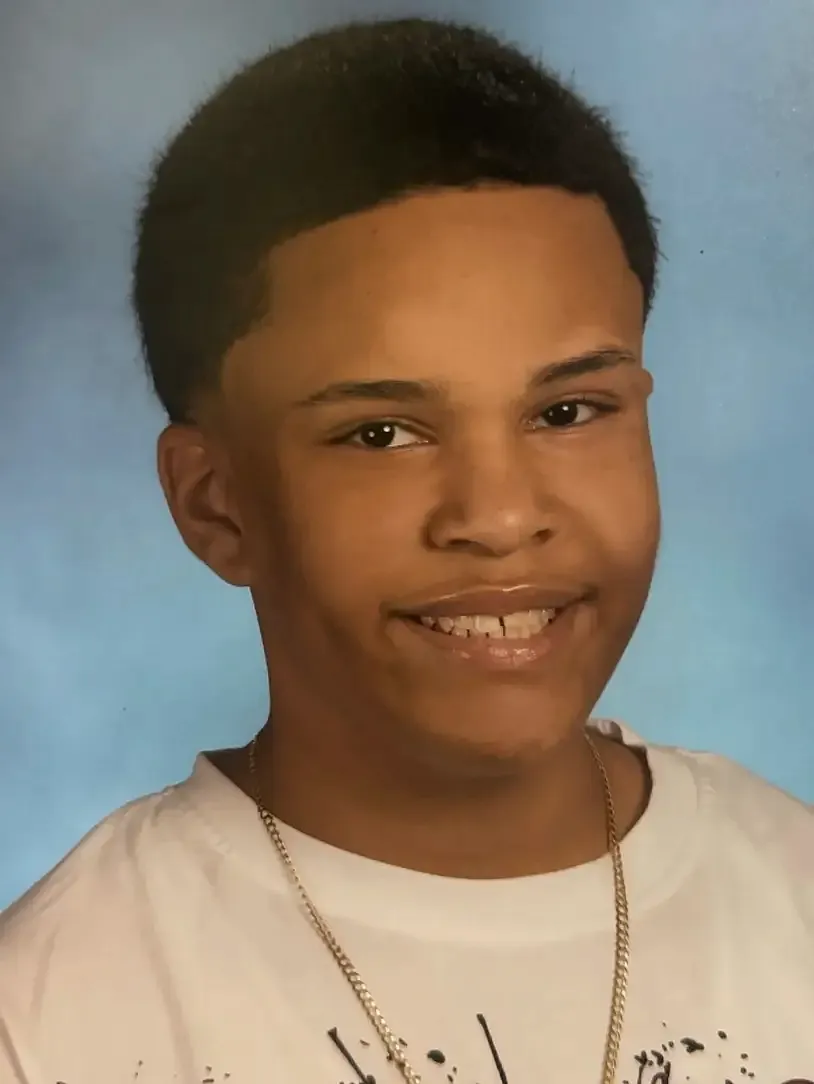

Jason’s story
Over the last year, Rosario has searched for answers for what happened to her little brother, a teen who played video games and danced in his bedroom. He was a member of the school’s track team. He loved to bake cookies and snuggle in bed with his mom.
Rosario says her brother would talk about the abuse he suffered at the hands of his classmates. He and his mother complained to school staff. But she says those pleas for help only brought more mistreatment.
“It got to the point where he stopped asking for help, and said to my mom, ‘I’m done telling you things because it only gets worse for me. They start calling me a crybaby,’” she said. “He would purposely miss the bus.”
Jason died by suicide in May of last year. He wrote a letter to his family wishing he’d been provided help.
“At the end, he wrote, ‘More needs to be done on mental health and bullying because the teachers don’t care,’” Rosario said. “He went to the right people. And they didn’t help.”
Rosario says she’s asked the school for records, but so far, she’s received nothing. Her family had never detailed the abuse in writing before Jason died, so they don’t have those documents either.

Jason Bernard (left) with his close friend Olivia Olowu. Jason's death in 2025 has fueled an outcry to reform antibullying laws in Massachusetts.
“Show me the paperwork, show me the history of the past two and a half years when my mom has knocked on your door,’’ she said. “They had none, they couldn’t give me anything.”
Peabody school administrators did not respond to a request for comment for this story.
A Texas-based nonprofit, the Youth Peace and Justice Foundation, also launched an investigation into Jason’s death. But officials from the organization told GBH News they later abandoned the review because they were unable to obtain documents related to the school and allegations.
The school system had been flagged before for not listening to bullying complaints. About a year before Jason died, state educational regulators cited his school, the J. Henry Higgins Middle School, for violating Massachusetts’ anti-bullying laws, according to records obtained by GBH New
The report was one of more than 200 investigations carried out throughout the state that year, records show. Among issues, the state found the school failed to formally investigate eight bullying allegations related to a 12-year-old special education student who had been “the target of ongoing in-person and cyber bullying by his peers.’’
The probe was prompted by a 2024 complaint filed by a parent of a sixth grader who said, among other issues, that a photo of the boy and his family was posted online with a “lewd drawing.” The boy also was a victim of verbal assaults while walking to the school bus, the report said.
State investigators also found the school failed to communicate properly with parents of the alleged victim and aggressors, according toa 12-page report filed by investigators from the state’s Problem Resolution System, which handles complaints in public schools.
The potential impact is actually more severe than what people have realized in the past. It’s understood now, medically, to be an abusive behavior, peer-mediated (by) another kid.
Peter Raffalli, pediatric neurologist at Boston Children’s Hospital
Jason’s death, about a year later, prompted many in Peabody to question what had been missed.
After his death, students staged a walkout and community members held a vigil to protest bullying. A group called the Peabody Special Education Parent Advisory Council described Jason’s passing as a “preventable death,” and urged families to “talk to their kids.”
The city launched a program called the Peabody PROMISE to provide mental health services and prevent bullying and youth suicide.
h
Sara Grinnell, the city’s director of social services, was tapped to lead the effort.
“We failed this child and what needed to be done, what should have been here to catch him and support him,” Grinnell told GBH News. “It’s a tragedy for everybody, and it was felt across the entire city,” she said.
Grinnell would not comment on any alleged missteps by staff at the Higgins, which enrolls about 1,300 students, more than a quarter of whom are Hispanic. But she is closely involved in efforts to expand both mental health counseling for students and improving the response to bullying allegations.
In September, the school opened a Student Resource and Support Center with three full-time clinicians who are seeing dozens of students a week. Higgins also created a six-member behavior assessment team to handle bullying allegations, a task that was once handled by just one administrator.
“We want every student to have somebody, so that when they’re feeling the way that Jason was feeling, they would have somebody to go to and somebody to confide in,’’ Grinnell said. “That’s really been the push — to make sure we’re supporting each and every child individually.”
‘I don’t feel safe sending her’
Most cases of bullying don’t end up in suicide, yet can have long-lasting physical and mental effects on young people.
Samantha Batista told GBH News that her daughter, who has autism, was physically bullied as a third-grader two years ago at a Lawrence public school. She says her daughter was stabbed in the hand with a pencil, shoved to the ground and slammed into a locker door, among other abuses.
“I felt completely hopeless,” she said. “I can’t obviously keep her from school all the time, but also, like, I don’t feel safe sending her.”
It took five months before the school suspended the alleged bully, she says, but her daughter still suffers from what occurred. Now in fifth grade and in a new school, Batista says her daughter has remained fearful and anxious.
“Fifth grade’s going great. She’s making progress, but she’s timid, she’s more scared,” said Batista. “She’s constantly looking behind her back.”
Fearing more issues would occur, Batista requested records of bullying incidents from the school, but was told none could be located.
Officials from the Lawrence Public Schools said they could not comment on a specific child, but that they are serious about preventing bullying.
The district has been cited by the state for violating the anti-bullying state law, records show.
Last year, the state cited a different public school in Lawrence for taking 45 days to resolve a bullying complaint and issue a determination. The investigation concluded Lawrence schools had “no reasonable basis for the delay” and violated the state law that requires prompt action to investigate allegations, according to a letter of finding obtained by GBH News.
State school officials told GBH News that they work closely with school districts to make sure students are supported.
“Bullying is never acceptable,” said Jacqueline Reis a spokeswoman for the Department of Elementary and Secondary Education, or DESE. ”School districts are required to thoroughly investigate complaints of bullying, and DESE takes seriously any instance in which a district doesn’t fulfill their obligation.”
Peter Raffalli, a pediatric neurologist who founded and directs the Bullying and Cyberbullying Prevention Advocacy Collaborative at Boston Children’s Hospital, said lack of action can have dire consequences. He said psychological trauma from bullying is similar to what domestic violence victims suffer.
“The potential impact is actually more severe than what people have realized in the past,’’ he said. “It’s understood now medically to be an abusive behavior, peer-mediated (by) another kid.”
Young people can experience depression, anxiety and low self-esteem, he said. Some students’ grades can suffer, while others don’t want to go to school at all. Some children turn to self-harm and suffer from toxic stress, a chronic diagnosis that affects physical and mental health.
“Some of the kids have been so traumatized, they have post-traumatic stress disorder,” he said.
Massachusetts is one of the few states that mandates regular training of school staff in bullying prevention, a requirement included in the 2010 law.
But there’s no oversight on compliance unless a parent or caregiver files a complaint about a school with the state education agency.
“There’s no real teeth because there’s no consequences if you don’t train your teachers. Nobody’s tracking who does it and who doesn’t,” said Elizabeth Englander, a psychologist who founded and runs the Massachusetts Aggression Reduction Center at Bridgewater State University, which works to prevent bullying and cyberbullying.
The center provides training to dozens of schools each year, but Englander sees the need for more support to push back against a growing problem harming tens of thousands of schoolchildren in Massachusetts.
“The state could be doing a lot about this issue that it’s not doing,” said Englander, suggesting a statewide teacher training program for college students who want to be educators. “They could be supporting statewide, mandated training so every kid who graduates … [is] ready to go out and be a teacher, has an idea of how to handle social issues that lead to bullying in schools.”
Englander joins other child advocates who worry that the current political climate is likely playing a role in discrimination-based school bullying.
“What the adults do, the children will do,” said Englander. “There are significant increases in bias-based crimes and bias-based harassment … so it’s likely that we will also see increases among children as well.”
Turning grief to action
Rosario, who works as an occupational therapist, is dealing with her grief by speaking out. She’s formed a foundation in Jason’s memory that hosts an anti-bullying walk each fall and other fundraising events.
She’s asked lawmakers to toughen anti-bullying laws by mandating live training for staff, not just online videos. She wants the state to require culturally competent awareness in the handling of bullying allegations, and make programs and policies accessible in other languages, such as Spanish and Portuguese.
A group of Peabody parents also are calling for legislative changes to strengthen the state’s anti-bullying law following Jason’s death.
“Let Jason’s story not be in vain,” they wrote to Gov. Maura Healey in a letter available on Moveon.org, which has more than 8,000 signatures. ”No parent should have to bury their child because we failed to act.“
Other advocates also are pushing for change. Last month, researchers at Northeastern University School of Law recommended an increase in annual staff training, a broader definition of bullying that includes a power differential between the aggressor and victim and better victim outreach and investigation timelines.
Rosario says her mother still longs for an apology from teachers they believe ignored their pleas for help.
She says several cafeteria workers reached out, telling her mother how much they loved Jason. An art teacher gathered up Jason’s artwork and gave it to her. But she says most of the staff never responded at all.
“The teachers that she spoke to, not one reached out to her … to say, ‘I messed up, but I’m gonna be better for these other kids’” said Rosario. “She hasn’t gotten that. I hope one day maybe, but that’s a guilt that they have to live with.”
Olivia Olowu, a close friend of Jason’s, said she also faced bullying at the Higgins Middle School.
Olowu agreed to talk to a GBH reporter in a Danvers’ mall, where she had a cookie at the Crumbl Cookies shop, a bakery chain that Jason loved.
Now 15 years old, Olowu says she often thinks about her friend who used to argue about who made better cookies. She called him her twin. But she also knew he was hurting.
“He said that he already went to people and nothing really came out of it, so there was like no point in telling them again,” she said. “He kind of just gave up.”
She said she wishes Jason had known how many people cared for him. She recently reviewed some old texts where she had told him just that.
“I sent him a video saying how he was my best friend,” she said. “That made me really upset, because other people were able to make him feel so lonely.”