Overview:
- Since 1951, total annual precipitation has increased by 14% across the Great Lakes region, while annual precipitation in Southeast Michigan has increased by 6.2 inches.
- In a survey of Detroit homes between 2012 and 2020, researchers found that four out of five households that flooded had mold in their basements.
Despite the growing attention to flooding in the region and across the United States, it’s “still perceived to be an exclusively economic issue,” not “a major public health issue," says University of Michigan's Peter Larson.
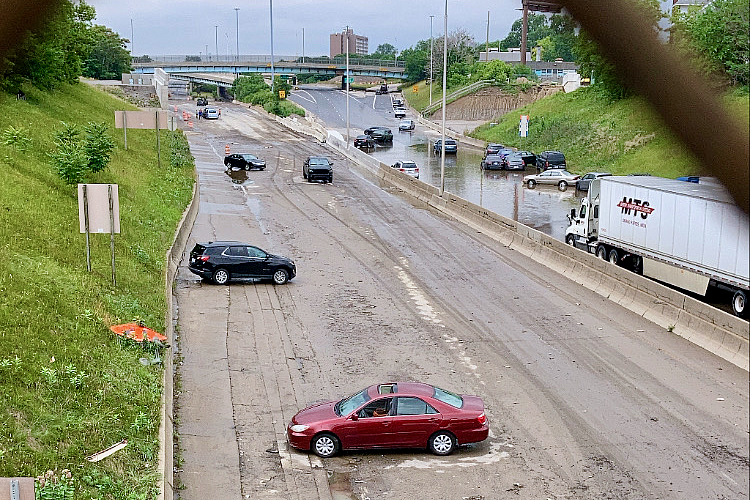
In the waning days of June 2021, a torrent of rain entered Jennine Spencer-Gilbert’s Field Street home. She watched the walls of her century-old home peel as 7 inches of rain fell in Detroit in the span of two days.
Beyond the initial water damage, Spencer-Gilbert faced another problem.
“We had to get as much of the mold out as we could, sanitizing appliances, furnaces, washing machines, dryers — you name it,” Spencer-Gilbert recalls. Her Ford Escape became caked with black mold after rain leaked in through the sunroof, and was totaled.
Spencer-Gilbert estimates her home has flooded four times in the last decade. Each time, she’s had to clean mold in her basement with bleach to ensure it doesn’t aggravate her preexisting asthma.
“You have to make sure your house is fumigated and clean,” she said. “So you can continue to keep living there.”
Frequent and heavy rainstorms have become a regular occurrence across Southeast Michigan and its largest city, Detroit. The region witnessed over $2 billion in flooding damage to houses, businesses, and roadways in recent years, according to the National Oceanic and Atmospheric Administration (NOAA).
The health effects of flooding can linger long after the water recedes, and threaten the wellbeing of the region’s 4.8 million residents.
Across the area’s cities and towns, experts say, residents are suffering through the physical and psychological impacts of recurring flooding and sewage backups.
“Every person in Detroit is at risk for flooding – every single household,” said Peter Larson, an epidemiologist at the University of Michigan who has studied household flooding in Detroit over the last decade.
In addition to the June 2021 storm, two other federally declared disasters occurred in Southeast Michigan in recent history, in August 2014 and August 2023.
Even without three 100-year storms inside of a decade, the region’s century-old stormwater infrastructure, flat topography, and impervious concrete contributes to the frequency of flooding and other climate emergencies.
Since 1951, total annual precipitation has increased by 14% across the Great Lakes region, while annual precipitation in Southeast Michigan has increased by 6.2 inches, or 20%, in that same time span, according to the Great Lakes Integrated Sciences + Assessments Center.
“A lot of the stormwater infrastructure, especially in our older cities, is not designed for this new climate, and so it easily overwhelms some of those systems,” said Aaron Ferguson, program manager with Michigan’s Climate Health Adaptation Program.
“When it rains like an inch or more in a short amount of time, we see a lot of street flooding, and it backs up into people’s basements.”
The Michigan Department of Health and Human Services (MDHHS), which houses the Climate Health Adaptation Program, has been observing long-term climate trends through data collected by the NOAA.
States west of Michigan are “projected to get drier,” Ferguson said, while the Great Lakes State is expected to see more precipitation.
A 2020 report by the Southeast Michigan Council of Governments projects that by the middle of the century the region will experience an average of 5.2 inches of rain in a 10-year, 24-hour event.
The increase in extreme precipitation events over the last century, experts say, are a result of warming surface temperatures, which increase the heat and moisture in the atmosphere needed for storms.
Flooding as a public health issue
Detroit’s combined sewer overflow system, in which the sewage and stormwater flow in the same pipe, can process 1.5 to 3 inches in a 24-hour period, according to city documents.
In the June 2021 flood, power outages and pump station failures contributed toward sewage backups in homes across the city, according to a 2022 report from the Great Lakes Water Authority.
Water intrusion into homes — through leaks in roofs, windows, pipes, or where there has been a flood — has the potential to contribute to mold and microbial growth that can cause or exacerbate respiratory symptoms, according to city and federal documents.
In a survey of Detroit homes between 2012 and 2020, Larson and other researchers found that four out of five households that flooded had mold in their basements, in addition to other structural problems like a leaky roof or foundation cracks.
Despite the growing attention to flooding in the region and across the United States, it’s “still perceived to be an exclusively economic issue,” not “a major public health issue,” Larson said.
“There’s serious mental health outcomes that are understudied and poorly understood,” Larson said.
Larson’s own interest in the health impacts of flooding traces back to witnessing roughly 13 feet of water fill his childhood home in Jackson, Mississippi in the late 1970s.
“To this day I don’t leave things on the floor in the basement. I try to keep all my stuff on the second floor … that (fear) never went away, even though I live on a hill.”
The Climate Health Adaptation Program’s Ferguson said the emotional and psychological stress from flooding is drawing more scrutiny and attention.
MDHHS works to provide educational material and technical assistance for public health officials to study the effects of climate change in local communities, he said.
The city offers general advice on how to control the spread of mold and prepare in the event of a flood on its website.
Detroit’s top public health official referenced the city’s mold problem in remarks last month.
“We know that the conditions that people live in show up in their outcomes, whether that’s asthma from mold or dampness, whether that’s injuries from unsafe structures or the daily strain that families carry as a result of having that concern on their mind from unsafe structures they live in,” Detroit Chief Public Health Officer Ali Abazeed said at an April press conference about a coordinated enforcement strategy for unsafe residential buildings.
‘Long-term trauma’ in Macomb County from 4-hour rain event
The repeat flooding – from rainstorms and water main breaks– that has battered the city of Detroit is a regional concern. When a major rainstorm struck Aug. 11, 2014, as much as 6 inches of rain fell in a four-hour window in Macomb County, which borders Detroit and Lake St. Clair.
The storm caused roughly $1.8 billion in flood-related damage to homes, businesses, and infrastructure, according to the National Weather Service.
Andrew Cox, director of Health and Community Services for Macomb County, worked at the county’s call center in weeks after the storm, collecting assessments from households that suffered property damages.
“It was the first, that I remember, natural weather event response that I had been part of,” said Cox.
Over the weeks the call center was live, Cox said it became clear “there was much more there talking to people and just hearing the losses of items, losses of things that they experience” as residents relived the flooding event.