

Silent Cry: The Unseen Toll of Infant Loss on Black Families in California
This story was produced in collaboration with the Bakersfield Observer as part of the 2026 Ethnic Media Collaborative, Healing California.

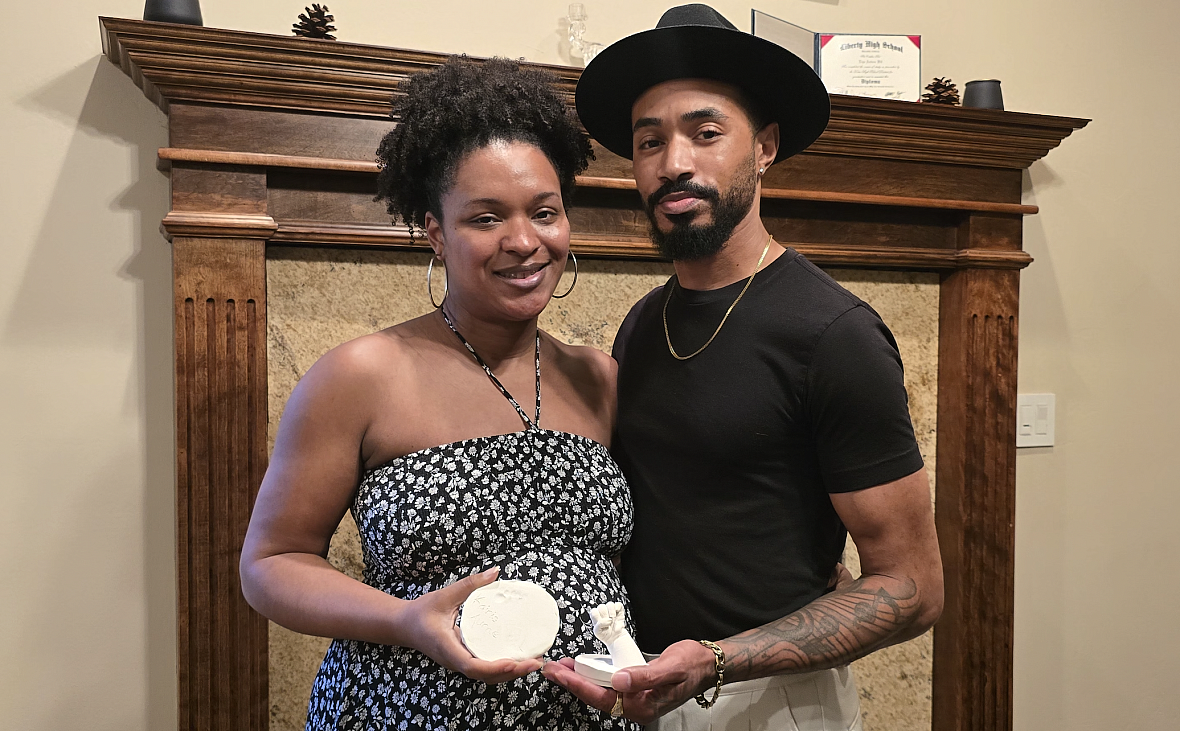
Kimisha Gill and André Hill share the footprint and fist mold of their late daughter Kairis Hill.
Cecil Egbele
More than a year after Kairis Aurae Hill died, the nursery her parents prepared in their Bakersfield home remains largely untouched. A white crib sits beneath a hanging mobile. Mickey and Minnie Mouse lean against the rails beside a teddy bear. Tiny clothes fill the drawers.
“We thought we’d be bringing her home to this room,” Kairis’ mother, Kimisha Gill, said quietly.
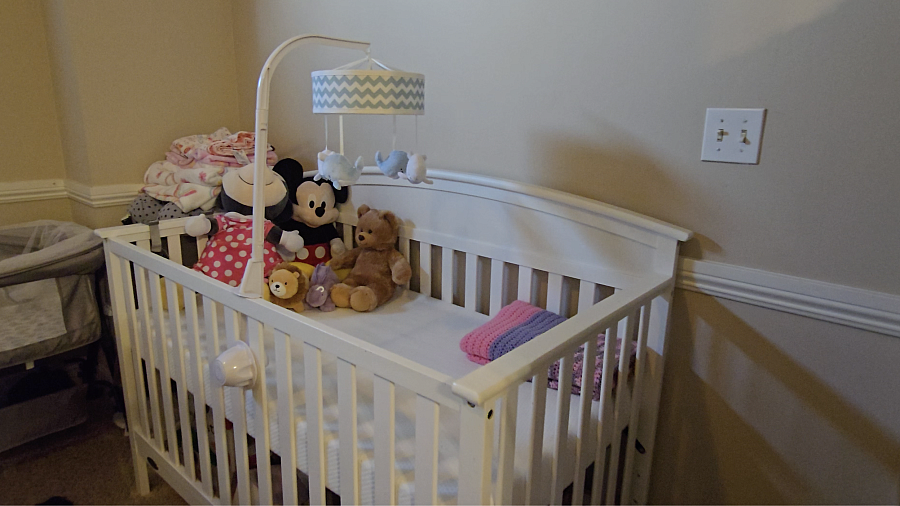
A crib with plush toys sits empty in the home of the Hills.
Cecil Egbele
Grief By the Numbers
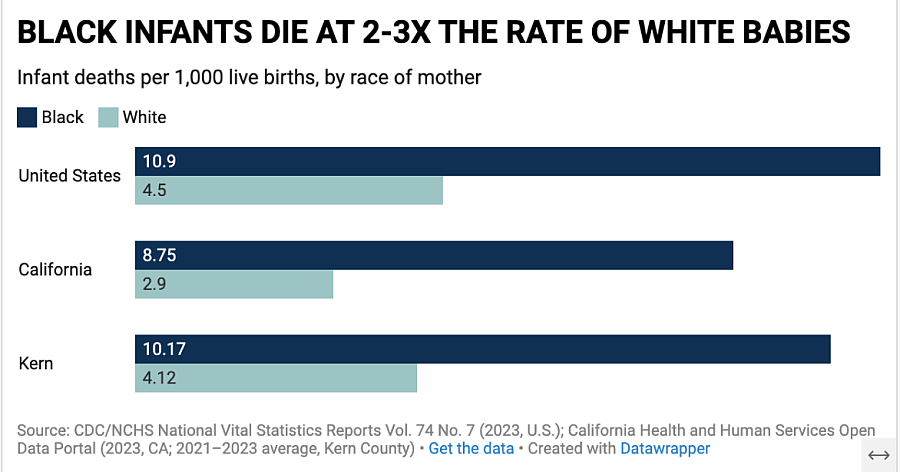
Across the United States, Black parents experience infant loss at rates twice as high as their white counterparts. In California, Black infants die at nearly three times the rate of white babies, a disparity that persists in Kern County, where socioeconomic challenges leave infants dying at triple the rate of white babies as well.
California’s grieving parents are often left in isolation. In Kern County, the Public Policy Institute of California found there were fewer than half as many mental health providers as coastal counties, leaving local families with nowhere to turn.
The loss extends far beyond the immediate tragedy. Research links stillbirth and infant loss to elevated risk for depression, anxiety, post-traumatic stress disorder, and complicated grief in bereaved parents, prompting mental health professionals to call for long-term support rather than short-term crisis intervention.
Bakersfield perinatal mental health therapist Mesha Muwanga sees the lasting effects of that grief firsthand.
“A lot of people grieving will shut down,” Muwanga said. “Let’s say you said something to me like, ‘You’re young, you can have another baby. Pray about it.’ I might not ever bring it up to you again. It just forces them to be quiet about their pain.”
Born on May 15, 2025, Kairis died five weeks later in the NICU after complications related to Down syndrome and pulmonary hypertension, shattering the future that Gill, 39, and her husband, André Hill Sr., 39, had imagined for their daughter.
“The longest amount of time I was able to hold her was the 10 hours after she died,” Gill recalled. I think I lost myself a bit when Kairis passed,” Gill said. “I definitely felt like a part of me died with her. The loss affected nearly every part of daily life.”
In the months that followed, Gill found herself returning to the nursery, where she recreated small rituals of the life she and Kairis never got to share.
“For some reason I felt called to look at her baby clothes,” Gill said. “I would pull out a onesie and think, ‘This is what I would put on her today.'”
Grief took different forms within the family. While Gill returned to the nursery, Hill focused on caring for his wife. “I wanted to make sure that I showed up for her in every way I possibly could,” he said. “I cried privately.”
One morning, shortly after returning home, Gill said that in the space between sleep and wakefulness she heard a little girl’s voice whisper a single word into her ear: “Mom.”
“There is no one else in the world who would have reason to call me Mom,” she said.
Then came the butterflies.
A yellow butterfly began appearing in the family’s backyard, lingering nearby in ways that felt unusual.
The family had chosen butterflies as the theme for Kairis’ baby shower and had nicknamed her their “Little Butterfly” before she was born. Now, the butterfly has a new meaning—a quiet reminder that Kairis is still near.
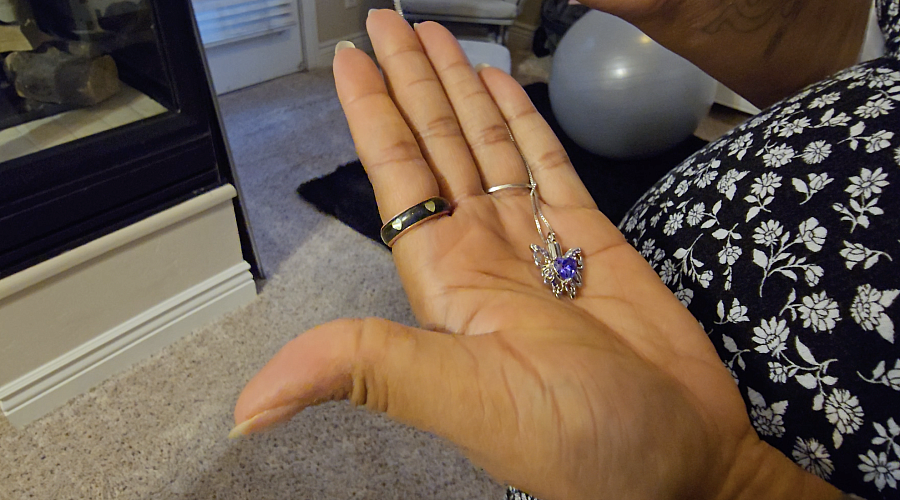
Kimisha Gill holds a butterfly necklace that will carry the remains of Kairis.
Cecil Egbele
Experts say experiences like these are common among grieving parents. Memories, sensory reminders and symbolic connections often become part of how families maintain continuing bonds with children who have died.
“Seeing or hearing the person you’ve lost can actually be a normal part of grief,” said Muwanga. “It’s not psychosis. It’s one way the mind protects itself.”
Grassroots Healing Services for the Bereaved
California has invested significantly in Black maternal health through programs such as the Black Infant Health Program and the Perinatal Equity Initiative. However, those programs are designed to support pregnant people and new parents, not families navigating bereavement after pregnancy or infant loss.
The California Department of Public Health (CDPH) offers the bereaved peer support groups addressing Sudden Infant Death Syndrome and Sudden Unidentified Infant Death, focusing on prevention, surveillance, and connecting families with local resources; Kern County offers a local SIDS Safe Sleep program.
For families seeking additional support, Medi-Cal covers full-spectrum doula services — when recommended by a healthcare provider — which may include doula care that specializes in pregnancy and infant loss. However, doulas are not mental health professionals and do not replace grief counseling or clinical care for those in the throes of loss.
Founded in 2018 by Black Bakersfield resident Trinity Brown after the stillbirth of her own daughter, the Noel Alexandria Foundation (NAF) steps into this gap of bereavement care for Kern County families. “We built the support we wished existed.”

Trinity Brown, CEO and Founder of the Noel Alexandria Foundation.
Cecil Egbele
In October 2017, at 36 weeks and five days pregnant, Brown woke to find she could no longer feel her daughter moving. At the hospital, doctors confirmed there was no heartbeat. She still had to deliver her daughter, but left the hospital without her child.
“Leaving the hospital without your baby, leaving your baby in the hospital, knowing you’re going to go home with empty arms,” Brown recalled.
Her body healed from childbirth, and life around her moved on. Her grief did not. Nine months later, she founded the Noel Alexandria Foundation, named after her daughter.
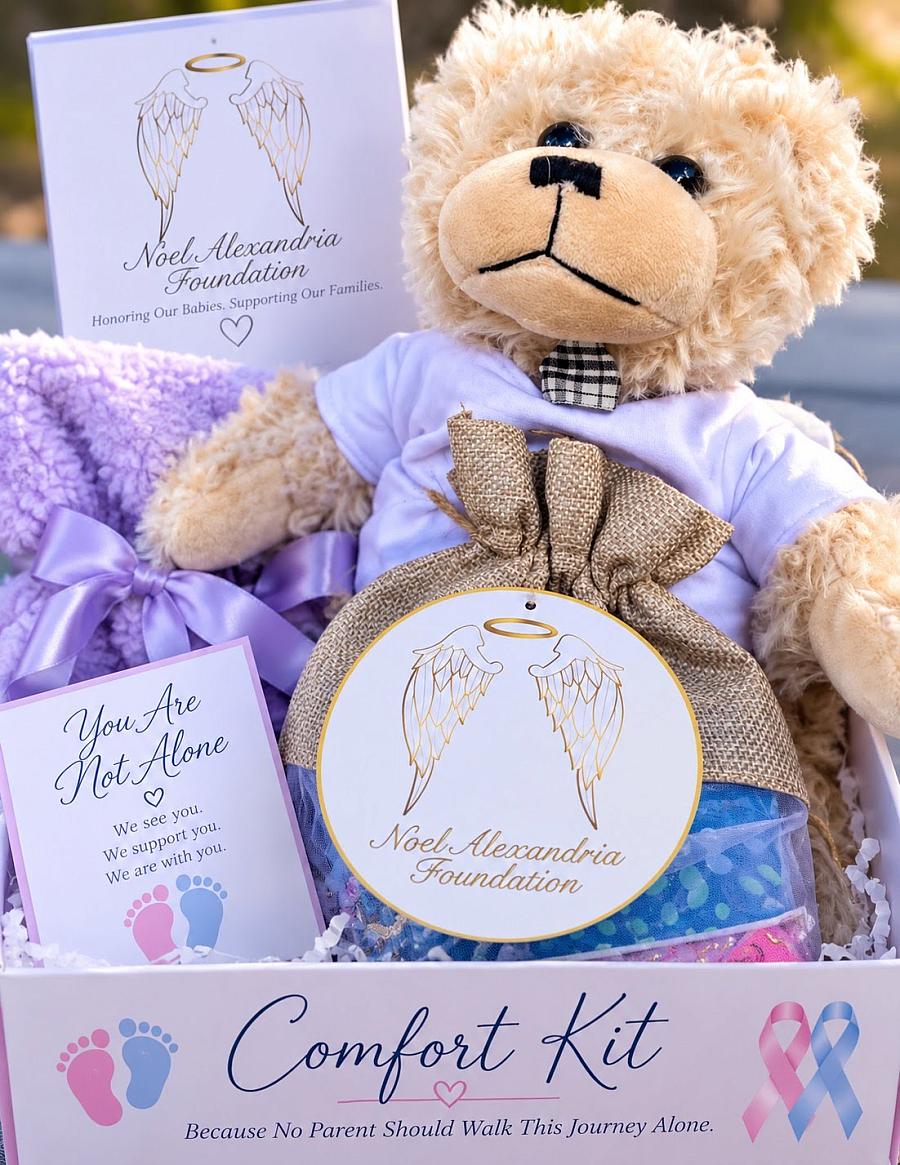
A sample of the Comfort Kit given by NAF to hospitals for families experiencing the loss of an infant.
Trinity Brown
“You still feel alone and isolated when other people haven’t gone through that experience,” Brown said. “You will hear people say, ‘You can always have another baby. Everything happens for a reason. At least you know you can get pregnant.’” But those words, Brown said, often deepen the wound.
The Noel Alexandria Foundation, is one of a handful of organizations focused on perinatal loss and maternal mental health. NAF provides a range of grief support for families navigating pregnancy and infant loss: from its support group Silent Cry and community behavioral health services to educational scholarships for students affected by pregnancy or infant loss.
They also offer bereavement trainings for medical health professionals. For families, they offer funeral assistance and their signature Comfort Kits that include a teddy bear the size and weight of a newborn.
To date, the organization has connected with the bereaved through hospitals and birthing facilities in Texas, Alabama, Wisconsin, and California, including more than 6,500 Kern County families.
Kimisha Gill did not find the Noel Alexandria Foundation through a hospital referral. She found it while scrolling through social media. As it turned out, Gill and NAF’s founder, Brown, had crossed paths in high school, decades before grief brought them back together.
Through NAF, the Hills received help with cremation urns and memorial jewelry. Gill began attending the bimonthly Silent Cry meetings. And in October 2025, the Hills walked in the Running with the Angels 5K Run/Walk, where their daughter’s name was called aloud, and a butterfly was placed in their hands. “I didn’t know I was going to need this type of sisterhood,” said Gill.
Brown said families are welcome at NAF at any point in their grief journey.
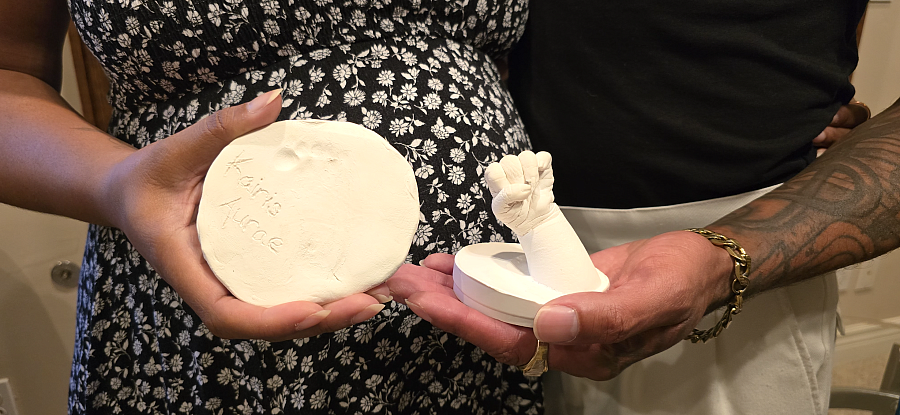
Kimisha Gill and André Hill hold the footprint and fist mold in remembrance of their late daughter Kairis Hill.
Cecil Egbele
“We don’t tell the family that they’re no longer able to attend because they’ve done six weeks,” said Brown. “We’re here with open arms all the time. We’re a family. We are here to support each other. It’s a lifelong journey.”
Brown aims to expand further nationwide so more grieving families can find community.
Grief Lives Alongside Joy
For many bereaved parents, another pregnancy marks the beginning of a new chapter, not the end of grief. The Hill family still keeps Kairis close through her footprints, hand molds, and a recording of her heartbeat tucked inside a stuffed giraffe. Her nursery remains much as they left it.
This July, Kimisha Gill and her husband welcomed their daughter, Kienna Aurielle Hill. For the Hills, her arrival has been both a celebration and a reminder of the daughter they lost.
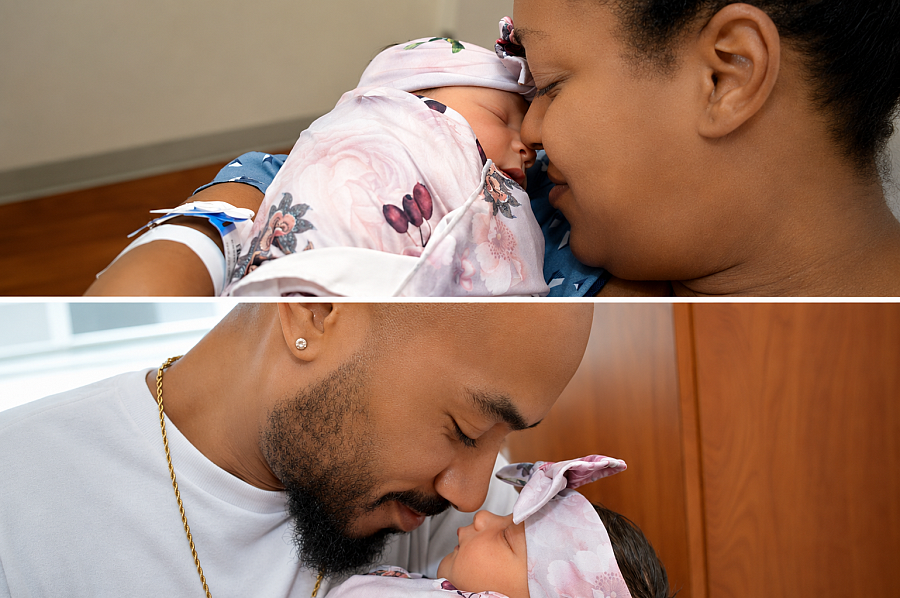
Kimisha Gill and André Hill give their new daughter Kienna Aurielle Hill a warm welcome to the world.
André Hill
“It’s a bittersweet feeling,” said Hill. “On one hand, we still miss our angel baby, Kairis, dearly, while simultaneously being thankful for her sister Kienna’s arrival.”
“We’re just doing our best to stay present and embrace the joy that comes with our new addition to the family, and still honor the feelings of grief when they arise.”