

Community engagement meets data in series exposing Chicago's glaring life expectancy gap

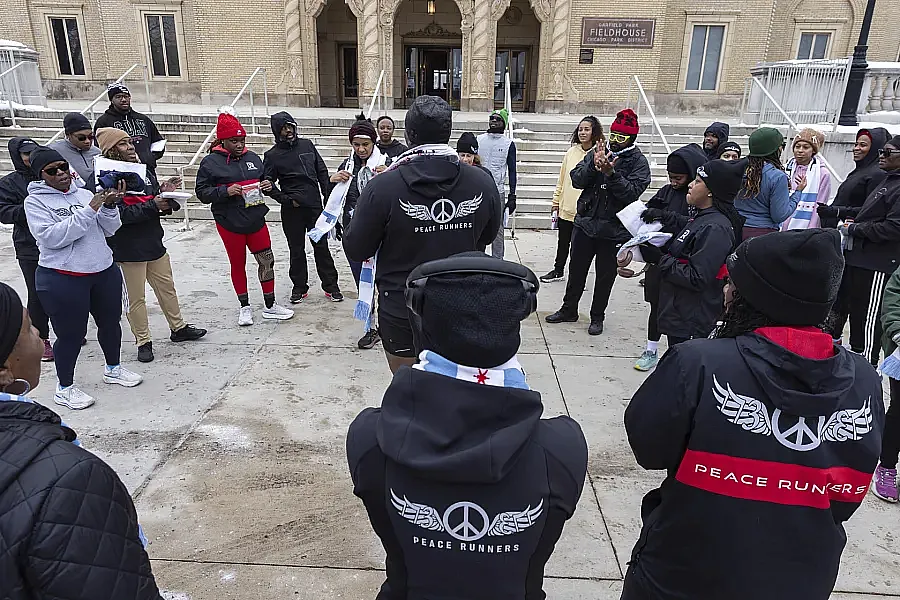
Photo by Manuel Martinez/WBEZ
In Chicago, the L train is the zigzag of public rail that connects the city. So for a recent reporting project on life expectancy, I decided to use this familiar feature to help explain a vast disparity.
On the Green Line, there are only about 5 miles, or seven stops, between West Garfield Park on the West Side and the Loop near downtown. Yet in that space, there’s a 20-year gap between how long people are expected to live — from 67 years on average in West Garfield Park, where most people are Black, to 87 in the Loop, where the majority are white.
This is the widest life expectancy gap in Chicago, and the biggest so-called death gap across neighborhoods of any big city in America.
Where you live and what you have access to — a job, fresh food, stable housing, a doctor, clean air — can determine when you die. And living in a chronic state of stress can shave years off your life.
The 20-year death gap in Chicago is a shocking statistic, and I wanted to understand more. How does this affect people’s lives and the fabric of their communities? What solutions do residents want in order to live healthier lives?
Community engagement for a project of this scale was key. So I spent much of last fall in West Garfield Park, listening and showing up. I met people where they felt comfortable — at the library, at church, at a park, in their living room. I joined them on trips to the grocery store and on walks around their neighborhood. I went to community meetings and food pantries. In many instances, I left my recorder in my bag. I was here to get to know people, and for them to get to know me.
And I wrote up a survey for residents to better understand how the death gap affected their lives and any questions they had that I could answer in my reporting. I personally emailed this survey to dozens of sources and organizations that are working to help their communities live longer.
I distributed the survey on social media. I printed it out and brought it to events. It was a key reporting tool. I also received a community engagement grant as part of my fellowship. With the help of Teena Apeles, national engagement editor at the Center for Health Journalism, we made postcards with a QR code linking to the survey. A few of my colleagues helped me distribute hundreds of those postcards in communities where the death gap is the widest — leaving them in cafes, in libraries, in park district buildings and so on.
This type of engagement takes a lot of time. And ultimately the people who I featured in my stories I mostly met through sources who trusted me, knew the types of stories I tell, and made introductions for me.
But distributing the surveys was still worth the effort because it gave me a broader understanding of what residents want and need. It also connected me to people who could become part of future stories. And they have become part of a feedback loop, as I send stories I have published in this series back out to everyone who I connected with.
I ended up talking to and surveying more than 50 people. The residents of West Garfield Park told me they want police and politicians to get rid of the drugs and the guns. They want the basics they now must leave their community to find — fresh food, a safe place to exercise and play, a job. And they’re not waiting to make this happen.
Finding people to illustrate how the death gap affects their lives was just one of the challenges in reporting this series. The other was finding data to support the stories I heard. I wanted to drill down as much as I could to understand not just what is driving the life expectancy gap in Chicago (heart disease, homicide, opioid overdoses and cancer). But more specifically, are people getting heart disease in West Garfield Park earlier than in other neighborhoods, and therefore driving down the average life expectancy? Is there a particular cancer that’s affecting residents, and at younger ages, compared to whiter, wealthier areas in Chicago? Could my series amplify that and bring about change?
I cast a wide net to try to find these answers, from the Chicago public health department to local and national researchers who study life expectancy. I read two books on the death gap in Chicago and other big cities, and I read multiple studies in medical journals and contacted those researchers.
Ultimately, I found compelling data, such as heart disease mortality rates by neighborhood, and years of lives lost by race, in the Chicago Health Atlas, a public database. I learned about a local research network that is mapping diseases by Chicago community area by age, which is something I was searching for and couldn’t find in public records. This network shared some key insights that I used in my story: that West Garfield Park has among the city’s highest rates of high blood pressure among people as young as 18. Hypertension is driven by stress, and is closely linked to heart failure, another researcher told me. This helped further explain the death gap in West Garfield Park.
I found another researcher who broke down the death gap by age and type of death from 2010-19 between Black Chicagoans and those of other races, providing another window into who is dying prematurely.
My colleague Justin Myers turned much of this data into powerful visualizations. It helps readers understand the death gap in a variety of ways. More broadly, we mapped life expectancy across Chicago, a detail any resident might care about no matter where they live.
My advice: There is a lot of data hiding in plain sight. Keep going. Be politely persistent. Ask everyone you talk to who else is studying the topic you’re interested in.
As you think about bringing your story to life, packaging it in a reader-friendly way is key. My colleague Manuel Martinez took stunning photos that accompanied each story, further connecting readers to generations of families, community leaders and researchers.
Besides in-depth digital stories, I brought these stories to life on the radio, a more intimate way of storytelling. Tosheika Thomas showed me the striking disparities she faces on a daily basis, from having to grocery shop a few miles away in the suburbs to the meat market in her own neighborhood. She talked about how much her neighborhood has changed since she was a little girl.
Her son Dae Reynolds showed us how he escapes the daily stresses that life brings in West Garfield Park, as he navigates chronic diseases that are far too common in his neighborhood.
Glydan Hoffman took me on a long walk through the park as she told me the story of how her son helped transform her health. That personal mission turned into a communitywide mission — Peace Runners 773.
I aimed to tell the stories of what it’s like to live in Chicago’s death gap, and highlight solutions. I found several homegrown ones already underway. I deeply believe in the public service of journalism, that stories across mediums can connect us all.