

The Health Divide: AOC’s fertility posts raise a question — who else gets the chance?

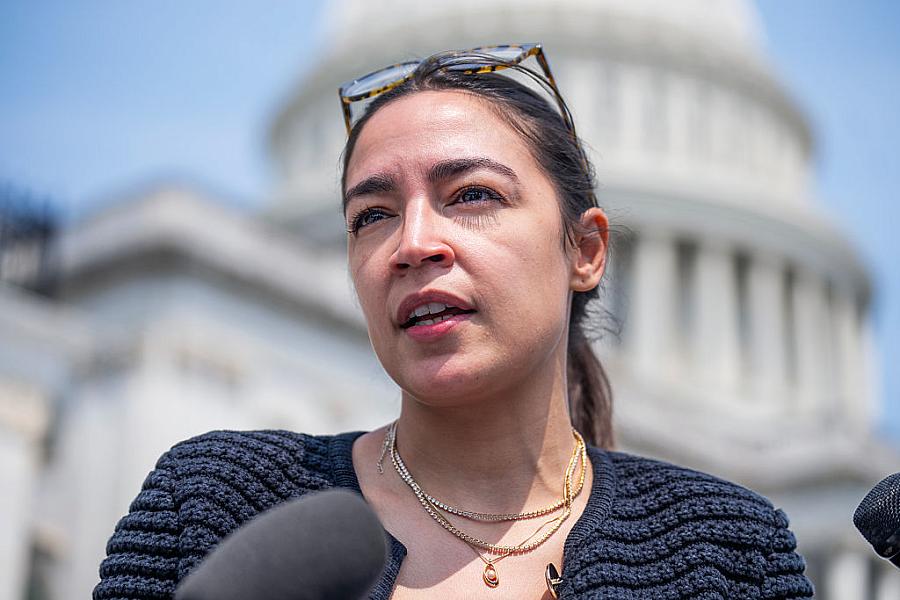
Rep. Alexandria Ocasio-Cortez talks with reporters outside the U.S. Capitol in July.
(Photo by Tom Williams/CQ-Roll Call, Inc via Getty Images)
Like many women I know, I’ve been riveted by Rep. Alexandria Ocasio-Cortez’s Instagram videos this month about freezing her eggs. I’ve watched her set out her medications, fill syringes, give herself injections, lie on a gurney before the egg retrieval, walk to brunch afterward and open get-well snacks from friends. As I write this, it’s Day 16 of her journey. She still has the belly bloat she said was her only discomfort after the procedure.
It’s an intimate look at a process that almost always occurs in private. Because AOC talks about the $10,000 she paid out of pocket for the procedure, the posts are also a reminder that fertility preservation, and fertility treatment generally, are out of reach for millions of Americans who want to build a family.
“As fantastic as it is to see AOC taking this huge step and speaking on this, it really raises equity questions,” said Dr. Lasha Clarke, assistant director of research and translation at the Center for Maternal Health Equity at Morehouse School of Medicine in Atlanta. “Like, who's getting to do this? Who gets the information that this is something they can do?”
The bill for egg retrieval is just the beginning. Egg storage can cost $5,000 a year. A single cycle of in vitro fertilization (IVF) ranges from $12,000 to $25,000. It often takes a few cycles, and sometimes more, to achieve a pregnancy.
There’s lots of anguished talk, especially among political conservatives, about the country’s plummeting birth rate. President Trump signed an executive order in 2025 that tries to make IVF more affordable by lowering medication costs and creating novel coverage options through private insurance.
But there’s almost no support for poor people who have trouble conceiving. Medicaid covers infertility workups, but once a diagnosis is made, most states don’t cover treatment. The few exceptions offer only limited benefits. New York and Washington, D.C., cover fertility drugs to induce ovulation, but not in vitro fertilization. Illinois and Utah cover fertility preservation before cancer treatment.
About half of states require the insurance plans they regulate to cover certain fertility treatments, though exactly what those treatments are varies widely, according to the infertility advocacy group Resolve. These mandates generally don’t apply to health plans provided by large or very small employers.
And while employer-based health plans have expanded fertility coverage in response to consumer demand, it’s far from universal. A 2024 KFF survey of large companies found that only 37% provide coverage for fertility medications, 27% provide coverage for in-vitro fertilization, and 12% provide coverage for freezing eggs or sperm.
Although the World Health Organization and the American Medical Association recognize infertility as a disease that should be managed (and by implication, covered) like any other medical condition, policymakers and insurance companies continue to treat fertility care as a lifestyle choice.
And that’s not the only barrier to access.
Infertility is more prevalent among Black and Hispanic women than among white women, for complex reasons. Among them: structural inequities, the stress of racism, discrimination in medicine, and higher rates of medical conditions such as fibroids, which can interfere with getting pregnant.
Yet Black and Hispanic women are much less likely to know someone who has had fertility treatments. They are also less likely to receive it themselves. Fewer than 1% of Black women who gave birth in 2022 had used infertility treatment, compared with nearly 3% of white women. And some research suggests that the outcomes are worse for Black women who use IVF or other assisted reproductive technologies.
One study found that that the live birth rate per IVF cycle was 19% for Black women, compared with 26% for white women. “These differences in treatment success are concerning; they are poorly understood and insufficiently studied,” the ethics committee of the American Society for Reproductive Medicine wrote in an analysis of disparities in infertility care.
As it happens, just as AOC began posting her videos, Clarke and a team of researchers published a study documenting the struggles that Black women face navigating the intricacies of infertility care.
The team surveyed 176 Black women and conducted in-depth interviews with 41. Most participants were married or partnered, highly educated, and employed full time with insurance coverage for some or all fertility services.
Even with these resources, “they still described experiencing or perceiving discrimination, difficulty getting the referrals that they needed, and sometimes inappropriate assumptions about whether they were going to be able to pay for something based on whatever biases [clinicians] come with to conversations with patients,” Clarke told me.
Roughly one-quarter of the study participants reported feeling under-supported by friends, family or doctors. Many said they longed for spaces where they could connect with other Black women dealing with infertility or find resources informed by Black voices and needs.
“This is not just a nice-to-have,” Clarke said. “It's actually instrumental in shaping whether a Black woman makes it into treatment and makes it through the treatment journey, and doesn't stop before she achieves the outcome that she desires.”
In some instances, fertility treatment was complicated by the poor care women had received over the years. Clarke said one of the women surveyed was in her late 30s and undergoing an infertility workup when she discovered that large fibroids were making it difficult to conceive. She had seen gynecologists regularly throughout her adult life, yet no one ever mentioned fibroids or how they might affect her reproductive future.
Clarke came to fertility research after years of studying maternal health equity and even in that field, she said, fertility challenges were largely overlooked until recently.
“I did a whole master's and doctoral degree on maternal health, and the words fertility, infertility, and whether we can or cannot have the children we desire were not mentioned one time.”
Journalists don’t have to wait for the next high-profile American to go public about fertility to give the topic the attention it deserves. “I’d love for the experiences among Black women to be amplified,” Clarke said. And, she added, “as conversation grows among women, it really needs to pick up among men because they’re a huge part of it.”
Journalists can also track policy stories. What has been the impact of Trump’s executive order on IVF? What do fertility coverage mandates look like in your state, and how do they support people to have a child, or hinder them?
A growing grassroots movement of “fertility justice” is seeking to reframe fertility treatment as essential health care and expand coverage by private and public insurers. Several bills in Congress aim to do the same thing. A bipartisan proposal introduced in March would require most group health plans to cover the diagnosis and treatment of infertility and preservation services. Another bill would require the Affordable Care Act to include fertility services as an essential health benefit.
“The bottom-line goal is equitable access to fertility care for all, regardless of your race, socioeconomic status, insurance status, disability, health conditions,” Clarke said.