

This disease is curable. Why do we still let it kill thousands every year?

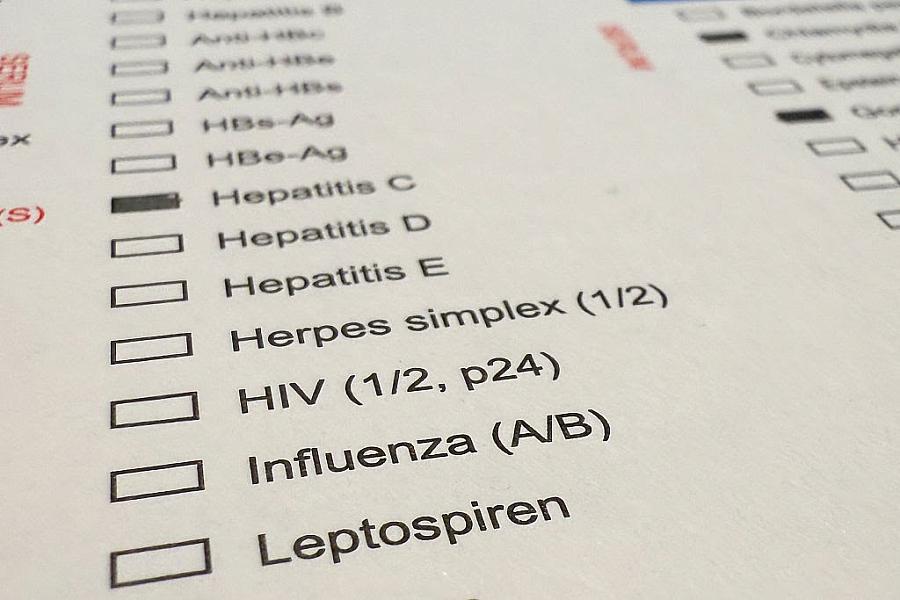
Photo by Sebastian Gollnow/picture alliance via Getty Images/modified by CHJ
I was at my desk at work one day many years ago when an old boyfriend called. He told me he’d just been diagnosed with hepatitis C, probably had it when we were together and urged me to get tested. I was newly pregnant, and I panicked. The blood-borne virus most commonly spreads by sharing needles and syringes, but it can be transmitted sexually or to a fetus or newborn.
To my indescribable relief, I tested negative.
Over the next decade, I stayed in loose touch with my friend. He remained symptom-free but lived under the cloud of a virus that threatened to eventually destroy his liver and his life.
Whenever icons of our youth died of hepatitis C-related liver cancer — singer Lou Reed, baseball Hall of Famer Mickey Mantle — the danger felt inescapable. The standard treatment back then, the immune booster alpha interferon combined with the antiviral ribavirin, wasn’t very effective, and it caused grueling side effects, including fever, nerve pain and depression.
But that’s changed. My friend enrolled in a clinical trial for the first medication targeting the hepatitis C virus directly, to suppress its growth. He took the drug for months, suffered some nasty side effects, but in the end, the virus was no longer detectable in his blood. He was cured.
As a medical writer, I never throw around the word miracle. But that’s how this turnabout felt to me.
The first direct-acting antivirals (DAAs) for hepatitis C came on the market in 2013, ushering in a new generation of drugs capable of eliminating the most common blood-borne infection in the U.S. Today’s versions — dramatically improved from the originals — cure more than 95% of patients after just eight to 12 weeks of daily pills, with minimal or no side effects.
So why do only about one in three infected people receive treatment? Why does a readily curable virus continue to kill thousands of people a year nationwide — people of color disproportionately? I’ve been thinking about all this since I read in September about California’s new law prohibiting many commercial insurers from requiring preauthorization for hepatitis C antivirals, which hints at one reason why treatment rates are so dismal.
There’s a long, shameful list of scientific breakthroughs that do not reach many people who could benefit: blood pressure control and colonoscopy after a positive stool sample, to name just two.
But the failure to turn a game-changing intervention into a public health triumph “is particularly egregious with hepatitis C,” said Dr. Joshua Sharfstein, vice dean for public health practice and community engagement at Johns Hopkins Bloomberg School of Public Health.
“It's been a decade since there’s been a cure for a horrible disease that causes incredible pain, suffering and death,” he said. “While the rest of the world is working to eliminate hepatitis C using this treatment, we’ve just seen more and more cases.”
Some 2.4 million to 4 million people in the U.S. were estimated to have chronic hepatitis C infection in 2020. Many didn’t know it. As intravenous drug use has spread with the opioid epidemic, new infections have increased, especially among adults under age 40.
Hepatitis C was listed as the cause of 11,000 deaths in 2023, but that vastly undercounts the toll. Without treatment, the infection can lead to cirrhosis, liver failure and kidney damage, in addition to cancer. But death certificates for these ailments often list the virus as a contributing factor, not the cause, or omit any mention of it.
American Indian and Alaska Native people die of hepatitis C at more than triple the rate of white people, and Black people die at nearly double the rate, according to the Centers for Disease Control and Prevention.
At nearly $95,000 for a 12-week course, the first DAAs on the market were expensive, and public and private insurers have used prior authorization and coverage restrictions to control access and costs.
Among the more onerous rules:
Patients had to reach a certain stage of liver damage before treatment would be covered. (Never mind prevention.)
Patients had to abstain from drugs or alcohol use.
Only a liver specialist could prescribe the antivirals, a huge barrier for people in medically underserved areas, people without insurance and many Medicaid recipients, who lack access to such a clinician.
Research has shown that more people get treated when there are fewer insurance restrictions.
DAA prices have declined over the years. Insurance hurdles have fallen more slowly.
Thirty-four state Medicaid programs have removed prior authorization requirements in most hepatitis C cases; 46 programs no longer require sobriety or drug abstinence; and all states have stopped delaying Medicaid DAA coverage until people develop serious liver problems. Most of these changes have occurred in the past two to four years.
The Biden administration proposed an ambitious national program in fiscal year 2024 to allocate more than $12 billion over 10 years to expand hepatitis C screening, testing, treatment, prevention, and monitoring for high-risk populations, including people without insurance and incarcerated people. The proposal ended with the Biden presidency.
In 2025, the Trump administration announced its hepatitis C elimination initiative — a $100 million pilot project. It has awarded grants to 19 state and community-based organizations to integrate hepatitis C testing and treatment into services for people struggling with addiction, mental illness or homelessness.
“I don't think even the Trump administration would describe that as a substitute for a national program,” Sharfstein said. “It was a great, positive step in the right direction. It’s just not scaled to the size of the problem.”
In August, OpenAI committed $100 million to a different national effort. It will use AI tools to help more people benefit from lifesaving medical advances, starting with DAAs. The initiative aims to double hepatitis C cure rates in Alabama, Illinois, Louisiana and Massachusetts and four more jurisdictions to be announced later this year.
There are many stories here for journalists to investigate. What’s your state Medicaid program doing about DAA coverage? What is the impact of loosened restrictions — are more people receiving treatment? Are racial gaps in hepatitis C infections and deaths narrowing? Is the Trump administration’s grant program producing lasting change in communities, or gains that last only as long as the funding?
My old friend was incredibly fortunate to have access to an experimental drug that worked. His cure was extraordinary; by now it should be universal. Again and again, American biomedicine has achieved marvelous advances in treatment. But our health care system fails to deliver them to everyone in need.