

The Health Divide: During this time of year, blood donations become especially important
Author(s)

Image
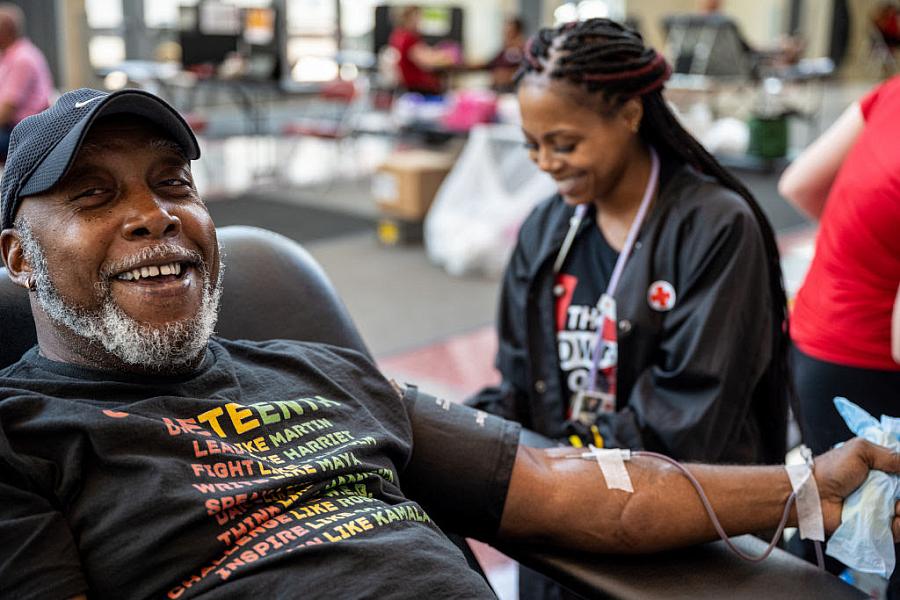
A man donates blood at a blood drive in Louisville, Kentucky.
(Photo by Jon Cherry/Getty Images)
Published on
December 8, 2025
You’ve probably seen this in the news before: "Blood donations are at critically low levels."
Donations often drop just before Thanksgiving, Christmas, and New Year's, as regular blood donors travel, attend family gatherings, and take part in other seasonal activities. This busy schedule makes it hard for donors to keep their appointments, and many schools and workplaces have limited hours or are closed.
Consequently, organizations such as the American Red Cross often issue statements encouraging people to donate blood. As we approach the holiday season, giving the gift of blood could be one of the most meaningful presents someone can give.
One aspect of blood donation that is often overlooked is the urgent need for more African American donors, according to Jennifer Warren from the American Red Cross of Wisconsin. The link between blood type and race is crucial; Black blood donors are especially vital for African Americans, particularly those with sickle cell disease.
This is because Black donors have over 600 antigens beyond the ABO types, and some, like the Ro blood type, are much more common in the Black community.
The problem is that although African Americans make up about 13% of the U.S. population, they account for less than 3% of blood donors, according to the American Red Cross. Other communities of color are also underrepresented in the donor pool, and the U.S. system faces broader problems, from overall donor shortages to demographic and seasonal swings. For instance, while Latino communities have a high prevalence of Type O blood — essential in emergency situations and often in short supply — they remain underrepresented in the donor pool, due to factors such as limited access to donation sites and outreach gaps.
12,000 new blood donors needed
Sickle cell disease is a hereditary blood disorder that mainly affects people of African and African American descent, with about one in 365 African Americans affected by it.
I have several relatives who have the disease, including two female cousins.
This condition causes severe pain, anemia, and fatigue, which can make it hard for affected individuals to perform everyday tasks or even keep their jobs, since a sickle cell crisis can result in severe, sharp, throbbing pain in the chest, stomach, back, and limbs that can last from a few days to several weeks or even longer.
Sickle cell disease significantly affects red blood cells, which are crucial for transporting oxygen throughout our bodies. In healthy people, these cells, containing hemoglobin A (HbA), are usually rounded with distinct doughnut-shaped indentations, perfectly designed to carry oxygen. However, when the HbS gene is present, it changes these cells into rigid, sickle-shaped cells that tend to get stuck and clump together in the bloodstream. The crescent shape reduces their ability to move freely and deliver vital oxygen.
My cousin Shawn and her daughter are among the 100,000 people affected by this disease. They rely on routine blood transfusions as a vital lifeline to prevent serious complications from sickle cell disease. But this reliance comes with another challenge: the more frequently they need transfusions, the higher the likelihood that their bodies will react negatively to blood that isn't an exact match, making it challenging to find compatible donors.
Sickle cell episodes have caused Shawn to lose jobs and made it hard for her to keep relationships, as many people do not understand the disease. Flare-ups have also led her daughter to struggle in school and miss days because of chronic fatigue and transfusions. Both have experienced long hospital stays, sometimes lasting a week or more, due to the disease's effect on their organs.
Although blood transfusions are a routine part of their lives, avoiding sickle cell crises by managing their stress — even though it’s not easy — has helped them better manage the disease.
About 47% of Black heritage donors have the Ro blood subtype, which is vital for treating sickle cell. A person with sickle cell may require up to 100 units of blood per year. (In 2023, the FDA approvedtwo gene therapies for sickle cell disease, but access remains limited.)
Amid these challenges, there's a silver lining: one in three African American blood donors could potentially match someone with sickle cell disease. However, lower participation rates among Black blood donors cast doubt on this hopeful statistic, adding extra pressure to the blood supply, especially during the busy holiday season when demand usually rises.
Having more African American donors is crucial, as they can better match with other Black individuals. However, increasing the number of donors overall is critically important, as it directly saves lives. “There is no substitute for human blood,” Warren said.
My wife, who has O-positive blood, is a blood donor. O-positive is the most common blood type. Anyone with a positive blood type can use her blood. However, she can only receive blood from someone with O-positive or O-negative blood.
Blood is essential for a variety of medical situations, including surgeries, cancer treatments, chronic illnesses, and traumatic injuries such as shootings, stabbings, and car accidents. For instance, a single car accident can require up to 100 units of blood. With over 1.9 million people expected to be diagnosed with cancer each year, many will need blood transfusions, sometimes daily, during their chemotherapy treatments.
One donation, usually one pint of blood, can benefit up to three people because the blood components can be separated and used for different patients.
Of the 328 million people living in the U.S., about 6.8 million donate blood, resulting in roughly 13.6 million units of whole blood collected each year, according to the American Red Cross. The organization provides around 40% of the nation’s blood and blood cell components.
Report the story or become the story
Journalists regularly highlight the urgent need for blood, especially during the holiday season. There are various ways to report on this. One approach is to tell the story from the perspective of someone who has sickle cell disease and relies on regular blood transfusions.
Consider encouraging your newsroom to participate in blood donation drives. Such initiatives can strengthen community trust as you become part of the solution.
At the Milwaukee Journal Sentinel, we organize several blood donation drives each year in partnership with other organizations located in our building. Recently, we held a blood drive in October as part of Breast Cancer Awareness Month, and our final blood drive of the year is scheduled for Dec. 10. Typically, dozens of people participate, and the process doesn’t take long.
Another idea: Try narrating your blood donation experience from a first-person point of view. Describe the process from start to finish: getting a good night’s sleep before donating, signing the paperwork, feeling the needle prick as you give a pint of blood, and showing how that blood can help people in your community.
Blood has a shelf life of about 42 days before it starts to decompose and can no longer be used. But it is rare for blood to go to waste, especially given the high demand for it.
When a person donates blood, it can reduce pain for patients, help prevent strokes, support someone undergoing chemotherapy, and more.
It has the power to save someone’s life.