

The Health Divide: Here’s who suffers most when thousands opt out of organ donor lists

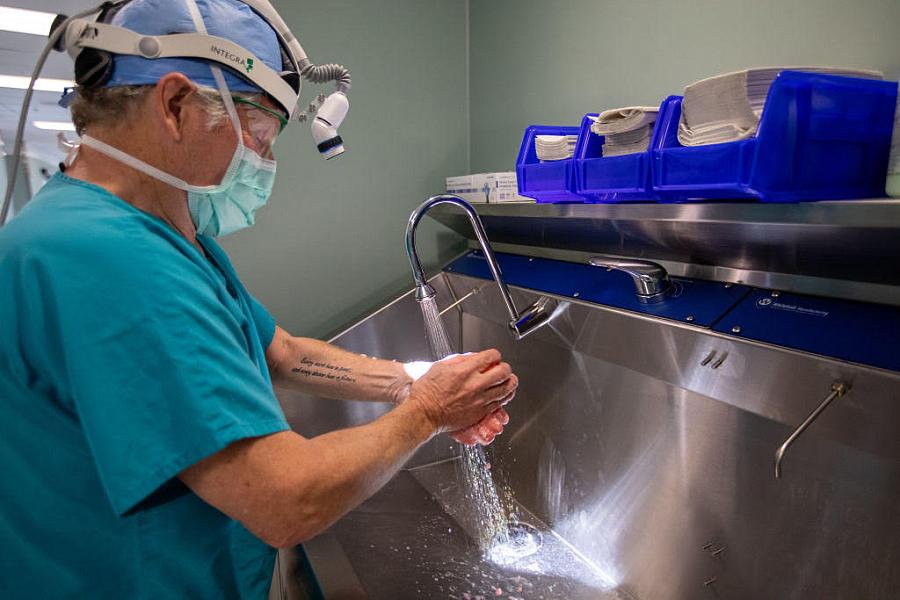
A surgeon scrubs in before a surgery to remove a liver from a donor in in Azusa, California.
Francine Orr/Los Angeles Times via Getty Images
This past February, Tyrone Dumas marked an important milestone: the first anniversary of receiving a new kidney.
Instead of throwing a party, Dumas visited his doctor for a checkup and received a clean bill of health. His doctor prescribed a few new medications, but the good news was that he was taken off some others.
After a quiet dinner out with his wife, the Milwaukee resident went home.
“I still have to be careful,” said Dumas, 73. “I wear my mask and try to avoid being around a lot of people because my immune system still isn’t where it needs to be. But I’m better off than I was two years ago.”
The journey to receiving a new kidney took nearly three years. At one point, a doctor suggested that Dumas might be too old for a kidney transplant. However, after speaking with another kidney transplant survivor, Dumas decided to get on the transplant list and see what happened.
Then one night he received a call around 10:30 p.m. His doctor asked if he could be at the hospital by midnight. Dumas’ daughter drove him to the hospital for the life-saving procedure. Today, he serves as a spokesperson for individuals who have received transplants.
The kidney is working well, but he doesn't know who to thank for the donation because the donor's family chose to stay anonymous.
“I wrote a letter thanking the family and gave it to the hospital, but I never heard from them. I just wanted them to know that because of the donation, I’m here today,” he said.
Last year, over 49,000 organ transplants were performed in the U.S., but 5,600 people die each year while waiting for an organ. A new person is added to the transplant waiting list every eight minutes.
However, after The New York Times published a series about questionable organ donation practices in 2025, thousands of Americans opted out of the donor list. Such losses can have devastating effects on African Americans and Hispanic people, who are overrepresented on organ waitlists but underrepresented among donors. As a result, any decline in available donors disproportionately affects these communities.
Series prompts registry exodus
After The Times published the articles last year — “Doctors Were Preparing to Remove Their Organs, Then They Woke Up,” and “A Push for More Organ Transplants Is Putting Donors at Risk — there was a 700% increase in people withdrawing their names from the donor registration list, according to the nonprofit organization Donate Life America, which oversees a national donor registry.
The Times series revealed unsettling incidents in which preparations for organ recovery began while patients still showed signs of life. There were also cases where individuals displayed neurological activity or signs of awareness or waking just as their organ donation was about to take place.
In one story by Brian Rosenthal, The Times reported that health care teams found themselves halting procedures upon discovering that the patient was not deceased. The process to donate the organ was halted, but the mere suggestion that such practices could occur was enough to instill fear in potential donors.
According to Newsweek, more than 5,400 people removed themselves from the Donate Life California registry in the weeks after July 20, when a second story from Rosenthal on premature attempts to remove organs ran. Texas saw more than 4,200 registry removals during the week of July 20-27, and over 6,000 for the entire month. Arizona recorded over 2,500 removals in July 2025, marking the highest single-month removal in its history, and Wisconsin had more than 800 removals by early October 2025, with 900 in August alone.
Before the exodus of people taking their names off the donor list, Blacks and Hispanic people needing organ transplants already faced significant challenges in obtaining organ transplants due to medical, social, and systemic issues.
While nearly 67% of organ donors in the United States were white in 2024, about 60% of people currently on the national transplant waiting list are people of color. While race-matching isn’t required, organs must be compatible in blood type and tissue markers, which means patients typically match better with donors who share similar genetic backgrounds.
Also, since kidney failure, diabetes, and high blood pressure are more common in Black and Hispanic communities due to long-standing inequalities — such as limited access to health care, living in food deserts, and stress caused by racism — these issues create barriers that can prevent individuals from receiving a transplant.
“You will be tested and examined, and they will look at your numbers. I assure you, your manhood will get challenged,” Dumas said.
Dumas, who has diabetes and high blood pressure, started testing to get on the transplant list in 2023. Doctors found he had prostate issues, which temporarily took him off the list. After resolving his prostate issues, he was put back on the list as he continued weekly dialysis. Getting these kinds of health issues in check is harder if you don’t have insurance, or a regular doctor, or live in a community that makes it harder to stay healthy.
Blacks and Hispanic people on the transplant list also face significant challenges because they are likely to be diagnosed with key conditions later than whites, and they’re less likely to be referred early to transplant centers, and are more likely to encounter cost barriers. Due to all of these factors, they are usually in worse health by the time they make the list, Dumas said.
Dumas appealed to individuals who have withdrawn their names from the donor list. "You can save not just one life, but multiple lives," he said.
One organ donor can save eight lives and improve the quality of life for over 75 people through tissue donation.
“A donor gave me a second chance at life, and I’m doing what the doctor told me to make sure I don’t mess this up,” he said.
Ripe for more reporting
As the aftermath of The Times series made clear, journalists play a crucial role in shaping public perceptions of organ donation.
But the real problems revealed by that reporting is far from the whole story, and health journalists can and should write stories of families whose loved one chose to be an organ donor. These narratives are vital too, because they illustrate how many people received another chance at life and what that legacy looks like. There is a need for both aggressive safety reporting and deeper reporting on access and racial inequities in the transplant system.
Following The Times investigation, it’s also important to follow up on what is being done to ensure safety and rebuild public trust in the community. There’s clearly a lot of work that needs to be done on that front, given the registry drops last year.
When discussing organ donation among Black and Hispanic populations, reporters would do well to highlight the challenges they face, such as longer wait times for transplants and a lower likelihood of receiving living donor organs. There are enduring questions about potential biases in referral patterns, for instance.
These human stories of organ donation and broader reporting on the systemic problems that afflict our current system are urgently needed. Smart journalism here could lead to changes and shifts in public perception that help more individuals receive a second chance at life.