

The Health Divide: Junk food is everywhere these days, but healthy food follows the money

(Photo by George Rose/Getty Images)
Some years ago, a friend of mine co-authored a book called “Hungry,” with her daughter. It recounted the years when my friend, Sheila Himmel, worked as a newspaper restaurant critic, dining out night after night, while at home her teenage daughter quietly struggled with anorexia. Although the book told an intimate story, it captured the contradictions and distortions in America’s food landscape, where hunger and abundance, deprivation and excess, exist side by side.
I thought about that book recently while reading a new study showing that despite federal efforts to bring grocery stores to underserved communities, at least 5 million people continue to live in so-called “food deserts.”
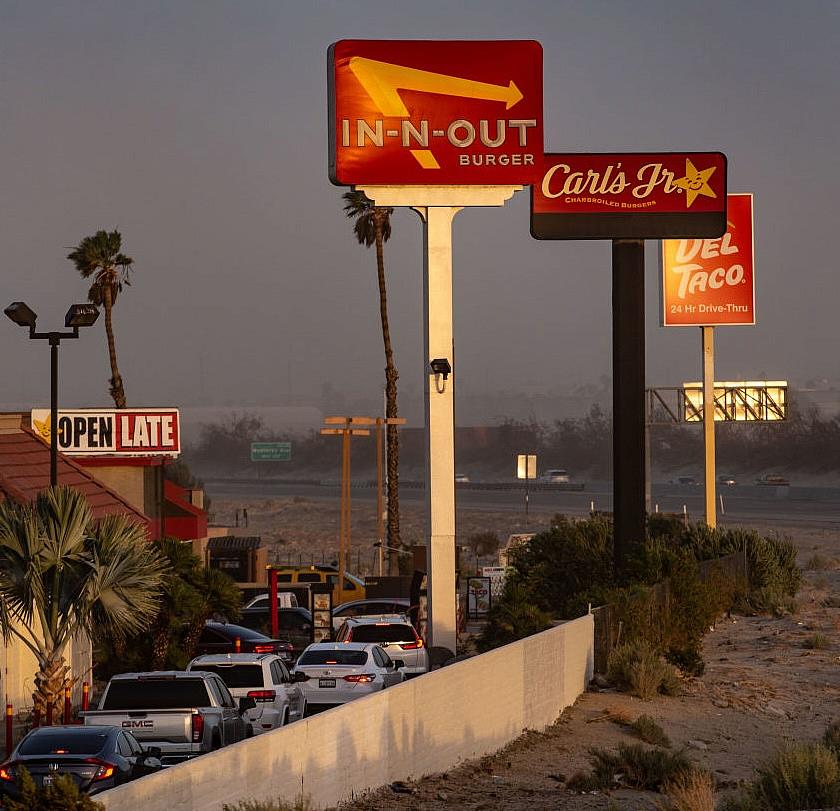
Meanwhile, nearly all of us now live in what researchers call “food swamps,” neighborhoods saturated with fast-food joints, mini-marts, chain restaurants and other sources of highly processed foods.
“That was a big surprise to me,” said Daniel Wiese, the study’s lead author and a principal scientist in the Cancer Disparities Research Program of the American Cancer Society. “So when I then re-evaluated the area where I live, and checked every single location — indeed, I ended up living in a food swamp too.”
In many places, like Wiese’s suburban Philadelphia neighborhood, the abundance of fast food is offset to some extent by the availability of fresh, healthy foods at supermarkets, farmers markets and other venues. And the food swamp designation, which has no universally accepted definition, included restaurants in the study, so a high-end farm-to-table establishment would be counted the same as a Taco Bell.
But the bottom line is clear: even when fast food dominates more affluent communities, residents generally have healthy options.
The choices are much more limited in the poor, often rural communities that make up most food deserts — and that have the highest rates of obesity, diabetes and other conditions linked to diet. Burger franchises and convenience stores have proliferated while healthy food retailers are scarce or nonexistent.
“The food landscape is not improving,” Wiese said.
In fact, it seems to be getting worse.
Using longitudinal data on all licensed food retailers in the United States, Wiese and his colleagues found that the number of unhealthy food retailers nationwide surged by 47% from 2003 to 2023, while the number of healthy food retailers increased by 12%.
The researchers characterized nearly 89% of census tracts as food swamps in 2023, up from 80% in 2003. Some rural areas at the crossroads of interstate highways actually had more fast-food outlets than residents, he said.
Meanwhile, efforts to expand access to grocery stores in low-income communities — including the Healthy Food Financing Initiative, a public-private partnership launched by President Obama — have achieved only modest gains, and those tended to be concentrated in cities.
Supporters of the initiative have complained it has been chronically underfunded. Wiese suspects that the complexities of the grocery business — capital investment, logistics, supply chains — also limit its growth, especially in remote areas.
Whatever the reasons for the limited progress, the study found that 5.5% of census tracts were food deserts in 2023, compared with 6.1% in 2003.
Now, even that progress is threatened by the drastic cuts to the Supplemental Nutrition Assistance Program (SNAP) included in the 2025 Republican budget bill. The Congressional Budget Office has estimated the bill’s expanded work requirements alone will lower SNAP participation by 2.4 million people a month over the next decade. And that’s not the only change likely to kick people off the program.
A Center for American Progress analysis projected that the SNAP reductions will put 27,000 food retailers at financial risk. Those in communities with the highest SNAP participation face the gravest danger.
Wiese’s study appeared in a special section on ultra-processed foods in the July issue of American Journal of Public Health. Collectively, the research, essays and editorials in the section make the case that the nation’s heavy consumption of highly processed foods is a public health crisis fueled by decades of rapacious corporate behavior and regulatory neglect.
Improving our diets, the journal argues, is not simply a matter of personal responsibility. It requires government action to rein in an industry that uses the same playbook that tobacco companies once employed to engineer, market and normalize products linked to chronic illness, and to tamp down public understanding of the harms. The journal makes a full-throated call for regulation, litigation, consumer protections and other systemic reforms.
Many Americans agree. Ultra-processed foods have emerged as the rare issue attracting support from both the public health community and the Make America Healthy Again (MAHA) movement — even if most people don’t really know exactly what ultra-processed foods are.
In a survey of 2,000 U.S. adults, published in the journal, only about one-third of respondents said they understood what makes a food “ultra-processed.” That’s not surprising — even experts haven’t agreed on a definition.
Yet roughly 70% of the survey respondents said ultra-processed foods are addictive, 73% support warning labels flagging their health risks, and strong majorities support banning food dyes and restricting ads targeted at children.
While the survey found some differences between Democrats and Republicans on a few policy proposals — taxing ultra-processed foods, for example — there was strong agreement across the political spectrum that the food industry exerts outsized influence over what people eat, and that it’s not healthy for us.
This consensus creates opportunities for education and policies aimed at helping people cut down on ultra-processed foods. But making fresh, healthy foods affordable, accessible and convenient for everyone is much harder. One in seven households was struggling to feed their families even before the SNAP cuts took effect and grocery prices shot up.
Wiese’s study is a reminder that improving the American diet will take more than warning labels, public awareness campaigns and bans on some chemicals and advertisements, important as those steps are. Weaning the country off sugary, high-fat, chemical-laden products — making all Americans healthy — will require confronting the deeper inequities that leave too many communities drowning in junk food.