

The Health Divide: A racist text exposes a housing problem that’s usually hidden

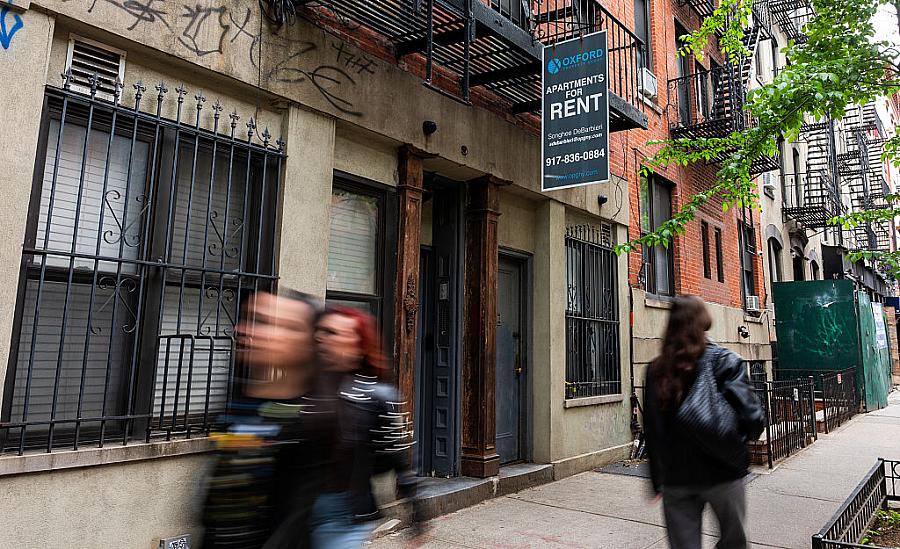
A “for rent” sign hangs from an apartment building in New York City.
(Photo by Spencer Platt/Getty Images)
Lisa Renee Olaso and her fiancé, Cyril Christopher, thought they'd found their next home.
Olaso, 53, had accepted a new job, and the couple was preparing to move from Delaware to New York. In June, they traveled to Queens to look at a three-bedroom apartment.
But before they could even step inside, Olaso received a text message that stopped them in their tracks.
"Ugh. They are Black."
Those four words allegedly came from Helen Tzelios, the real estate agent who was supposed to show them the apartment.
According to a lawsuit filed in October, Tzelios intended to send the message to the property owner. Instead, she sent it to Olaso.
Olaso told Christopher to get back into the car. She confronted the agent, who apologized and reportedly blamed her comment on problems involving previous Black tenants.
"It doesn't change the pain,” she said. “It doesn't take away the pain that you caused us that day.”
The couple filed a housing discrimination lawsuit against Tzelios, the real estate firm Douglas Elliman and the property owners, alleging violations of federal, state and local fair housing laws.
Douglas Elliman said it didn't learn about the incident until the lawsuit was received. Tzelios, an independent contractor, was terminated.
The couple would go on to find another home on Long Island. But their experience raises a question that goes well beyond one real estate agent or one apartment.
Nearly 60 years after Congress passed the Fair Housing Act, how much does race still determine where Black and Hispanic Americans can live? And what happens to their health when discrimination limits their choices?
Housing discrimination doesn't always come with a racist text
Most people who experience housing discrimination never receive the kind of blatant evidence that Olaso and Christopher got via text.
They may be told that an apartment is unavailable, never hear back from a landlord, or learn that someone else rented the property. They may never really know whether race played a role.
A 2021 study by the National Bureau of Economic Research examined more than 25,000 rental inquiries across the nation's 50 largest metropolitan areas. Researchers sent nearly identical messages to property managers, using names commonly associated with Black, Hispanic or white Americans.
Property managers responded to about 60% of inquiries from people with white-associated names. Response rates were almost 6% lower for Black-associated names and nearly 3% lower for Hispanic-associated names.
Researchers also linked discrimination against Black renters to greater residential segregation and reduced economic mobility.
For a family trying to find an affordable place to live, it can mean spending more time searching for housing, paying more for transportation, or having fewer housing options near work, schools, and health care. Some families may settle for neighborhoods they otherwise wouldn’t choose because their options are limited.
Housing discrimination doesn’t end once families become homeowners either. A 2022 Brookings Institution report found that homes in majority-Black neighborhoods were valued 21% to 23% lower than comparable homes in neighborhoods with few Black residents.
These differences matter because homeownership is a primary way families build wealth. Lower property values can affect how much equity homeowners accumulate over time and what they can ultimately pass to their children.
Federal housing protections are changing
The federal government's approach to housing discrimination has shifted under President Donald Trump.
In 2025, the Department of Housing and Urban Development sought to terminate 78 grants awarded to nonprofit organizations that investigate housing discrimination.
A 2026 Government Accountability Office report found that funding disruptions lasted about 10 months, forcing some organizations to reduce services.
One organization stopped conducting fair housing testing, and opened only 25 discrimination cases during the funding gap, compared with 82 in the previous 10 months.
The administration also wants to eliminate HUD’s “disparate impact” rule, a federal rule that allows people to challenge housing policies that disproportionately harm certain racial groups, even when there is no proof that the discrimination was intentional.
The Trump administration says the changes will reduce unnecessary regulations and give communities greater control. Fair housing advocates argue the changes could make discrimination harder to challenge.
In October, a federal appeals court blocked the administration's attempt to funnel money away from nonprofit organizations focused on preventing or investigating housing discrimination, Reuters reported.
Housing discrimination is a health issue
Where people live can influence their health in ways that aren't always obvious.
A 2020 National Bureau of Economic Research study examined links between racial discrimination in rental housing and exposure to toxic air pollution.
Researchers contacted landlords using names associated with Black, Hispanic, and white renters. They found that applicants with Black- or Hispanic-associated names were 41% less likely than those with white-associated names to receive responses about properties in areas with lower levels of toxic air pollution.
The study didn't measure whether individual renters developed health problems, but the findings suggest that discrimination can limit access to housing in cleaner-air neighborhoods.
Other research has examined the link between discriminatory housing practices and mental health.
A 2025 review of 21 studies examined redlining, gentrification, and mental health among Black American adults. More than half of the studies reported associations between discriminatory housing practices and mental health problems.
A separate 2023 review of 32 studies identified racialized housing discrimination as a contributor to residential segregation, which has been linked to disparities in health outcomes.
Researchers cautioned that additional studies are needed to understand the direct health effects of various forms of discrimination.
The findings don't mean that everyone who experiences housing discrimination will develop health problems. However, they help explain why the issue warrants attention beyond its financial and legal consequences.
There are lots of stories to pursue here
Housing discrimination is typically treated as a civil rights or legal issue, but its potential health consequences deserve more coverage from reporters.
Journalists can examine housing discrimination complaints and mortgage lending data to determine whether Black and Hispanic families receive different treatment than equally qualified white applicants.
They can also interview families about how discrimination has affected their housing choices. Did they have to move farther from work? Were they unable to find affordable housing in a neighborhood with cleaner air or easier access to health care?
Public health researchers, environmental health experts, and mental health professionals can help explain how those differences may affect health.
Enforcement is another area ripe for enterprise work. How many discrimination complaints result in investigations? Have federal funding changes affected the organizations responsible for investigating them?
Olaso and Christopher eventually found a home. But many families who experience housing discrimination may never learn why they were turned away, or how those lost opportunities influenced their ability to lead healthier lives.